
The Zoo Chimpanzee Isn't Waiting to Become Human
That ape-to-human illustration got evolution backward. Here's what the family tree looks like.
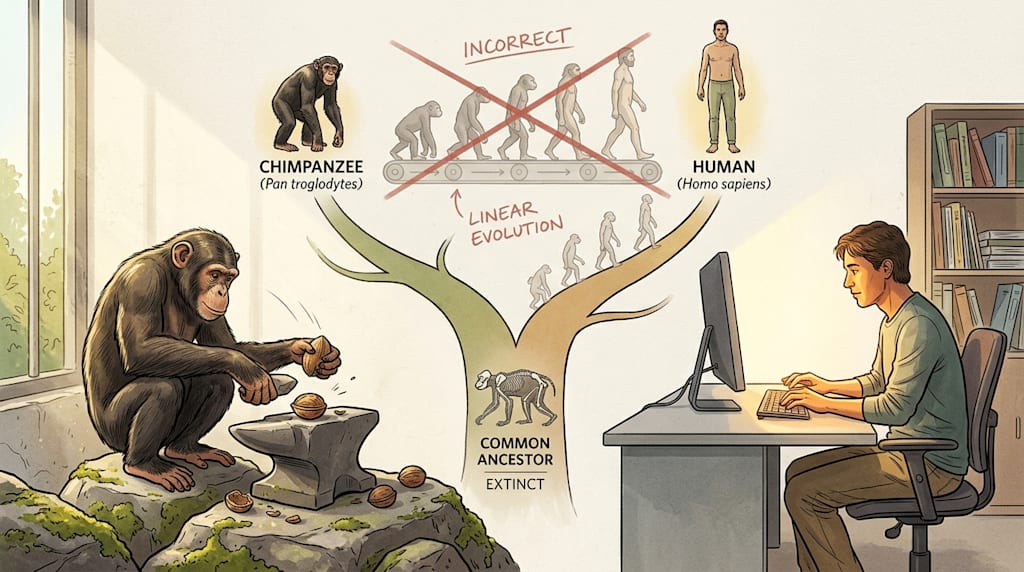
In a zoo, a chimpanzee squats in the corner of its enclosure and flips a stone over. It chooses a flatter one for an anvil. It picks up a nut, sets it on the stone, lifts another stone, and brings it down. The shell cracks. It eats the kernel and reaches for the next nut.
Outside the glass, a visitor says, “Why hasn't it evolved into a human yet?”
That sentence sums up the damage done by one famous illustration. The drawing runs left to right: a hunched chimpanzee straightens its spine, loses its hair, picks up tools, and sits down at a computer. The sequence is so smooth that people mistake evolution for a conveyor belt. Every ape and monkey should move forward in line. Anyone who has not reached the human stop must be stuck.
Evolution grows like an unpruned bush. Branches go everywhere. Some shoot up. Some crawl along the ground. Some wither halfway. Some stay nearly the same for tens of millions of years. Humans are not the flower at the top. Chimpanzees are not half-finished products stalled on the way. We are two different branches.
Those branches share an ancestor. Six or seven million years ago, an ancient ape lived in Africa. The climate shifted. Forests shrank. The East African Rift rose and broke a continuous environment into pieces. The western branch stayed in humid rainforest canopy. Over millions of years, it became today's chimpanzees and bonobos. The eastern branch faced dry savanna. The woods thinned. It came down to the ground, stood on two feet, stumbled through Australopithecus, and eventually produced Homo sapiens.
That common ancestor was neither a modern chimpanzee nor a modern human. It is extinct. Picture a grandfather with two lines of descendants. One line is us. One line is chimpanzees. We are cousins. A cousin does not evolve into you. You do not evolve into a cousin. You split from the same ancestor and live separate lives.
The phrase “humans evolved from apes” needs a qualifier. If it means humans evolved from some ancient ape, fine. If it means humans evolved from modern apes and monkeys, wrong. Modern apes and monkeys are our cousins. They are not our ancestors.
They have not stopped evolving. Wild chimpanzee genomes keep mutating and filtering. The jungle carries simian immunodeficiency virus, a close relative of HIV. It carries malaria parasites and tropical worms. Chimpanzees have spent hundreds of thousands of years turning over immune receptor genes, clotting mechanisms, and digestive enzymes to handle those threats. They are not frozen. They are adapting to their own environment.
Behavior shows it too. Some chimpanzee groups in West Africa choose stones of a certain hardness for anvils and crack hard-shelled nuts. Other groups sharpen sticks with their teeth and thrust them into tree holes to spear small animals. These skills are not instincts written into genes. They pass through groups by watching, learning, and copying. Behavior changes selection pressure. Selection pressure changes genes. That loop is evolution.
Humans never stopped either. Over the past tens of thousands of years, lactase persistence let some adults digest milk. It spread fast after herding appeared. Tibetan Plateau populations evolved low-oxygen adaptations. Some African populations evolved malaria resistance. People in different regions carry traces of environmental selection in skin color, immune systems, sweat glands, and body shape. Medicine, cities, contraception, and cross-regional marriage keep reshaping the selective environment. Evolution is happening now. Its scale is simply too long for the naked eye.
Apes and monkeys still exist because branching does not mean replacement. A species can split off a new branch without erasing the old one. One branch of fish went ashore and became tetrapods. The sea still has fish. One branch of apes moved toward upright walking. The forest still has chimpanzees. Unless competition or environmental change causes extinction, parent and daughter species can coexist. Different branches can flourish side by side.
The chimpanzee in the zoo can hang by one arm with dozens of kilograms of weight. Its big toe grips branches. Its thick fur blocks parasites. Its jaws crush tough plant fibers. In a rainforest, that body is a configuration polished over millions of years. Strip its fur according to a human template. Give it ankles that break easily. Make it give birth to premature infants that need more than a decade of care. Put it back in the jungle. That would cripple it.
The human brain, upright walking, fire, and social cooperation became useful in savannas, with tools, language, and civilization. Our brains burn enormous energy. Childbirth is dangerous. Knees and lumbar spines fail often. Infants need years of care. Drop all of that into a rainforest, and it may not be an advantage.
Ask instead why apes and monkeys should evolve into humans. In a rainforest, a nimble chimpanzee with parasite resistance, nut-cracking skills, and wooden spears is already complete.
The ape uprising in Rise of the Planet of the Apes is science fiction. Real chimpanzees will not evolve toward humans because humans expect it. They have their own future. That future is unpredictable. It will not aim at becoming human.
The illustration's deepest error is its line. It paints evolution as linear, purpose-driven, and human-centered. It implies that all life walks toward humans. Whatever has not arrived is backward. Whatever went elsewhere is a failure. Nature does not rank that way. Nature asks whether you survive and reproduce.
Chimpanzees still crack nuts. Humans still tap keyboards. A zookeeper blows a whistle. The chimpanzee hides the stone under the hay. Visitors drift to the next enclosure.
About the Creator
Jin
Writer of reamstories
https://reamstories.com/jin
Enjoyed the story? Support the Creator.
Subscribe for free to receive all their stories in your feed. You could also become a paid subscriber, letting them know you appreciate their work.
Comments
There are no comments for this story
Be the first to respond and start the conversation.