
The White Powder on the Lab Bench
A story of academic jealousy, a near-perfect poison, and the loophole that almost let it work.
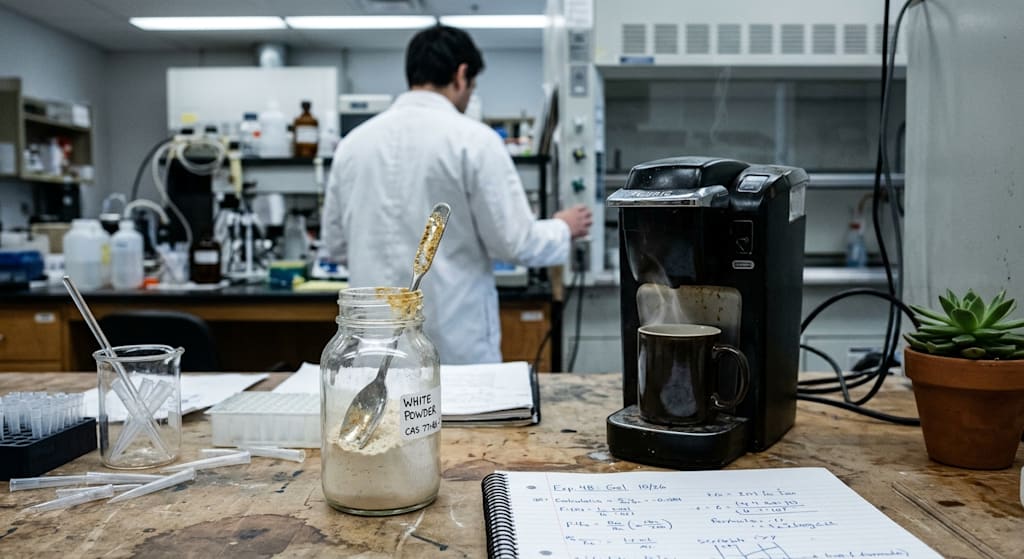
Many years later, lab people will probably still remember a scene like this.
On a gel-casting day, a bottle of white powder sat on the bench. The bottle was not locked. The drawer was not locked either. Anyone who needed to run SDS-PAGE would scoop a little out with a spoon, weigh it, and put it back. The spoon handle had last week’s gel residue stuck to it, and nobody wiped it off. No one asked, “How many grams did you scoop today?”
It did not have the dangerous aura of concentrated sulfuric acid, concentrated hydrochloric acid, formaldehyde, or acetic acid. It did not smoke. It did not sting the nose. It was not locked away by itself in a hazardous chemicals cabinet. It was just the most inconspicuous “daily consumable” in the lab.
It was not until the news came out that many people belatedly felt a chill.
This case happened at the University of Wyoming. The suspect, Aili Wang, 32, was a Chinese doctoral student in microbiology. The victim was her Vietnamese labmate, K.T. The motive pointed to academic jealousy: K.T.’s research was more productive and was in the process of applying for a patent, while Wang had failed her first doctoral dissertation defense. According to reports, she had also previously gone through the other person’s materials without a legitimate reason.
The poison she chose was acrylamide.
To medical students and people who work in biology labs, that name is all too familiar. Casting polyacrylamide gels and running SDS-PAGE electrophoresis are impossible without it. A white powder, highly soluble in water, colorless and odorless once dissolved. A neurotoxin. With long-term intake in small doses, it causes numbness, tingling, and weakness in the hands and feet. The damage may be irreversible.
It does not cause an immediate, violent rejection response. It does not leave burns like strong acids or bases. It is more like a slow erosion: a little fatigue today, a little numbness tomorrow, a little weakness the day after, dragging a person down bit by bit.
And its “ordinariness” became the best disguise. In many labs, acrylamide is just a white powder tossed casually on the bench or in a drawer. Anyone who needs to run a gel scoops some out and weighs it, then puts it back when done. No lab fusses over “who scooped how many grams today.” It is not like those hazardous chemicals controlled by dual-person dual-lock rules. It is just a consumable that is everywhere and that no one pays attention to.
Wang added acrylamide to the tea brewed in the small coffee machine in K.T.’s office. The bitterness of the coffee masked that slight astringency. After drinking, a rinse of the cup left nothing behind. Each time it was cleaned, the “strange taste” disappeared, which was highly deceptive.
She did not “scoop it away” from the lab bit by bit. She bought the chemical online through eBay in two separate orders. Later, she also tried to ask the platform to cancel her account to cover her tracks.
She was calculating in some ways. She precisely picked a poison that was solid, highly soluble, colorless and odorless, slow-acting, and inconspicuous. She even thought of using coffee’s bitterness to mask it. She was also bafflingly stupid in others: buying it online made no sense. If she took a little from the lab every day, no one would have noticed.
She may have had her own calculations. She probably never imagined that the stuff would change taste after being repeatedly heated. Even less did she imagine that the victim and his wife could boil the residual water from the coffee machine dry and isolate the poison for testing. Add in her later lies, her begging the e-commerce platform to delete records, and a series of baffling moves, and it is not hard to understand why she failed her doctorate.
The poison’s concealment is frightening. But the near-certainty of success is worse: if the victim and his wife had not found the poison, she would most likely have gotten away with it.
Because clinically, trying to detect chronic poisoning is hellishly difficult.
For a poison like acrylamide, the early symptoms are fatigue, weakness, and numbness in the hands and feet. Even if the victim went to the hospital, it would most likely be treated as cervical spondylosis, overwork, or even somatic symptoms of anxiety. The registration slip says cervical spondylosis; the EMG report says “no abnormality”; the doctor says to observe for two weeks first. Even if a doctor suspected poisoning, routine blood tests simply cannot detect this specific organic poison. You must have a highly suspicious clue before you can conduct targeted toxicology screening.
After a conference in August, K.T. developed extreme fatigue, insomnia, tingling and numbness in the fingers, and weakness in both legs. She began to suspect she had been poisoned. Later, K.T.’s wife and a chemistry professor boiled the water from the coffee machine dry and successfully isolated 63 milligrams of white powder, which tested as acrylamide. Such a high dose could not possibly have formed naturally. After surveillance was installed, Wang was recorded going through the victim’s desk and rinsing the other person’s mug with liquid from her own cup. After police questioning, she was arrested at Los Angeles airport while trying to flee back to China. She faced a felony charge of aggravated assault, with a maximum sentence of 10 years in prison and bail set at $1.5 million, cash only.
These details read like a suspense film. But it is not a movie.
The Zhu Ling case is another example. Zhu Ling was poisoned with thallium salts. Colorless, odorless, and soluble in water. Early symptoms may have been abdominal pain and hair loss; later came peripheral neuropathy. The concealment was extreme. At the time, doctors at Peking Union Medical College Hospital suspected thallium poisoning, but because she had no clear history of exposure to the poison, and because testing methods were limited at the time, Zhu Ling was misdiagnosed for a full 52 days. The medical record said “suspected porphyria.” Only later did someone ask whether she had been exposed to thallium. It was not until an internet appeal and the family’s unremitting efforts to send samples for testing that the diagnosis was finally confirmed.
These cases share a terrifying logic: poison is not necessarily dramatic. It may just make you feel “a little tired lately.”
Some labs manage acrylamide and similar reagents far less strictly than strong acids and bases. These reagents are not classified as highly toxic, but they are still highly hazardous. One inspection notice pointed out that the recorded in-and-out quantities of acrylamide did not match the actual inventory: two bottles recorded, one bottle actually in stock. No one could say where the other bottle had gone. Safety training emphasizes that acrylamide and similar reagents should be managed under “dual-person dual-lock” rules. But under the casual daily habit of “scooping a spoonful,” such standards are very hard to fully implement. Reagents can easily be taken without authorization, and tracing them is difficult.
Not every lab is badly managed. But when a highly hazardous reagent is treated as a “daily consumable” for a long time, it turns from a chemical into a blind spot. In a blind spot, anyone can take it, anyone can put it back, and no one asks an extra question. When nothing happens, everyone gets along fine. Once someone harbors a malicious thought, that blind spot is the best cover.
The environment is the bigger risk. In labs, everyone can get high-risk reagents at any time, and the pressure is enormous. People who have pulled all-nighters together, fought side by side, and complained together know all too well where your cup is and what your daily routine is like. Once jealousy, competition, mental breakdown, or conflicts of interest make them harbor malicious thoughts, that knowledge can turn into precise harm. You think they are labmates, comrades-in-arms, people who run gels with you every day. But in certain extreme moments, that “knowing” becomes a weapon.
There are steps to take.
Lab management needs to “de-normalize” these reagents. For highly hazardous reagents like acrylamide, at a minimum, in-and-out records should be traceable, use should be logged, and storage should be controlled. The goal is not to turn every lab into a vault. The goal is to make it possible to trace “who took it, how much they took, and when they took it.” Dual-person dual-lock may not suit every scenario, but “scooping a spoonful whenever you like” should not be the norm.
Personal protection needs “boundaries.” In the lab, keep cups, food, and drinks separated from the work area as much as possible. Do not casually accept drinks of unknown origin. If you notice a strange smell or taste, or something remains abnormal after repeated washing, keep a sample, seek medical attention promptly, and mention the possibility of occupational exposure. This may sound overly nervous, but the window for chronic poisoning often hides in exactly these “it can’t be that bad” moments.
Clinical diagnosis needs “one more question.” For unexplained peripheral neuropathy, extreme fatigue, hair loss, abdominal pain, and similar symptoms, especially in patients with a background in labs, chemical work, or other special occupations, a doctor asking one more question—“Any history of exposure?” or “Have any coworkers developed similar symptoms?”—may change the entire direction of diagnosis. The investigation of chronic poisoning does not rely on routine tests, but on highly suspicious clues.
Be guarded, but do not treat everyone as an enemy. The vast majority of people are normal. In an environment where high-risk reagents are always within reach and the pressure is enormous, we need to acknowledge that institutional loopholes exist and that the dark side of human nature exists. Acknowledging them is not about creating panic. It is about making “the next time” harder to happen.
That bottle of acrylamide is still on the bench. The spoon handle points outward, exactly the same as last month.
Except now, someone has looked at it one more time.
About the Creator
Jin
Writer of reamstories
https://reamstories.com/jin
Enjoyed the story? Support the Creator.
Subscribe for free to receive all their stories in your feed. You could also become a paid subscriber, letting them know you appreciate their work.
Comments
There are no comments for this story
Be the first to respond and start the conversation.