
The Universe’s Thermometer Has Two Ends. One Is Absolute Zero. The Other Breaks Physics.
Why -273.15°C is a floor you can never touch, and 1.4×10³² K is a ceiling where time and space stop making sense.
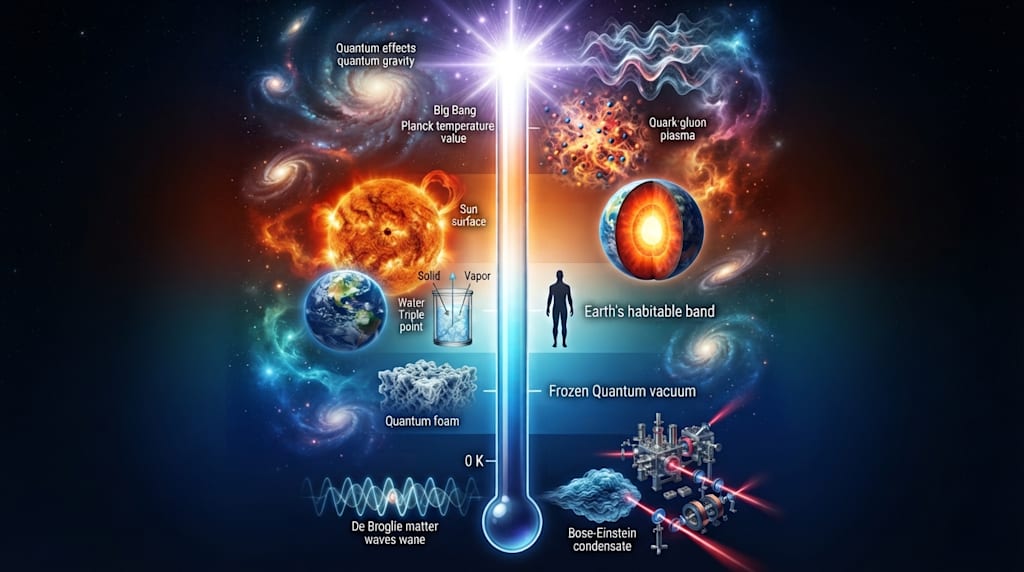
A thermometer has two ends. One end reads -273.15°C. The other reads 1.4×10³² K. Put those two numbers on the same ruler, and they look strange together. To see why, set the Celsius ruler aside and switch to Kelvin.
Kelvin starts at absolute zero. 0 K equals -273.15°C. 273.15 K equals 0°C. The triple point of water is 273.16 K. Everyday temperatures drift between 250 K and 320 K. The surface of the Sun is about 5800 K. The Sun’s core is about 15 million K. A hydrogen bomb explosion is about 350 million K. A supernova core can reach hundreds of billions of K. Particle colliders push small regions to several trillion K. These numbers climb by more than a dozen orders of magnitude and still do not touch the theoretical ceiling.
The ceiling is called the Planck temperature:
TP=ℏc5GkB2≈1.416×1032 KTP=GkB2ℏc5≈1.416×1032 K
It is built from ℏℏ, cc, GG, and kBkB. The gravitational constant GG sits in the denominator. GG is small, so TPTP is enormous. This temperature corresponds to about 10−4310−43 seconds after the Big Bang, one Planck time. At that time, the universe was extremely small and dense, and quantum effects and gravitational effects mattered equally. General relativity and quantum field theory both break down. No one knows whether the word “temperature” still means anything there.
Instruments have never measured 1.4×10321.4×1032 K. That number is the extrapolation boundary of current theory. The Big Bang model can be pushed back to the Planck era. Before that is blank. The blank is where our tools for describing temperature fail.
At the lower end, temperature is a measure of the average kinetic energy of particles. In an ideal gas, E≈32kBTE≈23kBT. The minimum kinetic energy is zero. If particles were completely still, the temperature would be 0 K. In the classical picture, 0 K is the floor. Quantum mechanics raises the floor: the ground-state energy of a harmonic oscillator is ℏω/2ℏω/2, not zero. Even at 0 K, particles still fluctuate. The third law of thermodynamics says you cannot reach 0 K in a finite number of steps. You can only approach it.
In the lab, laser cooling and evaporative cooling bring atomic gases down to nK or even pK. In space, the Boomerang Nebula is about 1 K, and the cosmic microwave background is about 2.725 K. The lab is colder than deep space. When cooled to nK, the de Broglie wavelength of atoms becomes long, wave packets overlap, and quantum effects govern the system. In 1995, a rubidium atomic gas achieved Bose-Einstein condensation. The atoms occupy the same lowest quantum state and form a macroscopic quantum object. It has no viscosity and can flow indefinitely. By changing the refractive index, it can slow light to a few meters per second, or even stop it. It can also simulate black holes and study Hawking radiation.
Upward, particle colliders smash gold or lead ions together, producing quark-gluon plasma at about 10121012 K. This is a hundred thousand times hotter than the Sun’s core, but still 20 orders of magnitude below the Planck temperature. Along the Big Bang timeline: at 10121012 K, quark-gluon plasma; at 10151015 K, electroweak symmetry is restored; above 10271027 K, the grand unification era; at 10321032 K, the Planck temperature. Each stage corresponds to a restoration of symmetry or a unification of forces. Labs can reproduce only the lowest few stages, briefly and locally.
There are two roots of the asymmetry. First, the lower limit of temperature comes from kinetic energy being non-negative. Kinetic energy cannot be less than zero, so 0 K is the absolute lower limit. Second, the upper limit comes from theory breaking down. The higher the energy, the more complex the required theory. At the Planck energy, gravity and quantum effects become entangled, and current theory gives no answer. The Celsius scale writes 0 K as -273.15°C, making the lower limit look like a small number. On the Kelvin scale, the lower limit is 0 and the upper limit is 1.4×10321.4×1032. The asymmetry remains, but its nature is clear: one is absolute zero, the other is a theoretical boundary.
If there were a kind of primordial life living in an environment 100 K below the Planck temperature, they would define that environment as 0ζ0ζ. Then in their eyes, the highest temperature in the universe would be only 100ζ100ζ, while the lowest temperature would be negative 1032ζ1032ζ. Human 0°C and their 0ζ0ζ are the same: both take some convenient environment as the zero point. A temperature scale is a ruler, not the world.
The range of temperatures humans can touch is narrow. Water freezes or melts at 273.16 K. The human body is around 310 K. Water reaches its critical point at 647 K and 22.12 MPa; above that temperature, no amount of pressure will liquefy it. Around 525°C, solids begin to emit visible light. Steel melts at 1538°C. Earth’s core is 6000°C. The Sun’s core is 15 million K. A hydrogen bomb is 350 million K. A collider is 10121012 K. These numbers form a line. The lower end is still some distance from 0 K; the upper end is much farther from 1.4×10321.4×1032 K.
The two ends of the thermometer: one is 0 K, which can never be reached; the other is the Planck temperature, where theory fails. We live in a narrow band in between. Water, proteins, life, laboratories, colliders: all are in this narrow band. Further down, quantum fluctuations prevent particles from being completely still; further up, spacetime itself begins to tremble. The numbers on the thermometer stop here.
About the Creator
Jin
Writer of reamstories
https://reamstories.com/jin
Enjoyed the story? Support the Creator.
Subscribe for free to receive all their stories in your feed. You could also become a paid subscriber, letting them know you appreciate their work.
Comments
There are no comments for this story
Be the first to respond and start the conversation.