
The True Story of the Vanishing Settlement of Roanoke
The United States First Unsolved Mystery

In the late sixteenth century, the English crown made a bold push to establish a permanent foothold in the New World. Under the authority of Sir Walter Raleigh, a fleet of ships set sail for the coast of what is now North Carolina. Their goal was to plant a self-sustaining colony that would challenge Spanish dominance and tap into the wealth of the Americas.
Instead, they birthed one of the most enduring and baffling mysteries in American history. More than one hundred men, women, and children walked into the untamed wilderness, and when help finally returned years later, every one of them had vanished without a trace, leaving behind only a single carved word.
In July 1587, a group of 115 English settlers arrived at Roanoke Island off the coast of present-day North Carolina. They were led by John White, who had been appointed governor of the new City of Raleigh. Unlike earlier expeditions made up primarily of soldiers and sailors, this venture was intended to establish a permanent civilian community. Entire families crossed the Atlantic hoping to build homes, plant crops, and begin new lives.
Trouble followed almost immediately. Relations with nearby Native American tribes, particularly the Secotan and Aquascogoc, had already been strained by earlier English voyages marked by violence and misunderstanding. Even so, the settlers began repairing abandoned fortifications and constructing homes.
Shortly after their arrival, White's daughter, Eleanor Dare, gave birth to a baby girl named Virginia, the first English child born in the Americas. The celebration was short-lived. Food supplies were dangerously low, and as summer faded, it became clear the colony could not produce enough crops to survive the coming winter.
Realizing the severity of the situation, the colonists urged Governor White to return to England for supplies and additional settlers. White hated leaving his daughter and newborn granddaughter behind, yet he understood the colony had little chance of survival unless he secured help.
In late August 1587, he sailed for England expecting to return within a matter of months. Instead, history intervened. As White reached Europe, war erupted between England and Spain. King Philip II launched the Spanish Armada, and Queen Elizabeth I pressed nearly every available ship into military service to defend the kingdom.
White remained stranded in England as month after month stretched into years. It was not until August 1590, three years after his departure, that he finally secured passage aboard a privateering vessel bound once again for Roanoke.
When White's ship anchored off Roanoke Island, violent weather made the landing dangerous, costing several sailors their lives in the heavy surf. Driven by hope, White went ashore expecting to find his family.
Instead, he found silence.
The settlement stood abandoned. There were no bodies, no signs of battle, and no evidence that the village had been destroyed by fire. Rather than appearing hastily deserted, the colony had been carefully dismantled. Houses had been taken apart, and a sturdy palisade enclosed the site, suggesting the settlers had left deliberately rather than in panic.
Before departing three years earlier, White had instructed the colonists that if they were ever forced to leave under attack, they should carve a Maltese cross into a nearby tree or post as a distress signal.
He searched anxiously.
There was no cross.
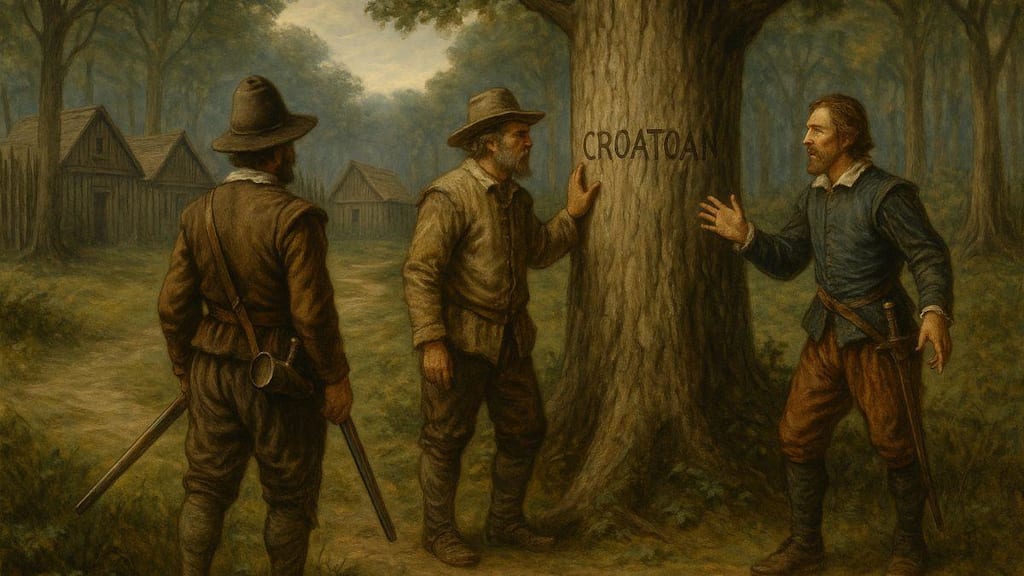
Instead, the letters CRO had been carved into one of the palisade posts, while a nearby tree bore the complete word CROATOAN.
Croatoan was the name of a nearby island, now known as Hatteras Island, and home to a Native American tribe that had remained friendly toward the English. White immediately believed the colonists had relocated there peacefully to live among their allies.
He never had the opportunity to find out.
Before the search could continue, a violent storm damaged the ship's anchors and cables. Supplies were dwindling, tempers among the crew were rising, and the sailors refused to risk navigating the dangerous shoals any longer. White was forced to abandon the search and sail away, never setting foot on Croatoan Island.
No rescue party ever returned to discover what became of the settlers. Later governors and explorers planned expeditions, yet storms, political upheaval, and a lack of funding repeatedly prevented a thorough investigation.
More than four centuries later, historians and archaeologists still debate the colony's fate. The leading explanation is that the settlers gradually merged with the Croatoan and other Indigenous communities. Later European explorers reported meeting Native Americans with lighter complexions, European features, and oral traditions describing ancestors who could read books.
Other evidence points inland. Archaeological discoveries at places such as Site X in North Carolina suggest that at least some of the colonists may have traveled up the rivers in search of more fertile farmland and a safer location away from the exposed coastline.
Another possibility is that the settlement eventually fell victim to hostile tribes or even Spanish raiding parties, although no physical evidence of such an attack has ever been uncovered at Roanoke itself.
The truth has never been found. The colonists simply stepped out of the historical record and into legend, leaving behind one of America's oldest unsolved mysteries and a single carved word that continues to inspire questions more than four hundred years later.
About the Creator
Nolan Reed
I write true stories, including unsolved mysteries and events that actually happened.
Enjoyed the story? Support the Creator.
Subscribe for free to receive all their stories in your feed.
Comments
There are no comments for this story
Be the first to respond and start the conversation.