
The Strange Reason Identical Twins Have Different Fingerprints
Their DNA is almost identical. Their fingertips tell a different story.
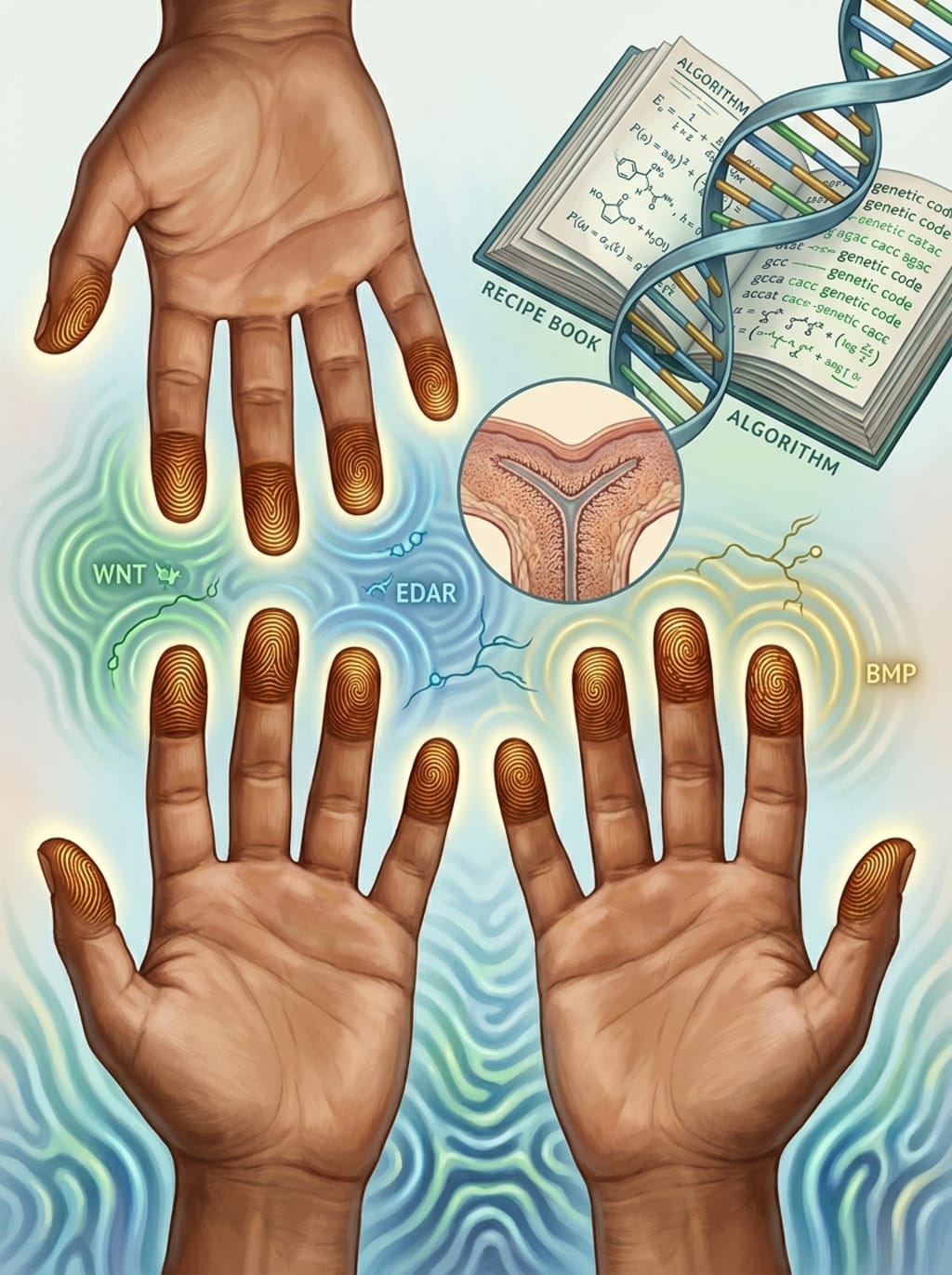
Identical twins can look so alike that strangers confuse them. Press their ten fingers onto paper, and the prints do not match. The ridges flow differently. Bifurcations land in different places. Triradii and minutiae do not line up. The difference is not a small detail at the edges. Each fingerprint is its own pattern.
This sounds odd. They come from one fertilized egg. Their genes are almost identical. The reason lies in development.
DNA does not hold a finished fingerprint image. Fingerprints are not encoded like a drawing. They grow during embryonic development. A self-organizing system builds them. That system spreads outward and amplifies tiny differences. Identical twins share the same rules. They do not share the same blueprint.
1. When do fingerprints form?
Human fingertip ridges start to form at about 13 weeks of gestation. They appear first on the raised volar pads at the fingertips. By about 15 weeks, the overall pattern is set: arch, loop, or whorl. By about 17 weeks, the initial ridges are complete.
Before birth, the rough draft of a fingerprint is already in place. After birth, fingers grow. The ridges scale with them. The basic pattern and details stay fixed.
The skin surface does not show the process well. Cut open a fetal fingertip, and a tissue section shows more. Ridges grow with the epidermis. They extend downward. They form a series of regular structures. The lines you see later come from growth and signaling inside the skin.
So the puzzle is how those lines get arranged in the first place.
2. Turing patterns: how a uniform system grows stripes
To understand fingerprints, start with Turing patterns.
Alan Turing proposed the Turing machine and the Turing test. In 1952, he studied biological morphogenesis. He suggested that a tissue could start almost uniform. If it contains several chemical signals that diffuse and promote or inhibit one another, the system can lose stability. Stripes, spots, and ripples can appear. The pattern is periodic.
Today, researchers call this a reaction-diffusion system.
Nature uses this logic in zebra stripes, cheetah spots, fish body patterns, and the complex patterns on pufferfish. DNA does not draw them stroke by stroke. Chemical signals interact during development. The pattern emerges.
Fingerprints work the same way. Before visible ridges appear, molecular signals inside the skin form a periodic spatial pattern. The molecular pattern comes first. Cells grow along it. The visible ridge lines come last.
3. WNT, EDAR, and BMP: promotion and inhibition
Three signaling pathways matter most in fingerprint formation: WNT, EDAR, and BMP.
Think of two opposing forces. WNT and EDAR promote ridge formation. BMP inhibits it.
Where WNT and EDAR are active, epidermal cells divide more. Tissue grows downward. A ridge forms. Next to it, stronger BMP inhibition blocks the same growth. The result is a regular cycle: ridge, gap, ridge, gap.
Researchers found that EDAR expression becomes periodic before the skin surface becomes uneven. Molecular periodicity comes first. Cell growth follows. Then come the fingerprint lines.
This resembles ripples on water. You do not draw each crest. Vibration moves through a medium. Crests and troughs appear. DNA does not say “grow a ridge here and leave a groove there.” Promoting and inhibiting signals constrain each other. Spacing and periodicity appear on their own.
4. Mouse experiments: turning stripes into spots
To test this explanation, researchers watched ridge formation on mouse digits. Mice do not have human arches, loops, and whorls. They do form transverse ridges on the ventral side of their digits. That makes them useful for studying the basic mechanism.
Using a WNT signaling reporter, researchers saw that ridges do not appear all at once. They start at the distal end of the finger. They advance toward the proximal end. Green marks active WNT signaling. The ridges spread forward like rows of ripples.
Fingerprint formation advances through space in a similar way.
Change the signals, and the pattern changes. When researchers reduced EDAR function, transverse ridges became isolated spots. The shift from stripes to spots is common in Turing-type self-organizing systems. The researchers changed the parameters. The system produced a different pattern.
When researchers increased EDAR signaling, ridges became wider. The spacing between ridges changed. When they inhibited BMP signaling, ridges also became wider. The area of active WNT expanded.
The experiments point to a simple division of labor. WNT and EDAR control where ridges grow. BMP controls how far they spread. Promotion and inhibition constrain each other. Ridges with regular spacing form. The researchers built a mathematical model. The reaction-diffusion mechanism reproduced many experimental results: wider stripes, changed spacing, and the shift from stripes to spots.
5. Why some people have arches, loops, or whorls
This explains only half the story.
A Turing system can produce parallel stripes. The harder question is why different people develop different overall shapes. Some have arches. Some have loops. Some have whorls. Many have bends, convergences, bifurcations, and triradii.
Human fingerprints do not start in one place. A fetal finger has several ridge initiation regions. They include the raised volar pad at the fingertip, the boundary near the dorsal and ventral skin, and regions near the flexion creases.
Ridges from these regions spread outward in different directions.
Imagine throwing several stones into a pond at once. Each stone makes ripples. One stone gives regular ripples. Many stones at different positions and times create interference. Human fingerprints follow a similar process. Ridge waves from different initiation regions travel, collide, and stitch together inside the fingertip. The result is a complete pattern. Small changes in starting position, direction, or timing can turn an arch into a loop or a loop into a whorl.
6. Triradii emerge from collisions
Look at your own loops and whorls. You may see a Y-shaped region where several ridge groups converge. This is a triradius.
Researchers found that triradii tend to appear where ridge-forming waves meet. DNA does not need to specify “make a triradius here.” Several ridge systems spread from different directions. When they meet, a triradius can appear.
Real fetal fingertips show several local regions with different ridge directions. A complete fingerprint forms when local ridge systems expand, collide, and stitch together.
Rivers behave in a similar way. Two rivers flow separately. When they meet, new channels, sandbars, and eddies form. No one designs every bend. The confluence itself creates complex structures.
7. Boundary conditions: finger shape, creases, and mechanical forces
One factor is easy to miss: the flexion creases on the fingers. These are the deep transverse lines that appear when you bend a finger.
The paper found that these creases change the local environment for ridge formation. At the deepest part of a crease, typical ridge formation is often suppressed. Near the crease, ridges readjust their direction.
This resembles boundary conditions in physics. The same wave system produces different patterns when the boundary shape changes. For a forming fingerprint, the volar pad shape, finger edges, and flexion creases are boundary conditions.
The final fingerprint shape depends on molecular signals and on the shape of the finger where those signals develop. Identical twins do not have identical finger geometry, intrauterine posture, or hand pressure. These small mechanical differences can make fingerprint patterns diverge.
8. How tiny differences get amplified
Turing-type systems are sensitive to initial conditions. Tiny differences do not stay tiny. Nonlinear interactions can amplify them.
Embryonic development is full of randomness. Molecular diffusion has noise. Cell division has timing fluctuations. Signaling molecule counts fluctuate. Tissue growth involves mechanical forces. Amniotic fluid flow, intrauterine position, and the umbilical cord and placental environment add more variation.
Each difference is small on its own. Inside a self-organizing system, it can change when a ridge starting point begins, the angle at which two wave fronts meet, or where a ridge bifurcates. Fingerprint details then go in different directions.
Each development regenerates fingerprints from scratch. Identical twins do not get failed copies.
9. DNA is a rule set, not a blueprint
Researchers built a mathematical model after these discoveries. The model did not contain a preloaded whorl image. It was not told to produce a loop.
Researchers gave the model real conditions: where the volar pads are, where the dorsal and ventral boundaries of the finger are, where the flexion creases are, and when different ridge-forming regions start. Then they let the reaction-diffusion system run.
The results made sense. Small changes in the positions, directions, and start times of a few regions produced arches, loops, and whorls.
DNA does not need to store a complete fingerprint image. It specifies how the finger develops, the approximate shape of the volar pad, which signals promote and which inhibit, and where ridges are more likely to start. Development executes those rules. A unique, complex fingerprint grows.
A recipe analogy helps. Identical twins receive the same recipe book. Heat, pan temperature, tiny ingredient differences, and the cook’s timing vary. The dishes are not identical. An algorithm analogy also works. DNA provides generation rules and parameter ranges. It does not provide an output image. Identical twins run the same algorithm in two slightly different developmental environments. They grow similar but not identical fingerprints.
Conclusion
Identical twins can look almost the same. They cannot copy fingerprints. This is how development works. Fingerprints are dynamic results of WNT, EDAR, BMP, and other signals interacting through a Turing-type reaction-diffusion system.
The volar pad shape, finger boundaries, flexion creases, and the positions and start times of multiple ridge initiation regions set the overall layout of arches, loops, and whorls. Molecular noise, cell timing, mechanical forces, and small differences in the intrauterine environment get amplified. They are written into every ridge bifurcation, bend, and triradius.
Fingerprints begin at about 13 weeks of gestation. The overall layout is largely set by about 15 weeks. They are complete by about 17 weeks, apart from growth. After that, fingers grow. Ridges scale. Details stay fixed. Identical twins share the same set of life rules. Each undergoes a developmental journey that cannot be completely repeated. Fingerprints are what that journey leaves on the fingertips.
About the Creator
Jin
Writer of reamstories
https://reamstories.com/jin
Enjoyed the story? Support the Creator.
Subscribe for free to receive all their stories in your feed. You could also become a paid subscriber, letting them know you appreciate their work.
Comments
There are no comments for this story
Be the first to respond and start the conversation.