
The Split Mirror: The Chilling Psychogeography of Tokyo and Osaka
Two cities, twin mirrors. Exploring the psychological divide, the geometry of rebellion, and the hidden ghosts of Japan's greatest metropolises.

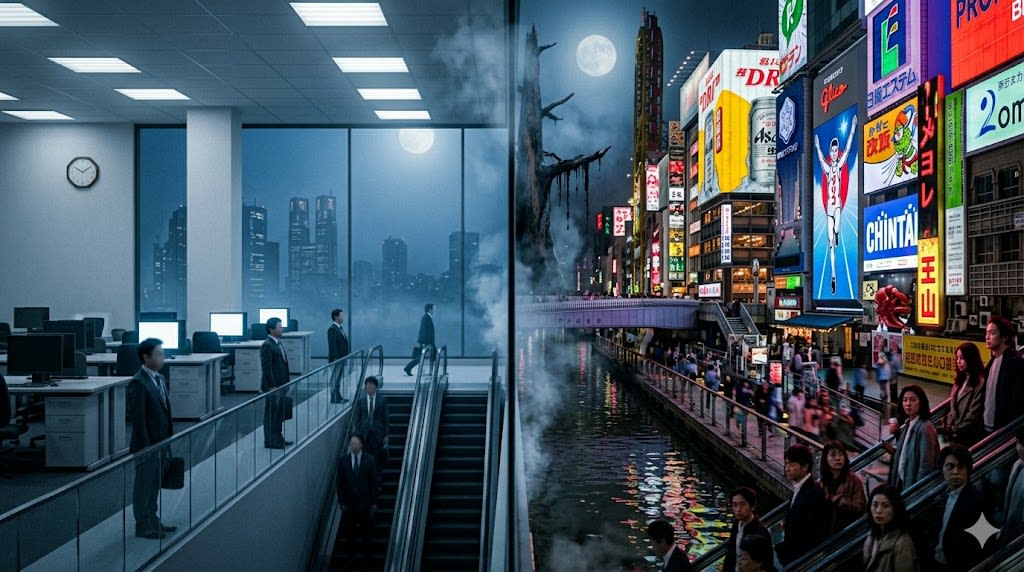
1. The Invisible Walls of Tokyo
To an outsider, Tokyo feels like a miracle of modern minimalism. It is a city of near-impossible silence despite housing millions. People move like water—efficient, quiet, and perfectly contained within their own personal spaces.
But this heavy, collective discipline creates a unique psychological phenomenon: The Void. Tokyo’s architectural and social layout forces you into a state of extreme self-awareness. When you step into a Tokyo subway car at midnight, the quiet is so absolute it feels active. The rows of passengers staring blankly into their smartphones become a living liminal space. It is a city built on Wa (harmony), but a harmony so rigid that any sudden, erratic human behavior feels like a tear in the fabric of reality itself. Tokyo is a horror of isolation; you are surrounded by millions, yet entirely invisible.
2. The Borderless Chaos of Osaka
Four hundred kilometers to the west, the mirror shatters. Osaka does not care about your invisible walls.
If Tokyo is a pristine, silent museum, Osaka is a breathing, roaring entity made of iron, steam, and neon. Historically the city of merchants (Shonin), Osaka’s culture completely bypasses the polite, safe distances of the capital. Here, people look you in the eye. Strangers talk to you at bus stops. The local dialect, Osaka-ben, is loud, rhythmic, and sharp—sounding more like a negotiation or a comedic routine than a language. Osaka doesn't isolate you; it absorbs you. It is a city that embraces Kegare (the chaotic pollution of life) rather than running from it.
3. The Geometry of the Escalator: A Silent Rebellion
Nowhere is this split personality more physically apparent than on the simple escalator.
In Tokyo, the unwritten law of geometric discipline dictates that everyone stands precisely on the left side, leaving the right side open for those in a hurry. It is mechanical. It is predictable.
But the moment you step off the Shinkansen at Shin-Osaka Station, the law flips. In Osaka, people stand on the right side. Why? Historically, it began during the 1970 World Expo to match international standards, or perhaps because Osaka merchants preferred to keep their right hands free to guard their wallets. But today, it feels like a psychological rebellion against the capital. For an outsider, this simple shift causes an immediate sense of disorientation—a literal flip of the urban matrix that signals you have entered a different realm entirely.
4. Neon and Concrete: The Visual Dread
The physical landscape reflects this psychological divide under the pale moonlight.
Tokyo’s nightlife centers around places like Shinjuku’s Golden Gai or the high-rises of Roppongi—dark, narrow alleys crammed with tiny bars that feel like secrets, where intimacy is gated by unspoken rules.
Osaka’s Dotonbori, however, is a sensory assault. Giant, motorized mechanical crabs claw at the air; massive, glowing signs cast a crimson and toxic-green hue over the murky river. It feels like a beautiful, industrial nightmare—a cyberpunk market that never went through a minimalist filter.
5. Conclusion: Choose Your Ghost
Ultimately, Tokyo and Osaka are the twin faces of the Japanese soul.
Tokyo challenges your mind with its suffocating, polite silence, making you wonder if you actually exist or if you are just a ghost walking through a concrete labyrinth. Osaka challenges you with its raw, unapologetic humanity, dragging you into its noisy, neon-lit current whether you are ready or not.
They are two distinct psychological landscapes. The question for the traveler is not which city is better, but which kind of vertigo you prefer to suffer from.
About the Creator
Takashi Nagaya
I want everyone to know about Japanese culture, history, food, anime, manga, etc.
Enjoyed the story? Support the Creator.
Subscribe for free to receive all their stories in your feed.
Comments
There are no comments for this story
Be the first to respond and start the conversation.