
The Silence After the Equation
A physicist spends years on a theory and learns that indifference can hurt more than rejection.
The day of the group meeting, he spoke for forty minutes. The projector fan was loud, and by the end he could barely hear himself. When he finished, he stood there waiting for questions. The silence lasted about ten seconds. Then someone in the back row asked, “Have you eaten lunch?” He said yes. The person said, “Oh. The cafeteria had braised pork today.” He turned off the projector and put the laser pointer back in its case. When the case snapped shut, the click sounded a little too loud in the quiet.
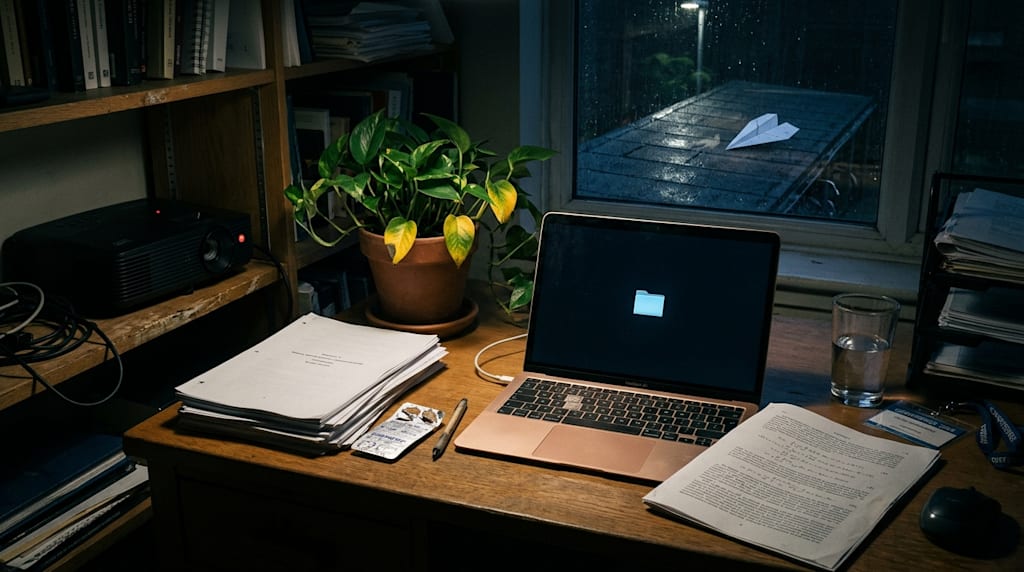
That night he printed out the first version of his theory: twenty-seven pages, stapled in the upper left corner. He flipped through it and drew a line under an integral sign on page three. He thought there might be a problem there. The next day he redid the derivation. No problem. He flipped through the twenty-seven pages again. It seemed fine. He put the printout in a drawer. In the drawer there was also half a pack of stomach medicine and a pothos. The tips of the pothos leaves were a little yellow. He watered it.
The first submission was three months later. The referee comments came back quickly, two pages. The first point said “the connection between this work and the existing literature is not clear enough.” The second said “insufficient novelty.” He printed the comments, folded them into a paper airplane, stood on the balcony, and threw it. The paper airplane hit the drying rack and landed on the roof of the bicycle shed below. He watched for a while, went downstairs, moved a chair over, and still couldn’t reach it. The next morning he went to look again. The paper airplane was still there, wet with dew, the ink smeared. He found a clothes pole, poked it down, flattened it out, and tucked it into a notebook, together with the twenty-seven-page printout.
The second submission went to a different journal. It was under review for four months, then rejected. This time the comments were one sentence: “We suggest submitting to a more specialized journal.” He looked up that “more specialized journal.” Lower impact factor, longer review period. He didn’t submit. He starred the rejection email in his inbox. By the time the starred emails reached seventeen, he realized he had stopped opening them much.
He emailed a close colleague in the field and attached the abstract and a two-page introduction. Three days later the reply came: “Interesting, but I’m very busy lately and may not have time to look closely.” He marked the email unread. The next day he marked it read. The day after that, unread again. On the fourth day he removed the star and moved it into a folder called “To Deal With.” That folder already held more than a hundred emails.
Once, at a conference, he ran into a senior researcher. He walked over and said he wanted to explain an idea he had been working on recently. The other person said, “Sure, go ahead.” He had gotten three sentences out when the other person’s phone rang. The man glanced at the screen, said, “Sorry, I need to take this,” and walked away. He stood there, clutching the printout, the edge of the paper creased by his grip. He looked down at the crease and tried to smooth it with his thumb. He couldn’t. He stuffed the printout into his bag, went to the coffee break area, and took a cookie. The cookie was a little stale. He ate two bites and threw it away.
That night at home he opened his computer, found the theory document, selected the whole thing, and put his finger on the delete key. The screen lit his face. A spot on the keyboard cover had worn white: the “D” key. He paused, released the delete key, and pressed the right arrow. The cursor jumped to page three, under the integral sign. There was a typo: 的 had been written as 地. He changed 地 back to 的, saved, and closed the document.
He went to the kitchen to pour water. The kettle was empty. He filled it, waited for it to boil, and stood there watching bubbles rise from the bottom. When it boiled, he poured a cup, didn’t drink it, left it on the table, and went to his room to sleep.
For the next few months he didn’t open the theory folder again. He did routine calculations, things he wasn’t excited about but could publish. Every morning at the office, he opened the folder, looked at it, didn’t click, closed it, and did other things. The folder’s modification date stayed at the night he fixed the typo.
The following spring he saw a notice for a small academic conference in another city. The conference was small, and its topic was related to one small piece of his theory. He took the theory apart and kept only one concrete problem. He wrote a six-page abstract and submitted it. It was accepted.
At the conference he spoke for fifteen minutes. When he finished, someone raised a hand and asked a concrete question: in which limit does your approximation break down? He blanked for a moment, then said he hadn’t carefully calculated that yet. The person said, “You could calculate it. If the breakdown range isn’t large, it might still be salvageable.” Back at the hotel he calculated for three hours and found that the breakdown range was not large. He emailed the person two pages with the derivation. The person replied: “Got it. I’ll take a look.”
He screenshotted that email and saved it in a folder called “Feedback.” The folder also held seventeen starred rejection letters, one “interesting but I’m busy,” and a photo of a paper airplane. He looked at the folder, closed it, went downstairs to the convenience store, bought a bottle of water, came back, and continued revising the six-page abstract, preparing to submit the full paper.
He didn’t know whether that “I’ll take a look” would lead anywhere. He didn’t wait for it anymore. He just updated the modification date on the theory folder and added a new file called “Limit Analysis.” The pothos was still on the desk, the leaf tips still yellow. He watered it. Water seeped from the bottom of the pot and left a small ring on the desktop. He wiped it with a tissue and threw the tissue at the trash can. He missed. It fell on the floor. He bent down, picked it up, and threw it away again.
About the Creator
Jin
Writer of reamstories
https://reamstories.com/jin
Enjoyed the story? Support the Creator.
Subscribe for free to receive all their stories in your feed. You could also become a paid subscriber, letting them know you appreciate their work.
Comments
There are no comments for this story
Be the first to respond and start the conversation.