
The Same Breath Kills a Candle and Feeds a Fire. Here’s the Physics.
Your exhaled air isn’t pure CO₂, and that’s only the first surprise. The real story is heat, oxygen, and a thin film of gas you can’t see.
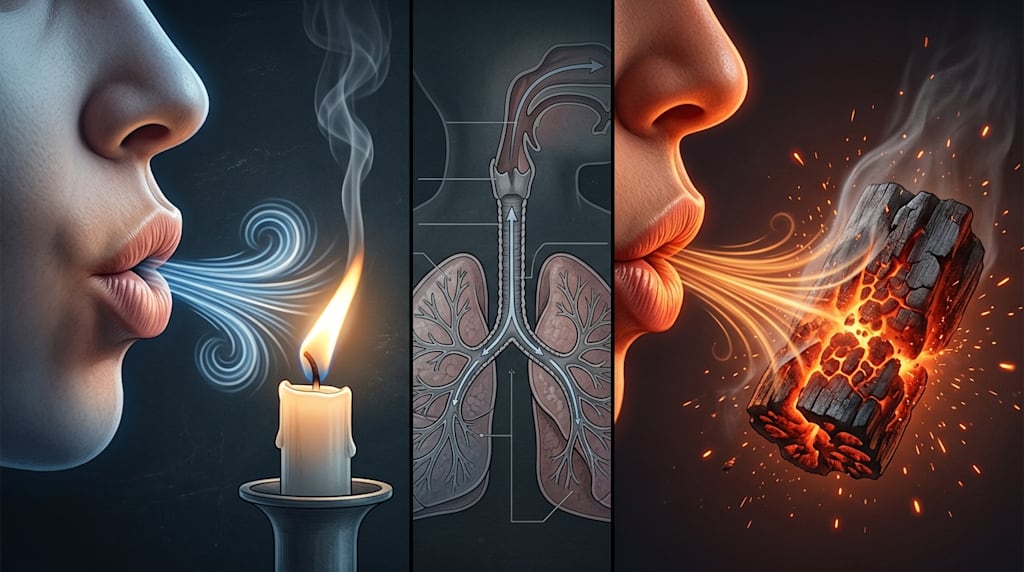
If exhaled air were pure carbon dioxide, a walk in the woods would be a health hazard. A person’s average exhaled breath is about 3.6–4% CO₂, not 100%. Alveolar gas is higher, around 5.3%, but the air that leaves the mouth is diluted on the way out. The gap between alveolar gas and exhaled breath sits in the trachea and bronchi, the anatomical dead space. During inhalation, fresh air first fills these non-exchange airways and mixes with old gas before reaching the alveoli. During exhalation, the lungs do not squeeze out every last bit of alveolar gas; they push out a portion, and that portion mixes with gas from the dead space. Average exhaled CO₂ therefore lands well below alveolar concentration.
After the breath leaves the mouth, it also entrains surrounding air. A jet of exhaled air mixes with room air and quickly approaches ambient composition. A mouth and a hair dryer differ in velocity, temperature, and moisture; their CO₂ delivery to a piece of charcoal is not the main variable. The main variables are airflow, cooling, and oxygen supply.
CO₂ is not a one-breath poison, but it is not safe either
Normal atmosphere holds about 0.04% CO₂, roughly 400 ppm. At about 1000 ppm (0.1%), some studies report mild declines in high-level cognition and decision-making; other people report drowsiness. The effect depends on the task, ventilation, and the person. At 2500–5000 ppm (0.25–0.5%), long exposure can bring headache, poorer attention, and a slight rise in heart rate. The body deepens breathing to compensate, and some people feel chest tightness or shortness of breath. At 1% (10,000 ppm), prolonged exposure can produce clear breathlessness, headache, and anxiety. At 4%, long exposure can cause marked headache, palpitations, and respiratory acidosis. Above 5%, the lungs have serious trouble excreting CO₂; severe exposure can lead to loss of consciousness, arrhythmia, and circulatory failure.
The 5% boundary comes from gas diffusion. At sea level, venous blood PCO₂ is about 46 mmHg, and alveolar PCO₂ is about 40 mmHg. That gradient drives CO₂ across the alveolar membrane. When inhaled CO₂ rises, the gradient shrinks, and excretion becomes less efficient. At higher concentrations, CO₂ can diffuse back into the blood, contributing to central depression and acidemia. CO₂ is not a classic poison; it disrupts acid–base balance and gas exchange.
High-concentration CO₂ stunning or euthanasia in slaughterhouses is not a “painless, 100% approval” method. Animal welfare research documents aversion, struggle, and respiratory distress in many animals. The method is contested. For humans, 5% and above over long exposure is dangerous, but a single breath does not drop a person on the spot. Concentration and exposure time set the boundary.
Why exhaled breath is diluted
The lungs are not a single balloon. The trachea and bronchi conduct gas but do not exchange it. When a person inhales, fresh air first enters this dead space and mixes with the gas already there. When a person exhales, the first portion comes from the dead space, and later portions carry alveolar gas. The average exhaled CO₂ lands around 3.6–4%, below the 5.3% in alveolar gas.
The jet of exhaled air then mixes with surrounding air. A breath blown through a straw, a mouth, or a fan carries different momentum and different temperature, but the CO₂ concentration reaching a candle or a piece of charcoal is not the decisive factor. The decisive factors are the flow field and the combustion mode.
A candle goes out because heat leaves faster than it arrives
A candle burns as a gas-phase homogeneous diffusion flame. The wick does not burn as a solid stick of wax. Heat melts and vaporizes wax; the vapor cracks into combustible fragments; those fragments mix with air and burn in the flame. The candle’s heat reservoir is small.
A fast breath stretches the flame, pushes it away from the wick, dilutes the combustible vapor, and drives convective cooling. When heat production falls below heat loss, the chain reaction stops. The candle goes out. The CO₂ in the breath is far too low to act as a fire-extinguishing agent. A CO₂ extinguisher works by discharging a high concentration into the fire zone; a mouth cannot.
A windproof lighter is often misread. The flame is not immune to wind. It premixes air with fuel, raises combustion temperature, and places a metal flame holder at the nozzle. The metal stores heat. If the flame is briefly disturbed, the hot metal can reignite the fuel–air mixture. The lighter is quick to relight, not windproof.
Charcoal glows brighter because the breath breaks a stagnant film
Charcoal smolders by solid heterogeneous combustion. The reaction occurs at the carbon surface. The effective contact area is limited, and the burn is incomplete. The surface produces CO and CO₂. Those gases occupy the region near the surface and reduce the partial-pressure driving force for oxygen diffusion inward. As the gases diffuse outward, they resist the inward flux of oxygen (the Stephen flow effect). Without convection, a stagnant film of CO and CO₂ forms over the charcoal surface and suppresses further burning. The charcoal stays alive because its mass stores heat.
A breath breaks that film. The airflow brings fresh air to the surface and raises the oxygen flux. The charcoal’s stored heat resists the convective cooling. The surface gets hotter and glows red. The CO₂ in the breath does not help combustion; CO₂ neither burns nor supports burning. The useful part of the breath is the flow and the oxygen it delivers.
The same breath does two opposite things. At a candle, convective cooling and flame stretch outweigh heat production, so the flame dies. At charcoal, improved oxygen supply outweighs the cooling loss, so the surface burns faster.
Safety boundary: charcoal in a closed room
Charcoal that burns incompletely produces carbon monoxide. In a closed or semi-closed room, CO accumulates. Blowing on the charcoal improves local oxygen supply; it does not replace ventilation. Dizziness can be an early sign of CO poisoning, not “stars circling in daylight.” Charcoal burning in an enclosed space is the dangerous setup. Blowing itself is not.
CO₂ also has a clear limit. It does not burn and does not support burning. The human body buffers CO₂, and ordinary daily exposure stays far below dangerous levels. Long exposure at high concentration changes the outcome. Concentration, time, and ventilation decide the outcome.
Exhaled breath is not pure CO₂; its average CO₂ concentration is about 3.6–4%, and alveolar gas is about 5.3%. CO₂ risk depends on concentration and exposure time. A candle goes out through convective cooling and flame stretch; charcoal glows brighter because airflow breaks the stagnant surface film and delivers oxygen.
About the Creator
Jin
Writer of reamstories
https://reamstories.com/jin
Enjoyed the story? Support the Creator.
Subscribe for free to receive all their stories in your feed. You could also become a paid subscriber, letting them know you appreciate their work.
Comments
There are no comments for this story
Be the first to respond and start the conversation.