
The Real Reason One Late Train Never Crashes the Whole Railway System
Inside the invisible buffers, rankings, and daily resets that keep the Beijing–Shanghai line moving, even when the board turns red.
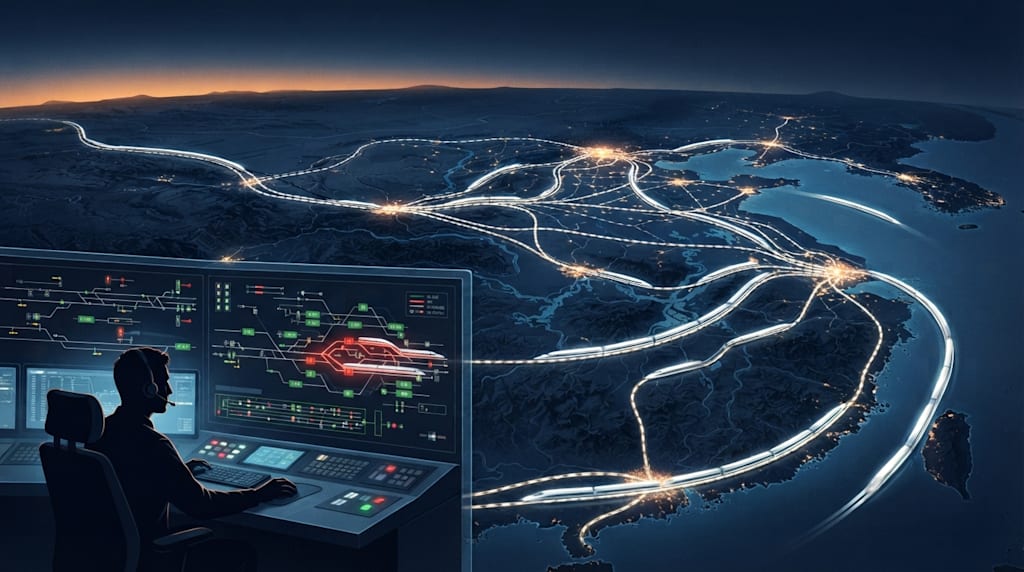
At a Spring Festival platform, the board shows a red “delayed.” A train arrives four minutes behind. Doors open. Passengers push out, others push in. The conductor blows a whistle. The train leaves four minutes behind. It cannot leave early. If it arrives early, it waits. The system looks like a machine that only stores delay. Every late arrival becomes a late departure. Every late departure becomes a late arrival down the line. Why doesn’t the whole timetable drift into chaos?
The railway is a queueing network with buffers, reordering rules, and a daily reset. Small delays are absorbed. Medium delays are recovered. Large delays are cut off by holding a train, swapping a trainset, cancelling a service, or rebooking passengers. The system does not try to make every train punctual. It tries to keep the whole network from locking up.
The asymmetry is real but incomplete. A train that arrives early cannot leave early. Passengers bought tickets for a departure time. Platform staff, connecting buses, crew schedules, and track slots all follow the timetable. But the early arrival is not wasted. It becomes dwell time. If the next section runs on schedule, the train can carry that spare minute forward. If it has too much spare time, the dispatcher can slow it down or hold it outside a station. The train cannot arrive early and grab a platform before its slot. The spare time is stored, not spent.
Delay does not simply add. At each station and each section, there is a buffer. Suppose a train is d minutes late. The next section, station stop, or junction can recover b minutes. If d is less than or equal to b, the train leaves on time and the delay is erased. If d is greater than b, only d minus b passes on. The system is a series of leaky buckets. Delay flows in. Some leaks out. The rest continues.
The timetable works as a recovery plan. It is built for an average driver, average weather, and the possibility of a slower train ahead. It includes slack in section running, station dwell, junction routing, and turnaround. A train scheduled to stop for five minutes may finish boarding in three. A train scheduled to run a section in eighteen minutes may do it in sixteen. A train scheduled to turn back in thirty minutes may be ready in twenty. These minutes are not waste. They are the system’s shock absorbers.
The Beijing–Shanghai high-speed line shows how this works. Nanjing South to Shanghai Hongqiao is about 289 kilometers. A nonstop train at 350 km/h can cover it in 60 minutes. In the timetable, only a few trains get 60 minutes. Many get 66. If a train stops once more, the schedule often adds about seven minutes, including two minutes of dwell. That extra time is not there because the railway wants to be slow. It is there because a slower train may be ahead, because passengers may take longer to board, because a driver may not be the fastest on the roster.
On high-speed rail, the slack is tight. It often sits before major hubs. Kunshan South to Shanghai Hongqiao on the Beijing–Shanghai high-speed line normally takes 16 minutes. In the timetable, many trains get 17 or 18. On the Shanghai–Nanjing intercity line, the fastest G train takes 18 minutes, but many are given 19 or 20. If a train loses one or two minutes because of heavy boarding, it can often make them up before entering Hongqiao.
Some people object that the farthest platform in a station group is a longer walk than the nearest one. That is true. But the difference is small. In a large station group, the farthest and nearest platform faces might be 100 meters apart. A train entering or leaving may travel 200 meters more. At a side-line speed limit of 45 km/h, or about 10 meters per second, that is 20 seconds. Twenty seconds does not decide a timetable.
Even “flag bearer” trains, the ones that stop only at major stations, have some water in their schedules. They are arranged first, and slower trains are inserted around them. But they are not run at the physical limit. A nonstop Nanjing South–Shanghai Hongqiao train at 350 km/h can run in 60 minutes, maybe 59 with a strong driver. Yet many are given 66. Why? Because a 300 km/h train ahead may not have reached its stop. The faster train catches up, has to slow down, and waits for the switch to clear. If the slower driver runs at 305–308 km/h and closes doors early, the delay is small. If not, the faster train pays.
High-speed rail also uses station dwell as a recovery tool. A train with a long scheduled stop can sometimes be turned faster. The conductor hurries passengers. The doors close. The train leaves a minute or two early from the dwell, even if it arrived late. This does not break the timetable. It restores it.
Conventional railways are messier. They share tracks with freight. They run on single-track sections. They use different locomotives. Their slack is often larger, and their delays swing more widely. On a single-track line, trains must meet. Freight schedules are looser than passenger schedules. Some freight trains are not even in the published timetable. The meeting point can shift. A passenger train may arrive 20 minutes early at a station, or 40 minutes late, and still leave the section close to schedule.
One passenger remembers K8381 on the Wan-Gan line. In the single-track section from Wuhu to Huangshan, the train arrived at Jixi County 20 minutes early. The conductor’s handheld terminal showed 27 passengers getting off and none getting on. It could have left early. But the train also carried railway workers. Three of them boarded. The train waited.
Another remembers K1326. It reached Ma’anshan at 6:23 a.m., 40 minutes after its 5:43 schedule. The station display still showed the old 5:53 departure. The train left at 6:29, 36 minutes late. By Nanjing, at 7:31, the delay was down to 13 minutes. The single-track section had enough slack to swallow most of the loss.
Conventional timetables also carry old data. On the Huainan line, a Fuyang–Hefei nonstop train with an HXD3C or HXD1D locomotive should run in about 2 hours 10 minutes if nothing blocks it. The timetable shows 2 hours 18 minutes for the fastest, and many trains take 2 hours 24 minutes or more. The line was electrified late. Many schedules still reflect older diesel locomotives. The newer electric locomotives accelerate and brake better, so the old times now contain slack.
Sometimes a station closes at night. The train no longer stops, but the timetable is not compressed. The stop is removed, the time remains. Sometimes one line is retimed, but connecting lines are not. The schedule is patched, not rebuilt. The slack grows. A train can arrive early at every station and finish an hour ahead.
The dispatcher matters here. The dispatcher does not try to make every train punctual. The dispatcher tries to keep the network alive. The goals are simple: no accident, no gridlock, protect the main line, protect the hubs, protect cross-regional connections. When a train falls behind, the dispatcher may hold it to let an on-time train pass. The late train takes the side track. The on-time train goes first. The late train’s passengers may see another train glide by. They do not see the decision that keeps the line moving.
The dispatcher can also compress a stop. Conductors hurry passengers. Doors close. The train leaves. The dispatcher can change the platform to avoid blocking a following train. The dispatcher can hold a late train at a bureau boundary so the delay does not cross into another region. The dispatcher can shorten a turnaround. If the turnaround is still too tight, the dispatcher can swap the trainset. A spare set comes out of a siding. The late set goes to the depot. The next service leaves on time with different equipment. If that is not enough, the dispatcher can cancel a service, merge two services, or rebook passengers.
The order is a ranking, not first come, first served. High-speed trains, cross-regional trains, and connecting services may go first. Lower-priority trains wait. A local delay is sacrificed to protect the trunk line. The passenger on the held train sees a delay. The dispatcher sees a network that is still moving.
Turnarounds are the last line of defense. They are not the only one. A train that finishes its run late cannot always start its next run late. At the terminal, there is usually 20 to 40 minutes of turnaround time, sometimes more. That covers cleaning, watering, waste removal, crew change, and passenger boarding. If a train is hours late, the turnaround cannot absorb it. The system does not force it. It cuts the delay. The late trainset may be taken out of service. A spare set takes the next trip. The next departure may be delayed or cancelled. Passengers are rebooked. One train’s hours-long delay does not become every later train’s hours-long delay.
The timetable also resets every day. Most trains return to the depot at night. The maintenance window opens. The next morning, the timetable starts again. Overnight trains are fewer and have more slack. The delay does not integrate across days. It is cleared at the depot.
None of this means the railway never breaks. Heavy snow, typhoons, equipment failures, overhead line outages, and extreme passenger flows can cause widespread delays. Spring Festival is hard. The maintenance window is compressed. Trains run at night. The slack is thinner. The system can become messy. But the dispatcher’s goal is not perfect punctuality. The goal is to avoid total gridlock.
High-speed rail has little slack and high density, so delays spread quickly. Conventional rail has more slack but shares tracks with freight and often runs on single lines, so its delays swing more. The Beijing–Shanghai line looks orderly because the timetable has buffers, the signaling system can reorder trains, the high-speed fleet is uniform, the big stations can turn trains, spare sets are available, and dispatchers make real-time choices.
One late train does not collapse the whole schedule because the railway is a network with buffers, reordering, and a daily reset. Small delays are absorbed by slack. Medium delays are recovered by dispatchers. Large delays are cut off by swapping trainsets, cancelling services, and rebooking passengers. Very large delays cause local chaos, but the system sacrifices the local to save the whole.
A delay is a ripple. The timetable is the levee. The levee does not stop the water. It gives the water somewhere to go. The dispatcher does not make every train punctual. The dispatcher keeps the network from locking up.
The next time you stand on a Spring Festival platform and see a red “delayed” on the board, look at what happens around it. A conductor waves the last passenger through. A door closes. A train that arrived four minutes late pulls out four minutes late. Another train, on time, crosses the junction ahead. The board still shows red. The line still moves.
About the Creator
Jin
Writer of reamstories
https://reamstories.com/jin
Enjoyed the story? Support the Creator.
Subscribe for free to receive all their stories in your feed. You could also become a paid subscriber, letting them know you appreciate their work.
Comments
There are no comments for this story
Be the first to respond and start the conversation.