
The Mercury-to-Gold Startup Has a Spectrum, a Preprint, and a Very Long Road
Marathon Fusion says it made stable gold from mercury. The nuclear physics checks out. The power plant, the separation plant, and the 18-year cooling period do not exist yet.
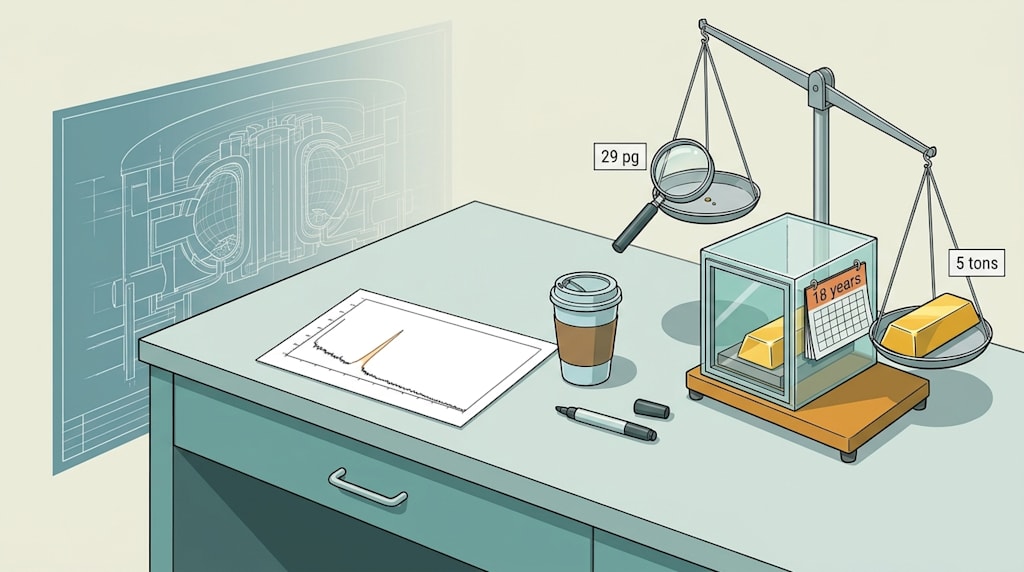
A spectrum and a cold cup of coffee
In Marathon Fusion’s lab, the gamma-ray spectrometer printed a curve with several crowded peaks. One peak sits at the characteristic energy of mercury-197. Co-founder Kyle Schiller put that image into the public release. Next to it: no sample mass, no neutron flux, no blank-control spectrum.
The image supports one claim. The irradiated sample contained a nuclide signature that matches mercury-197. It does not show how much was produced, how pure it was, what else came out of the target, or whether those other nuclides decayed away within half an hour.
That is the starting point. One spectrum, one preprint, one “ten times CERN” line. No independent lab has repeated the run. No peer review has signed off. No third party has taken the same mercury-198 into the same kind of neutron field and tried again.
Schiller’s release wording was “successfully transmuted mercury into stable gold.” At the nuclear-physics level, that sentence is accurate. Gold-197 is stable. Mercury-197 does decay into it. The word “successfully” carries more weight. It suggests a repeatable, collectible, scalable process. The public evidence supports a reaction signal.
The coffee on the lab table went cold. Nobody had time to drink it. Startup results tend to arrive with cold coffee.
Picograms and tons in one article
The news hook is the comparison to CERN. During its 2015–2018 run, the Large Hadron Collider produced about 29 picograms of gold. A picogram is one trillionth of a gram. Twenty-nine picograms is 0.000000000029 grams. Ten times that is 0.29 nanograms. A balance will not move. A microscope will struggle.
CERN’s gold atoms also appeared in high-energy collisions and scattered through a detector. Nobody could collect them.
Marathon Fusion did not say whether “ten times” means total mass, production rate, or the count rate of one nuclide. Even under the most generous reading, the annual output sits in the nanogram range. Nanograms to grams is six orders of magnitude. Grams to tons is another six.
The headline does not say “nanogram-level signal.” It says “mercury into stable gold,” and the body adds a model estimate of 5 tons per year at 1 GW of electric power. Picograms and tons end up in the same article with twelve orders of magnitude between them. A careless reader will assume they sit on the same road.
The road has a sequence. Build a commercial fusion plant. Enrich mercury-198. Put a mercury target in the blanket. Separate gold from toxic mercury and radioactive nuclides. Store the gold for up to 18 years. Then talk about a market.
The first step does not exist. No fusion plant anywhere sells commercial electricity.
Hit the nucleus, then wait 64 hours
Mercury has 80 protons. Gold has 79. Remove one proton and mercury becomes gold. The hard part is making the nucleus cooperate.
Marathon Fusion uses two steps.
First, hit it. Deuterium-tritium fusion produces 14 MeV neutrons. Those neutrons enter mercury-198 nuclei. Mercury-198 absorbs one neutron and emits two. The reaction is (n, 2n). It is standard nuclear physics. The product is mercury-197. The proton count stays at 80. The nucleus is still mercury. It is just unstable.
Second, wait. Mercury-197 has a half-life of about 64 hours. It decays by electron capture. The nucleus takes an electron and turns a proton into a neutron. The proton count falls from 80 to 79. Mercury-197 becomes gold-197.
The engineering placement is clever. Future fusion reactors need neutron multipliers to keep tritium breeding viable. One fusion reaction releases one neutron. Tritium self-sufficiency is already tight. Mercury-198 can serve as an (n, 2n) multiplier. Marathon Fusion’s pitch: the blanket needs a multiplier anyway, so use mercury-198 and produce gold on the side. Power and alchemy share the same neutron budget.
On paper, that works. A 1 GW thermal plant produces 2 to 5 tons of gold per year in the model. At $100,000 per kilogram, gold revenue can exceed electricity revenue.
The plant in that paper has never been built.
Five missing items
To test the claim, ignore the press release and look for five things in the public record.
First, mercury-198 consumption before and after irradiation. If mercury-198 barely changed, where did the gold-197 come from? If it dropped, by how much? What is the error bar?
Second, gold-197 production and chemical separation recovery. A peak on a spectrum is a nuclear signal. “We recovered X grams of gold from the mixture” is process data. The release has the first. It lacks the second.
Third, a side-reaction list. 14 MeV neutrons on mercury do not only run (n, 2n). (n, γ), (n, p), and (n, α) can occur. Gold-195 has a half-life of about 186 days and adds to the cooling burden. The public materials do not give types or amounts.
Fourth, a blank control. Does unirradiated mercury produce a background signal under the same detector settings? What does an irradiated sample look like before the decay wait?
Fifth, independent replication. Change the neutron source, the mercury-198 batch, and the operator. Do you get the same spectrum and the same yield?
None of the five is fully public. The 2025 preprint has not been peer-reviewed. The company has not disclosed the gold mass produced, the purity, or the cost.
The accurate sentence is this: Marathon Fusion showed a gamma-ray spectrum consistent with a mercury-197 signature and said the signal came from an (n, 2n) reaction on mercury-198. That claim has not been independently verified. Yield, purity, and side products have no public quantitative data.
That sentence lacks the punch of “successfully transmuted mercury into stable gold.” It is the sentence that survives scrutiny.
Eighteen years and a plant that does not exist
Even with all five items filled in, the technology needs a running fusion plant.
The global fusion industry has experimental reactors running, demonstration reactors on drawing boards, and commercial reactors in slide decks. The first commercial plants are years from operation under the most optimistic industry estimates. Marathon Fusion’s model depends on neutron flux, blanket design, thermal efficiency, and gold production rates from that plant.
Then comes mercury. Natural mercury is about 10% mercury-198. The model needs large amounts. That means an enrichment line or a lower yield at natural abundance. Mercury is toxic. Large-scale use requires closed systems and emission monitoring. Regulation will cost money.
Then comes radioactive cooling. Gold-195 and other nuclides have their own half-lives. The company says the gold may need up to 18 years of storage before it meets safety standards.
Eighteen years means inventory. A plant producing 3 tons per year would hold 54 tons after 18 years. That gold cannot be sold. It can only be monitored. Storage, security, radiation monitoring, and financing costs do not appear in the “$100,000 per kilogram” revenue line. The model has revenue. It lacks a waiting line.
Two sets of numbers
Marathon Fusion’s commercial estimates come in two versions.
The press version: 1 GW electric, 5 tons of gold per year. One hundred plants add 500 tons per year, about 14% of mine production.
The 2025 preprint: 2 tons per GW thermal per year. Its example uses 1500 MWth, 40% efficiency, and 600 MWe. That gives 3 tons per year. At $50/MWhe, electricity revenue is about $263 million. At $100,000 per kilogram, 3 tons of gold brings about $300 million.
Electric power and thermal power mix. Five tons and three tons coexist. The 100-plant projection assumes the same plant can be copied at scale. Each number looks plausible alone. Together they raise a baseline question.
The larger problem sits upstream. The fusion plant has no commercial model. Using gold revenue from a plant that does not exist to argue the economics of another plant that does not exist is circular reasoning with a gold shell.
The estimates have value as design-stage sensitivity analysis. They do not prove commercial value. A concept car’s wind-tunnel data can guide the design. It cannot sign off on production profitability.
The gold price will not flinch
Take the most optimistic case: 100 plants and 500 tons per year. Global mine production in 2025 was about 3,672 tons. Five hundred tons is a 14% marginal addition. Add the 18-year cooling period, separation costs, and regulatory approval, and market entry slows further. The gold market absorbs 14% marginal supply without rewriting its structure.
One detail deserves more attention than the tonnage. Once transmuted gold-197 decays to safety standards, its nucleus matches natural gold. Conventional assays cannot tell them apart. The “artificial gold” label disappears at the physical level. Consumers see gold. Regulators face a supply stream that is indistinguishable from mined gold. That issue matters more than the annual output. It is also not today’s issue.
Today’s issue is the spectrum and the five items not attached to it.
Back to the cold coffee
On release day, the lab coffee went cold. The spectrometer curve became a photo in the press release. The peak matches mercury-197. Wait 64 hours and that peak should weaken. A gold-197 peak should appear. Nuclear constants govern that decay. Neither the company nor the reader has to believe it.
Belief belongs to another list. Mercury-198 consumption must be large enough. Side reactions must stay controllable. A separation process must exist. The 18-year storage cost must be bearable. Someone must build the 1 GW plant.
None of that has happened. It may happen later. It may not. Until it does, “mercury into stable gold” is a proposition allowed by nuclear physics, unverified by engineering, and without a commercial reference.
The coffee on the table went cold. A spectrum sits beside it. So does a marker with its cap off. The peak on the spectrum exists. The road from that peak to tons of gold remains in the drawings.
The 18-year cooling clock starts when gold comes out of the reactor. That day depends on a plant that does not exist. Those 18 years have not started counting.
About the Creator
Jin
Writer of reamstories
https://reamstories.com/jin
Enjoyed the story? Support the Creator.
Subscribe for free to receive all their stories in your feed. You could also become a paid subscriber, letting them know you appreciate their work.
Comments
There are no comments for this story
Be the first to respond and start the conversation.