
The Lyrics Fit. The Melody Didn't. And Then I Accidentally Fixed It.
The track was already exported by the time I realized something was off.

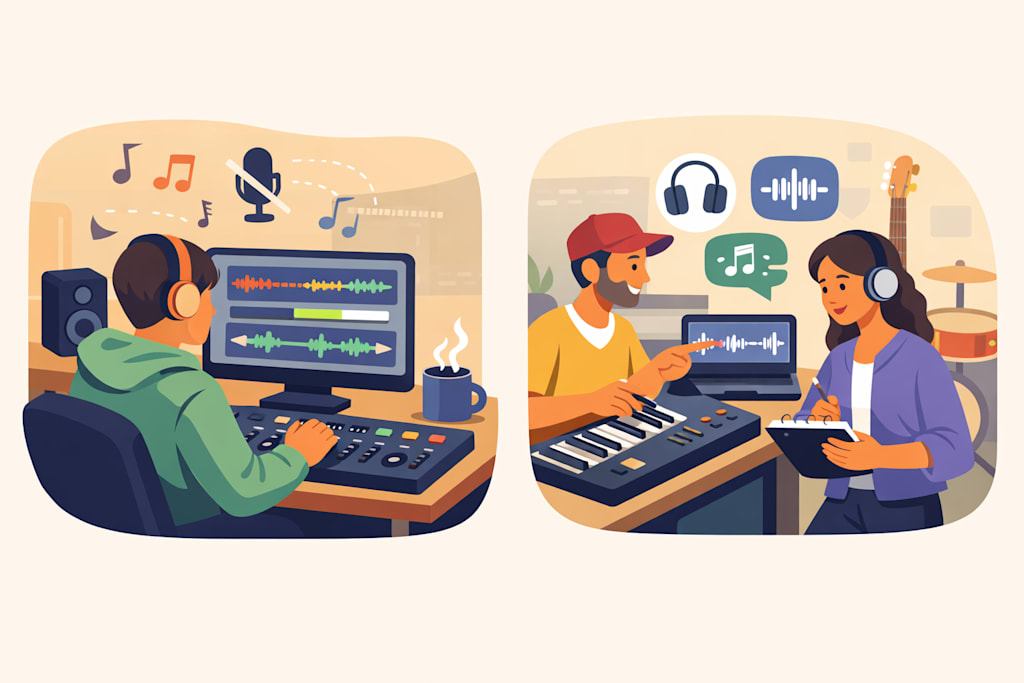
Not wrong, exactly. Just... misaligned. Like a subtitle that's half a second behind the video — you can still follow along, but something in your brain keeps snagging on it. The AI lyrics generator had done its job. The words were there. The rhyme scheme held. The emotional arc moved from verse to chorus the way it was supposed to. But when the melody landed on top of them, the whole thing felt like two strangers walking in the same direction without actually going anywhere together.
I'd been awake since around 1 a.m. Not for any good reason. Just one of those nights where sleep doesn't show up and you end up doing things you'd never schedule during daylight hours.
What I Was Actually Trying to Do
I make short documentary-style content — mostly self-funded, occasionally picked up by small platforms. For a while I'd been licensing music the usual way: browse a library, pick something that roughly fits the mood, pay the fee, move on. It works. It's also completely forgettable, which started to bother me more than I expected.
So I'd been experimenting with AI music generators for a few weeks, mostly out of curiosity rather than any real plan. That night I was working on a two-minute piece about urban community gardens — quiet subject, needed something that felt unhurried without being sleepy. I typed a prompt into the AI lyrics generator first, which is apparently backwards from how most people approach this. Usually you'd want the musical skeleton before the words.
I didn't know that yet.
The Mismatch Nobody Warned Me About
The lyrics came back fast. Four verses, a chorus, even a bridge I hadn't asked for. Thematically they were solid — something about soil and patience and things growing slowly in concrete places. I liked them. I copied them into the music generation prompt and let the AI music generator build around them.
The result was technically impressive. Instrumentation was clean. The tempo felt right. But the stress patterns in the melody kept landing on the wrong syllables. Lines that were meant to breathe got rushed. A word like "slowly" — which should've stretched out — got clipped into something percussive. The lyrics and the melody were coexisting without actually communicating.
I exported it anyway and went to bed. (I didn't go to sleep. I just went to bed and stared at the ceiling wondering if this was a prompt engineering problem or something more structural.)
The Accidental Fix
The next evening I went back to it. I wasn't trying to solve the mismatch problem specifically — I was just tired and started poking at things without a clear goal, which is apparently when I do my best accidental learning.
I rewrote three lines of the lyrics. Not for content reasons — I just shortened them, cut a few syllables, made the natural spoken rhythm of the lines more regular. Then I ran the same music generation prompt again without changing anything else.
The result was noticeably different. Not perfect, but the melody now seemed to find the words instead of running alongside them. The stressed beats landed closer to where the language wanted them to land. I sat with it for a while, genuinely unsure whether I'd discovered something useful or just gotten lucky with a random generation.
I tried it again with a different set of lyrics. Same thing — when the syllable count per line was more consistent and the natural speech stress was more predictable, the AI music generator produced melodic phrasing that felt more intentional. When the lyrics were irregular or dense, the melody seemed to default to something generic, like it was ignoring the words and just filling space.
What This Might Actually Mean
I want to be careful here because I'm not a musician and I don't fully understand what's happening under the hood of these tools. But my working theory — based on a few weeks of unscientific experimentation — is that most AI music generators aren't really "reading" lyrics the way a human composer would. They're not hearing the words and building melody around meaning. They're probably responding to structural patterns: line length, syllable density, maybe punctuation as a proxy for phrasing.
Which means the AI lyrics generator and the AI music generator aren't really talking to each other. You're the translator in between. And if you hand off lyrics that were written for reading rather than singing, the music generation process has no reliable way to know the difference.
I started paying attention to this more deliberately. I'd read the lyrics out loud before generating music — not to perform them, just to hear where my voice naturally rose and fell. If a line felt awkward to say, I'd rewrite it before it ever touched the music generator. Small adjustment, but it changed the output in ways I didn't expect.
One Tool That Made the Loop Easier
Around this time I also tried Freemusic AI, mostly because someone in a small Discord server mentioned it handled lyric-melody alignment better than what I'd been using. I can't make a direct comparison because I wasn't running controlled tests — but I did notice that the melodic output felt less generic when the lyrics had clear rhythmic structure. Whether that's the tool or just my improved input, I genuinely can't say.
What I can say is that the feedback loop got faster. Generate, listen, identify the mismatch, adjust the lyrics, regenerate. That cycle — which used to take me an evening — started taking twenty minutes. Not because the AI got smarter, but because I got better at knowing what to listen for.
The Part I'm Still Unsure About
Here's what I keep coming back to: if I'm rewriting the lyrics to fit the melody, and the melody is being shaped by the structure of the lyrics, then at what point does either of them actually mean anything on its own?
I'm not asking that rhetorically. I genuinely don't know. The final track for the community garden piece worked. People who watched the documentary didn't mention the music, which is usually what you want — it means it wasn't distracting. But I also can't fully explain why it worked, or whether I could reliably reproduce it.
Maybe that's fine. Maybe that's just what working with these tools looks like for now — a lot of iteration, occasional accidental insight, and a growing list of things you've noticed without fully understanding.
Or maybe the question of whether lyrics and melody are "matching" is more subjective than I'm treating it, and I've been optimizing for something that doesn't have a fixed answer.
I'm still not sure. I keep making things anyway.
About the Creator
Derek Fowler
I am a AI test lover, I like using and discover new AI saas tools.
If you are interested, welcome to follow me:)
Enjoyed the story? Support the Creator.
Subscribe for free to receive all their stories in your feed.
Comments
There are no comments for this story
Be the first to respond and start the conversation.