
The Future of Air Brake Systems: How Safety, Electrification, and Smart Transportation Are Transforming a Multi-Billion-Dollar Industry
Advanced Braking Technologies Are Becoming the Backbone of Commercial Vehicles, Railways, and Electric Mobility Worldwide

Modern transportation depends heavily on safety, reliability, and operational efficiency. Whether it is a long-haul freight truck crossing continents, a city bus carrying thousands of passengers daily, or a high-speed train moving between major metropolitan areas, braking systems play a critical role in ensuring safe operations.
Among the various braking technologies available today, air brake systems have become the preferred choice for heavy-duty transportation. Their durability, reliability, and ability to deliver consistent stopping power under demanding operating conditions have made them indispensable across commercial vehicles and rail networks.
As governments strengthen safety regulations, transportation companies modernize fleets, and electric vehicles become more common, the demand for advanced air brake systems continues to rise. Manufacturers are investing heavily in innovation, creating lighter, smarter, and more energy-efficient braking technologies that meet the evolving requirements of the global transportation industry.
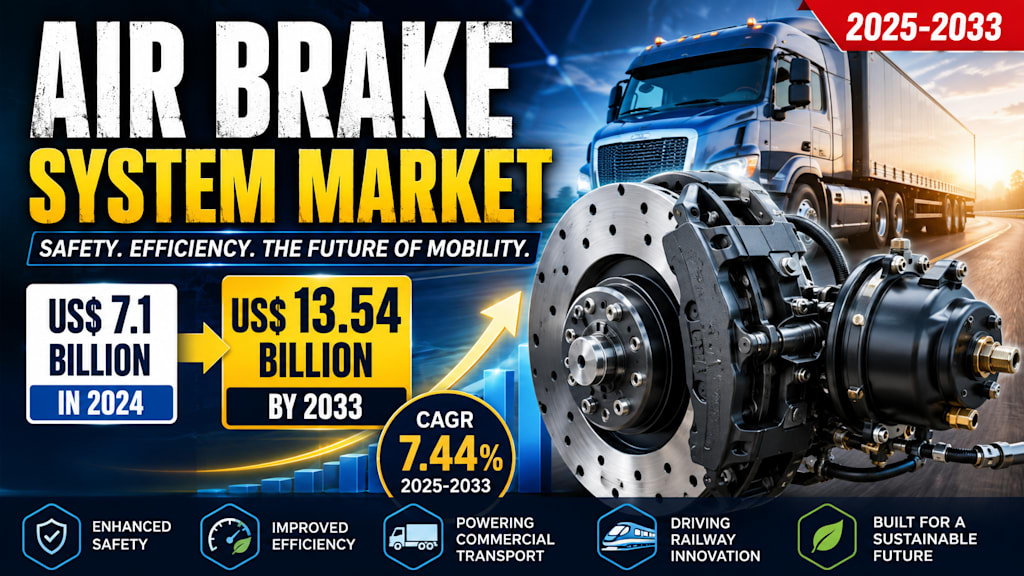
According to Renub Research, the Global Air Brake System Market is projected to grow from US$ 7.1 billion in 2024 to US$ 13.54 billion by 2033, expanding at a CAGR of 7.44% during 2025–2033. This growth highlights the increasing importance of advanced braking solutions in modern transportation ecosystems.
Understanding Air Brake Systems
An air brake system is a braking mechanism that uses compressed air instead of hydraulic fluid to activate the brakes. These systems are particularly common in trucks, buses, trailers, and railway vehicles because they provide superior braking force and enhanced reliability.
The system typically consists of several essential components, including:
Air compressors
Air reservoirs
Brake chambers
Air dryers
Foot valves
Slack adjusters
Brake drums or discs
Unlike traditional hydraulic systems, air brakes offer a significant safety advantage. Even if a leak occurs, the system is designed to maintain braking capability, reducing the risk of catastrophic failure.
This reliability explains why air brakes have become the industry standard for heavy-duty transportation worldwide.
Why Transportation Safety Is Driving Market Growth
Road safety remains one of the most important concerns for governments, transportation operators, and vehicle manufacturers.
Heavy commercial vehicles operate under challenging conditions, often carrying substantial loads over long distances. These vehicles require braking systems capable of delivering consistent performance regardless of weather conditions, terrain, or operating environment.
Air brake systems provide:
Faster response times
Enhanced vehicle control
Reduced stopping distances
Improved reliability
Lower risk of brake failure
As governments continue implementing stricter vehicle safety regulations, transportation companies are increasingly adopting advanced air brake technologies to comply with regulatory requirements and improve fleet safety.
The result is a growing global demand for modern air braking solutions.
Fuel Efficiency Is Becoming a Major Market Driver
Fuel costs remain one of the largest operational expenses for fleet operators worldwide.
While braking systems are primarily associated with safety, they also influence vehicle efficiency. Advanced air brake technologies are helping transportation companies reduce energy losses during braking operations and improve overall vehicle performance.
Modern systems incorporate:
Electronic controls
Automated brake adjustments
Smart monitoring technologies
Energy recovery capabilities
These innovations reduce wear and tear while improving operational efficiency.
As transportation companies seek ways to lower fuel consumption and operating costs, air brake manufacturers are developing systems designed to maximize both safety and efficiency.
The Rise of Electric Vehicles Creates New Opportunities
The rapid growth of electric vehicles is reshaping the transportation industry.
Unlike conventional vehicles, electric vehicles rely heavily on regenerative braking systems that convert kinetic energy into electrical energy during deceleration. This recovered energy is then stored in batteries for future use.
To support these advanced capabilities, manufacturers are developing specialized air brake systems designed specifically for electric commercial vehicles.
These systems must deliver:
Seamless integration with regenerative braking
Enhanced energy efficiency
Superior vehicle control
Compliance with evolving safety standards
As commercial EV adoption accelerates globally, air brake suppliers are expected to benefit significantly from this emerging opportunity.
Growing Railway Investments Boost Demand
Rail transportation is experiencing a major revival worldwide.
Countries across Asia, Europe, and the Middle East are investing heavily in high-speed rail networks, metro systems, and freight rail infrastructure.
Railway vehicles require sophisticated braking systems capable of operating safely at high speeds while maintaining passenger comfort and operational reliability.
Modern air brake technologies provide:
Improved stopping accuracy
Enhanced safety performance
Reduced maintenance requirements
Greater operational efficiency
As governments continue expanding railway networks, demand for advanced air brake systems is expected to rise substantially.
Aftermarket Services Are Creating Long-Term Revenue Streams
The aftermarket segment represents one of the most stable growth opportunities within the air brake industry.
Commercial vehicles accumulate significant mileage throughout their operational lifecycles. As these vehicles age, regular maintenance and component replacement become essential.
Common aftermarket services include:
Brake chamber replacement
Air compressor servicing
Air dryer maintenance
Brake system inspections
Component upgrades
Industries such as logistics, public transportation, and freight transportation depend heavily on reliable vehicle performance, creating continuous demand for air brake maintenance services.
This recurring revenue stream provides manufacturers with long-term business opportunities beyond initial vehicle sales.
Key Challenges Facing the Industry
Despite strong growth prospects, several challenges continue to affect market expansion.
Limited Awareness and Technical Training
In developing regions, many fleet operators lack specialized knowledge regarding modern air brake technologies.
Without proper training, maintenance personnel may struggle to install, inspect, or repair advanced braking systems effectively.
This skills gap can lead to:
Improper maintenance
Increased repair costs
Reduced system performance
Slower technology adoption
Industry stakeholders are increasingly investing in training programs and technical education initiatives to address these challenges.
Complex Maintenance Requirements
Air brake systems contain multiple interconnected components that require regular inspection and maintenance.
Compared to simpler braking technologies, air brake systems often require:
Specialized tools
Skilled technicians
Routine system diagnostics
Scheduled servicing
For smaller operators, these maintenance requirements can increase operating costs and create barriers to adoption.
Manufacturers are responding by developing more user-friendly systems with predictive maintenance capabilities and digital monitoring tools.
Regional Market Insights
United States
The United States remains one of the world's largest markets for air brake systems.
Demand is supported by:
Large commercial vehicle fleets
Stringent safety regulations
Expanding logistics operations
Infrastructure development projects
Technologies such as Anti-lock Braking Systems (ABS) and Electronic Braking Systems (EBS) are increasingly becoming standard features across commercial vehicles.
Germany
Germany plays a crucial role in the European air brake market.
The country's strong automotive manufacturing base and engineering expertise continue to drive innovation in braking technologies.
German manufacturers are leading developments in:
Air disc brakes
Electronic braking systems
Trailer braking technologies
Smart vehicle safety systems
India
India's air brake system market is experiencing steady growth due to rising commercial vehicle production and expanding railway infrastructure.
Key growth drivers include:
Urbanization
Infrastructure development
Fleet modernization
Government safety initiatives
The growing adoption of advanced braking technologies across transportation sectors is expected to further accelerate market growth.
United Arab Emirates
The UAE is emerging as an important market for advanced braking systems.
Strong investments in:
Construction
Logistics
Public transportation
Smart mobility projects
are contributing to increased demand for high-performance air brake solutions.
Emerging Technologies Shaping the Future
Technology continues to transform the air brake industry.
Some of the most significant innovations include:
Electronic Braking Systems (EBS)
EBS improves braking precision through digital control systems, enhancing vehicle stability and safety.
Predictive Maintenance
Sensors and telematics systems can monitor brake performance in real time and identify potential issues before failures occur.
Lightweight Components
Manufacturers are developing lighter brake components to improve fuel efficiency and vehicle performance.
Connected Vehicle Integration
Future air brake systems will increasingly communicate with vehicle management platforms, enabling smarter fleet operations.
These innovations are expected to play a major role in the next phase of market growth.
10 Recent Developments from Leading Air Brake System Companies
1. Knorr-Bremse AG
Expanded investments in digital braking technologies and predictive maintenance solutions for commercial vehicles and rail applications.
2. ZF Friedrichshafen AG
Continued advancement of integrated braking systems designed to improve vehicle safety and autonomous driving capabilities.
3. Wabtec Corporation
Strengthened its railway braking portfolio through enhanced digital rail solutions and intelligent monitoring technologies.
4. Nabtesco Corporation
Focused on developing advanced railway braking systems supporting high-speed rail expansion across Asia.
5. Haldex Group
Accelerated innovation in electronic braking systems and air management technologies for commercial vehicles.
6. Meritor Inc.
Expanded braking technology offerings aimed at improving efficiency and safety for heavy-duty transportation fleets.
7. TSE Brakes Inc.
Enhanced specialized braking solutions for industrial, mining, and rail transportation applications.
8. Federal-Mogul Holding Corporation
Continued development of performance-focused braking components designed to improve durability and operational efficiency.
9. Wabtec Rail Division
Introduced enhanced smart braking systems incorporating data analytics and remote monitoring capabilities.
10. Knorr-Bremse Rail Systems
Advanced intelligent train braking technologies supporting safer and more efficient rail transportation operations.
Final Thoughts
The global air brake system industry is entering a period of significant transformation. Rising transportation safety standards, expanding railway infrastructure, growing commercial vehicle fleets, and the rapid adoption of electric mobility are creating strong demand for advanced braking technologies.
With the market expected to increase from US$ 7.1 billion in 2024 to US$ 13.54 billion by 2033, manufacturers have substantial opportunities to innovate and capture new growth across commercial transportation sectors.
As digitalization, predictive maintenance, and smart mobility technologies continue reshaping transportation systems, air brake manufacturers that invest in innovation, sustainability, and safety will be best positioned to lead the next generation of global transportation solutions.
About the Creator
Enjoyed the story? Support the Creator.
Subscribe for free to receive all their stories in your feed.
Comments
There are no comments for this story
Be the first to respond and start the conversation.