
The Flying Saucer Sold in Yiwu for $1.2 Billion Can’t Take You Anywhere
Behind the viral UFO are 86 models that don’t fly, three missing certificates, and a battery problem no one has solved.
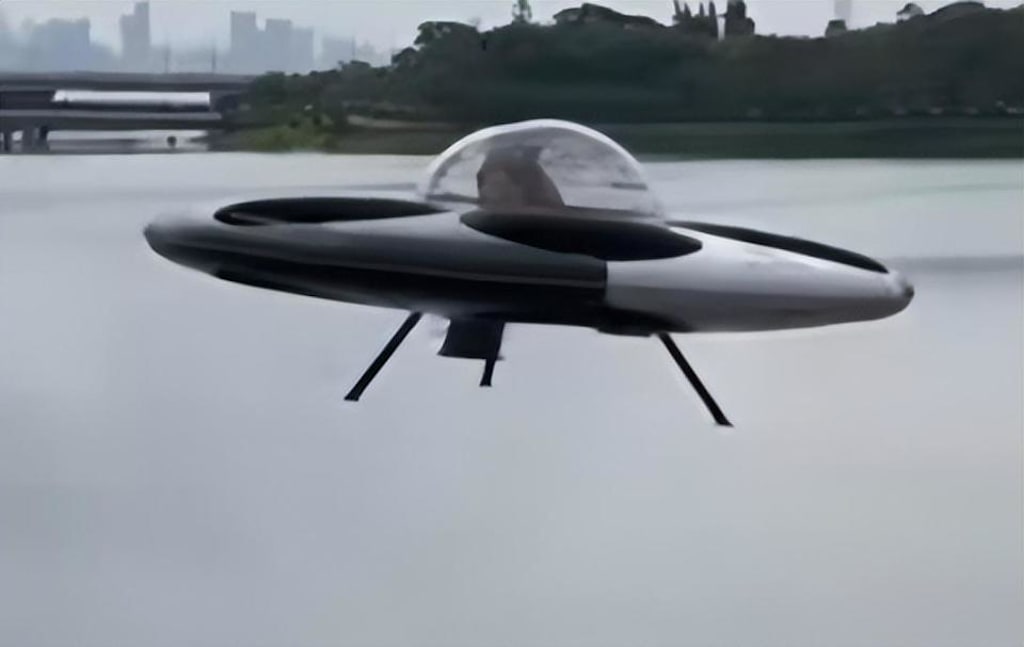
I. The flying saucer in the Yiwu showroom
In September 2026, on the fourth floor of the Yiwu Global Digital Trade Center in Zhejiang, a disc-shaped aircraft sits in the showroom of Shenzhen Zhihang UAV. It is about 5 meters in diameter, with a 360° fully transparent spherical cockpit. The body is assembled from fiberglass, carbon fiber, aluminum alloy, and aviation plywood. Six ducted fans are completely enclosed inside the fuselage; no propellers are visible from the outside.
It is listed at RMB 800,000. Its flight altitude is about 30 meters, its endurance is 15 minutes, and it supports vertical takeoff and landing as well as water and land takeoff and landing. Its wind resistance rating is Level 5. It has obtained a Special Flight Permit for a civil unmanned aircraft issued by the Civil Aviation Administration of China, numbered SFP22574.
The showroom manager told Yiwu Business Daily that it receives more than ten groups of Chinese and foreign buyers per day on average, with “a steady stream of inquiries.” Because the manned version is too expensive, Zhihang has also launched a toy remote-controlled flying saucer priced at RMB 268.
The aircraft’s appearance has been repeatedly shared on social platforms. In the comments, some ask “How high can it fly?” and some ask “Does it need a license?” The most frequent comment is: “This must be AI-generated, right?”
II. Anatomy of the RMB 120 million order
The “single order of RMB 120 million” repeatedly cited by the media comes from a presale agreement between Zhihang UAV and Qionghai Sea Skydiving Co., Ltd. The latter will purchase 68 two-seat manned flying saucers and 86 static display flying saucers, for a total of nearly RMB 120 million.
The 86 static display units do not fly. They are meant to be placed in scenic areas, commercial complexes, and flight camp entrances for tourists to photograph. Qionghai Sea Skydiving’s plan is to rely on Zhihang’s flying saucers to build 100 flight camps across the country, using an immersive scenario of “looking up from the ground + soaring in the air” to drive low-altitude consumption.
Zhihang’s estimate is that a single flying saucer can serve more than 1,000 tourists per year on average, and that after all 100 camps are fully implemented, they will drive hundreds of millions of yuan in low-altitude tourism consumption.
Whether this estimate holds depends on two variables: the visitor flow at the camp locations, and how much tourists are willing to pay for a 15-minute, 30-meter-high flight experience. Neither figure has been made public.
III. The distance between a special flight permit and the four certificates
The “Special Flight Permit for a civil unmanned aircraft” held by this flying saucer is separated from the qualifications required for commercial passenger-carrying operations by an entire airworthiness certification system.
According to the rules, an aircraft that has obtained a special flight permit may not engage in commercial passenger-carrying operations and may not carry persons, unless they are personnel related to that special flight. In March 2024, the Civil Aviation Administration of China publicly solicited opinions on Special Flight Permit SFP22574. Jin Liang, founder of Zhihang, said at the time that the flying saucer “passed relevant technical and safety assessments and can conduct scientific research test flights and small-scale performances in multiple designated areas.”
Commercial passenger-carrying operations require four certificates: Type Certificate (TC), Production Certificate (PC), Standard Airworthiness Certificate (AC), and Operating Certificate (OC).
On March 28, 2025, Heyi Aviation, a subsidiary of EHang, received the Operating Certificate for passenger-carrying civil unmanned aircraft issued by the Civil Aviation Administration of China. Combined with its earlier TC, AC, and PC, EHang became the world’s first eVTOL company with full-chain compliance qualifications for commercial operations.
It took EHang seven or eight years to complete this path. It took three years from TC application to certification. In January 2021, EHang submitted the type certificate application for the EH216-S to the Civil Aviation Administration of China; in October 2023, it obtained the TC; in December 2023, the AC; in April 2024, the PC; and in March 2025, the OC.
Zhihang’s flying saucer is currently limited to “scientific research test flights and small-scale performances.”
IV. The aerodynamic bill of ducted fans
The flying saucer uses a “six-axis, twelve-propeller” ducted design, enclosing the propellers inside the vehicle so that people nearby can approach safely. This design has safety advantages, but it adds several aerodynamic problems.
Under certain conditions, ducted fans are more prone to airflow instabilities: tip leakage, windward separation, vortex breakdown, rotating stall, and duct recirculation. When the vehicle hovers or slowly circles at low altitude, which is the flying saucer’s typical flight state, a strong crosswind can cause the airflow inside the duct to separate asymmetrically, producing lateral forces and rolling moments.
The flying saucer’s wind-catching surface is its entire disc-shaped body. A Level 5 wind resistance rating means it can fly in winds of 8.0–10.7 m/s. Within this wind-speed range, three questions remain unanswered in publicly available materials: whether asymmetric airflow separation inside the duct will occur, how likely it is, and whether the flight control system has sufficient correction margin.
Zhihang’s flight control system is self-developed. Jin Liang is a graduate of Beihang University.
V. The physical ceiling of batteries
The flying saucer has a 15-minute endurance and a flight altitude of about 30 meters. These two parameters determine that it can currently only be used for low-altitude sightseeing and flight performances.
The root cause of short endurance is the battery. Lithium batteries used by mainstream eVTOLs today have an energy density of about 250–350 Wh/kg. Wu Ximing, chief technical expert of the aviation industry, gives these figures: the usable energy density of battery packs is about 200–250 Wh/kg, while the effective work output of fuel is about 3,000 Wh/kg. If all the onboard fuel of a 13-ton helicopter were replaced with batteries, its original 4-hour endurance would drop to about 20 minutes.
Solid-state batteries are seen by the industry as a necessary technological leap. A review paper published in IEEE proposed that solid-state batteries need to reach an energy density of 400–1,000 Wh/kg to meet the safety and performance standards of commercial flight. The paper’s roadmap predicts that semi-solid-state batteries will support near-term low-altitude operations, while all-solid-state systems are expected to achieve widespread commercialization in eVTOLs only in the mid-2030s.
CATL has planned small-batch mass production of all-solid-state batteries with an energy density of 500 Wh/kg by 2027. From mass production to aviation-grade application, there are still steps such as airworthiness certification, system integration, and cost control.
Wu Ximing also pointed out an easily overlooked constraint: limited by physical laws, at the current level of battery technology, the payload peak of an eVTOL occurs at a takeoff weight of around 2.5 tons. Above this weight, payload declines.
VI. The ledger of low-altitude cultural tourism
The flying saucer’s current business model is to exchange “visual impact” for ticket revenue. The ledger of this model can be examined through three numbers.
The first number is ticket price. There is currently no ticket-price data for Zhihang’s flying saucer in scenic-area operations. For reference, similar low-altitude sightseeing programs: helicopter sightseeing of 5–10 minutes usually costs RMB 500–1,500. eVTOL operating costs are theoretically lower than helicopters. Lu Yi, co-founder of Tianlingke, gave the figure that its L600 can keep operating costs at RMB 1.5 per seat-kilometer, and future end-user ticket prices are expected to fall between first class and business class on high-speed rail. TCab Tech expects the per-seat-kilometer cost of its E20 to fall to the RMB 3–4 range.
The second number is average daily flight sorties. Cultural tourism scenarios are affected by weather and visitor flow, so the number of flyable days is limited. A 15-minute endurance means a single unit can perform at most 3–4 sorties per hour (including takeoff, landing, and passenger turnover time). After deducting charging time, the average daily effective flight sorties are even lower.
The third number is the number of camps. Whether the plan for 100 camps can be implemented depends on whether the visitor flow at each camp can support operating costs. Zhihang’s estimate is that a single flying saucer serves more than 1,000 tourists per year on average; that figure corresponds to an average daily visitor count of fewer than 3.
VII. Changes on the policy side
In airspace management, the Central Air Traffic Control Office, together with the National Development and Reform Commission and other departments, has designated fixed dedicated airspace in Shanghai and Sichuan and promoted the “scan-to-fly” model. Users scan a code to complete real-name registration, choose a flight time and area, and finish filing in less than two minutes. Hunan, as the country’s first pilot province for province-wide low-altitude airspace management reform, has completed classified airspace designation and established a low-altitude surveillance network covering the entire province. Sichuan has carried out a low-altitude operation management pilot, releasing more than 120,000 square kilometers of low-altitude airspace resources.
On the insurance side, in February 2026, the National Development and Reform Commission, the National Financial Regulatory Administration, and the Civil Aviation Administration of China jointly issued the Implementation Opinions on Promoting the High-Quality Development of Low-Altitude Insurance, proposing that by 2027 a mandatory liability insurance system for unmanned aircraft will be initially established, and by 2030 the low-altitude insurance policy framework will be basically formed.
The scenario-expansion principle proposed by the National Development and Reform Commission is: “cargo before passengers, isolation before integration, distant suburbs before urban cores.”
VIII. The flying saucer’s current coordinates
The flying saucer in the Yiwu showroom is currently a low-altitude sightseeing device with a special flight permit, a 15-minute endurance, and a flight altitude of 30 meters. Nearly 60 percent of the orders its manufacturer has received are non-flying display models. Its airworthiness qualifications are still three certificates away from commercial passenger-carrying operations. Its endurance is limited by the energy density of current lithium batteries. Its business model depends on scenic-area visitor flow and tourists’ willingness to pay for a 15-minute flight.
Its listed price is RMB 800,000. Zhihang also sells a toy version for RMB 268.
If you want to sit in it and take a photo, go to a scenic area that has introduced this device, queue up, spend some money, and experience it for a few minutes. This may soon be possible. If you want to use it for commuting, the bottleneck is not Yiwu’s manufacturing capacity but the maturity of the airworthiness certification system, battery energy density, and the low-altitude operating network.
It took EHang seven or eight years to obtain all four certificates. Zhihang has just obtained the first one.
About the Creator
Jin
Writer of reamstories
https://reamstories.com/jin
Enjoyed the story? Support the Creator.
Subscribe for free to receive all their stories in your feed. You could also become a paid subscriber, letting them know you appreciate their work.
Comments
There are no comments for this story
Be the first to respond and start the conversation.