
The Egg With No Father
A hen can lay without a rooster. The biology is older than the farm, and the cost is real.
An egg at dawn
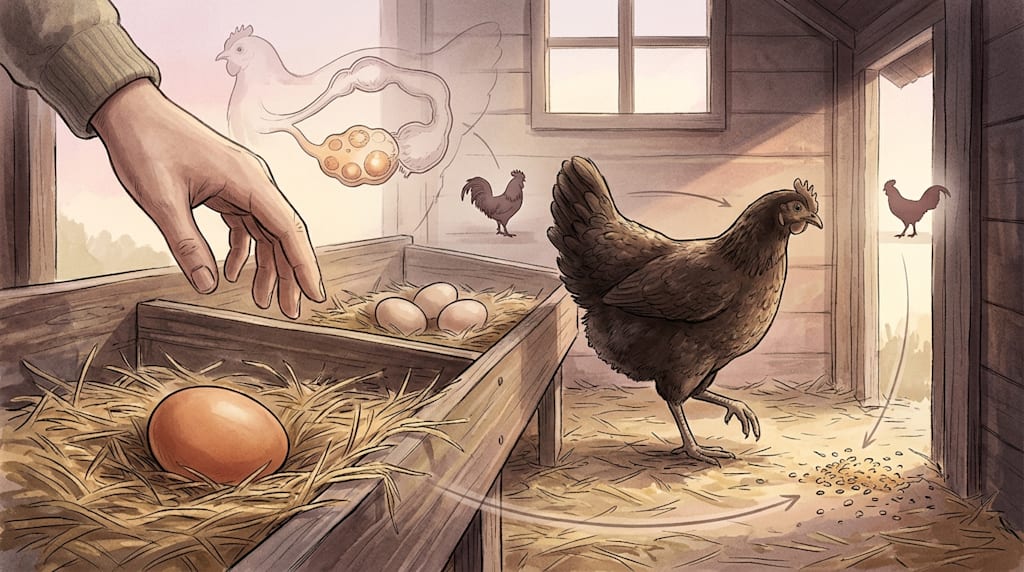
In the morning, an egg lands on the straw. It is warm and slightly damp. Genetically, it has no father. The hen has never seen a rooster, or she has seen one, but the mating left no sperm in the right place at the right time. The egg cell traveled alone through the oviduct. It was wrapped in albumen, sealed inside shell membranes, coated with calcium carbonate, and pushed out by muscles and reflexes that do not need an audience.
A person bends down and takes it. The hen clucks, steps off the nest, and goes back to pecking at the ground. Tomorrow there may be another egg.
The scene is ordinary enough that the question rarely gets asked. A hen can lay an egg without fertilization, and the egg costs her protein, calcium, and energy. It carries no embryo. It cannot become a chick. For the individual hen, it looks like a bad bargain. If evolution favors what works for the individual, this behavior needs an explanation.
The answer sits in the old machinery of egg laying, in the difference between wild reproduction and domesticated production, and in the human habit of reading sacrifice into a process that has no intention behind it.
Fertilization is not the switch
People often imagine that an egg exists because fertilization happened. Bird bodies do not work that way.
In a hen, reproduction runs on a chain of signals: light, nutrition, the hypothalamus, the pituitary, the ovaries. Follicles grow in response to gonadotropins. A mature ovum is released from the ovary and enters the oviduct. The infundibulum is where fertilization can occur. If sperm are present, the ovum may be fertilized. If they are not, the ovum remains unfertilized. Then, either way, it keeps moving. The magnum adds albumen. The isthmus adds shell membranes. The shell gland deposits the shell. The egg passes through the cloaca and out.
Fertilization decides whether the egg contains an embryo. It does not decide whether the egg is made. The rooster supplies sperm, not a trigger for ovulation. A hen without a rooster still ovulates, still packages the ovum, still lays.
A single mating can fertilize several eggs because sperm can be stored in the hen’s sperm storage tubules for a period after copulation. But timing, sperm quality, the hen’s age, and individual variation all leave some eggs unfertilized. The unfertilized egg is not a special adaptation. It is what the reproductive program produces when the ovum does not meet sperm.
An egg is an ovulated ovum packaged for release. Fertilization is an event that may happen along the way. The packaging runs regardless.
Why the chicken lays so many
If the story stopped there, wild birds would still lay the occasional unfertilized egg, but they would not produce like modern layers. The domestic chicken’s output is a second story.
The chicken descends mainly from the red junglefowl. Wild junglefowl have a breeding season, a limited clutch, and a tendency to stop laying once a nest is full. Many birds show indeterminate laying: if the nest contains fewer eggs than some internal set point, the female adds more. That set point is a loose neural and endocrine correspondence to the number of eggs in the nest, often somewhere around six to fifteen, depending on species and individual. When the clutch is complete, the bird stops laying and begins incubation.
A person who takes eggs every day keeps the nest below that set point. The hen responds by adding more. She is responding to a nest that never fills. The person is the reason it never fills.
Modern layers have been selected for high output and reduced broodiness. A commercial layer may lay about every twenty-eight hours, sometimes two eggs in a day. That rate belongs to domestication, management, and breeding, not to the wild norm. Some birds, pigeons among them, are determinate layers: they produce a fixed number of eggs per breeding season, and taking eggs away does not make them lay without limit. The chicken became one of the world’s most important egg producers partly because her reproductive program was easy to exploit with a simple daily action.
Early domestication may not have been about eggs at all. Chickens may first have been kept for cockfighting, ritual, or display. Egg production came later and was intensified through selection. The bird’s genes spread through human settlements, kitchens, and markets. From the perspective of the gene, the domestic chicken is a success. From the perspective of the individual hen, the story is more expensive.
The energy ledger
An unfertilized egg is not free. Albumen, shell membranes, and shell all require materials. A laying hen may use roughly twenty-seven percent of her daily energy intake for egg production. If feed is short, or if stress, infection, or parasites add other costs, the hen’s body tends to reduce laying or stop altogether. The body does not spend without limit. Reproduction gives way to survival.
But there is a detail that gets lost in the language of waste: an unfertilized egg and a fertilized egg cost almost the same to produce. The albumen still has to be made. The shell still has to be deposited. The difference is whether the ovum met sperm. The hen does not pay an extra penalty for “unfertilized.” The high cost belongs to egg formation itself, and the extreme cost belongs to the domesticated bird’s sustained output.
So the question “isn’t this a waste for the hen?” needs a more precise answer. Egg production has a cost. The cost is paid whether or not fertilization occurs. Domestication and selection amplify the cost by pushing the hen’s body beyond the wild pattern. The individual bird does carry a physiological burden, but the burden is not a moral transaction between hen and human. It is the result of genes, bodies, and environments interacting.
People say the hen is “giving” eggs. She is not giving. She is laying. The language of gift and sacrifice is ours, not hers.
Evolution is not trying to satisfy anyone
The phrase “benefits the human, not the hen” assumes that evolution should optimize each individual’s interests. It does not.
Natural selection filters variants by their effects on surviving offspring in a given environment. A trait can carry a cost and still persist if the cost is not severe enough to reduce fitness below that of alternatives. The unfertilized egg is not a trait that was selected for on its own. It is a by-product of sexual reproduction and egg laying. To remove unfertilized eggs without disrupting ovulation, fertilization, and egg formation would not be a simple edit. In wild conditions, the fraction of unfertilized eggs and the energy they cost are usually not fatal. The selection pressure is weak. The machinery stays.
Many biological traits are patchwork. Humans are endotherms, and a large share of their energy becomes waste heat. Birds are endotherms too. A human lecturing a bird about wasted energy is a small joke. Evolution is an editor that keeps patching an old program. If it runs, it is not rewritten.
There are stranger corners. Rarely, an unfertilized egg can begin parthenogenetic development. Chromosome doubling can produce a normal male individual. Chickens use ZW sex determination: males are ZZ, females are ZW. A parthenogenetic ZZ male is possible, though rare, and is not the main explanation for unfertilized eggs. Some wild birds, ostriches among them, place infertile eggs at the rim of the nest. The result can draw egg-eating predators toward the edge, like a buffer. The bird does not understand the mechanism. Behavior, physiology, and evolutionary consequence often run on separate tracks.
Humans and chickens domesticate each other
Over a longer view, the domestic chicken’s egg output is a long mutual domestication. Humans provide feed, shelter, and stable conditions. Chicken genes spread through human bodies and tables. From the gene’s perspective, the domestic chicken is an extraordinary success. From the individual’s perspective, the high-yield layer carries a heavy physiological load. In industrial systems, broiler chickens are often slaughtered at forty to forty-eight days of age. Laying hens are usually retired and slaughtered within one to two years. A chicken can live more than twenty years in captivity. The maximum recorded captive lifespan is twenty-three years and 152 days as of 2026, but commercial birds do not reach it.
The unfertilized egg is one visible product of this arrangement. It combines oviduct physiology, wild bird nesting strategy, human egg collection, artificial selection, and modern farm management. A single egg contains a reproductive rhythm and a history of domestication.
The hen does not know any of this. She responds to light, feed, nest, and internal signals. The person responds to market, habit, and breakfast. The egg is warm when it leaves her body. The person carries it into the house. The hen clucks once and steps down from the nest box. In a few hours, the light will fade, and her body will begin another yolk.
About the Creator
Jin
Writer of reamstories
https://reamstories.com/jin
Enjoyed the story? Support the Creator.
Subscribe for free to receive all their stories in your feed. You could also become a paid subscriber, letting them know you appreciate their work.
Comments
There are no comments for this story
Be the first to respond and start the conversation.