
The Dancers Who Walk on Fire
Midsummer fire-walking is a real European tradition. Here is the folklore behind it, and the forbidden romance it inspired
On the night of 23 June, in the small Spanish village of San Pedro Manrique, a bonfire burns down to a carpet of glowing embers. At midnight men walk across it barefoot, often carrying someone on their backs. The crowd counts each step. Nobody is supposed to get burned, and most years nobody does.
It looks like a stunt. It is actually one of the oldest kinds of ritual in Europe.
Why midsummer, and why fire
All over Europe, the shortest night of the year was a night for fire. On St John's Eve people lit bonfires on hilltops, jumped over the flames for luck, drove cattle between two fires to protect them, and rolled burning wheels down slopes. Fire at midsummer was believed to cleanse, protect and heal. It marked the turning point of the sun, and what happened on that night was supposed to shape the whole year.
Many of the customs were about the future. Young women threw wreaths of flowers into rivers and watched where they floated to learn who they would marry. Couples jumped the fire together, and if their hands stayed joined, the match was said to hold. Herbs picked on midsummer morning were dried and kept for healing until the next year.
Walking on the embers
Fire-walking is the most extreme version of that belief. In a handful of places it survived into modern times. In several villages of northern Greece, the Anastenaria still dance on embers in late May, holding icons and moving to the sound of a lyre and drum. Their tradition says the dancers are protected because the fire knows them.
Scientists will tell you about the low heat conductivity of wood embers, the layer of ash on top and the short contact time of each step. The dancers will tell you about faith, trance and preparation. Both explanations can be true at once. Physics explains why a confident, steady walk is survivable; it does not explain why a community keeps choosing to do it, year after year, as a promise to something larger than itself.
The fire in these customs is never just heat. It is a witness. People spoke to it, threw herbs and names into it, and believed it could tell an honest heart from a false one. In some places a girl who stepped through the smoke unharmed was thought to be ready for marriage; in others the ashes were scattered on the fields to carry the blessing into the harvest.
The vow behind the ritual
Old fire rituals are full of vows: promises made to a saint, a spirit or the fire itself in exchange for protection. A dancer might take part because a parent once promised it during an illness, or because a sick child recovered. The vow is personal, but the walk is public, and that is the point. Everyone sees what you owe and what you have paid.
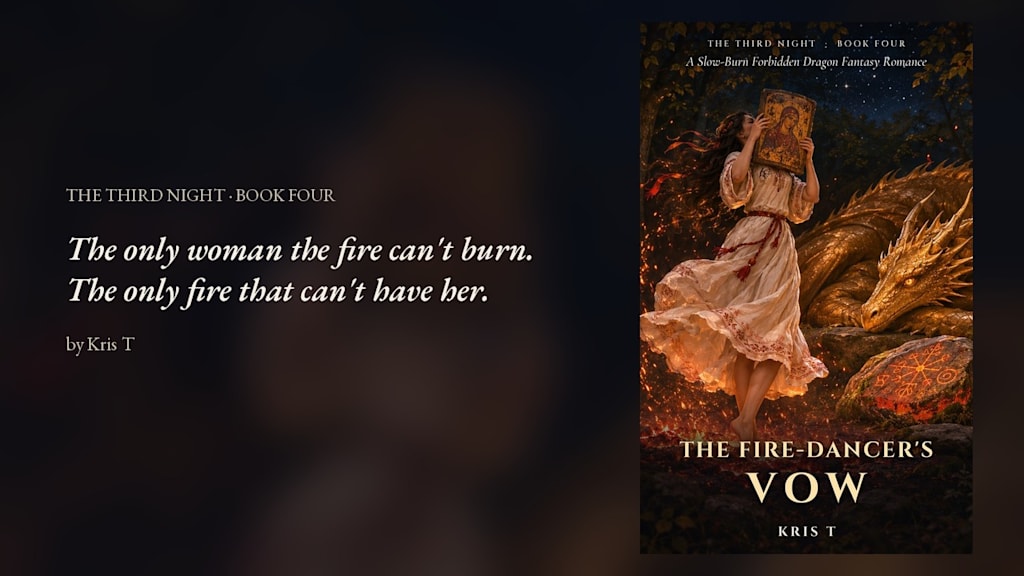
That idea, that the fire knows the feet of the people who dance on it and remembers what they promised, became the starting point for The Fire-Dancer's Vow, Book 4 of my series The Third Night, where a young keeper of the dancers' stone discovers that the vow she made may never have been hers to make.
Today some of these rituals draw visitors and cameras, and it would be easy to see them as performance. Spend time with the people who keep them, though, and a different picture appears. For the dancers the night is the end of weeks of preparation, fasting or prayer, and the walk itself lasts only seconds. What matters is the year of belonging that it seals. Communities that have lost almost everything else have kept this, because a shared promise is harder to take away than land or language.
Next time you see a midsummer bonfire, remember that for most of European history it was not decoration. It was a promise made to the fire.
Kris T is the author of The Fire-Dancer's Vow, Book 4 of the folklore romance series The Third Night.
About the Creator
Enjoyed the story? Support the Creator.
Subscribe for free to receive all their stories in your feed.
Comments
There are no comments for this story
Be the first to respond and start the conversation.