
The Clerk Who Mailed a Formula for Pi
In 1913, Srinivasa Ramanujan sent G. H. Hardy a page of numbers. One line computed pi faster than anything Hardy had seen. It took decades to learn why.
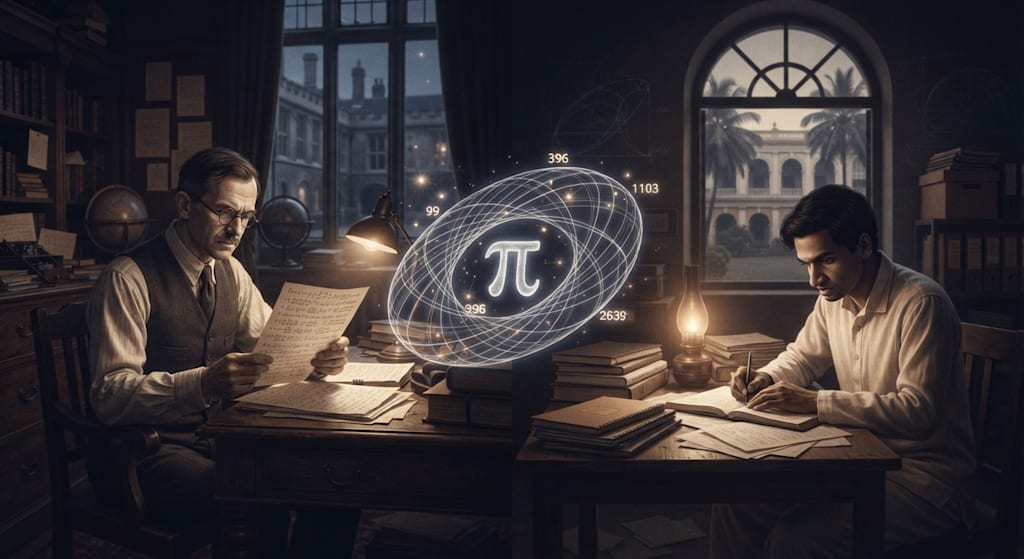
In 1913, a letter arrived in Cambridge from Madras. A clerk named Srinivasa Ramanujan had filled pages with mathematical results. Some were wrong. Some were already known. A few were unlike anything G. H. Hardy had seen.
One result was a method for pi. It was an infinite sum. Each term used factorials. A linear factor started at 1103 and increased by 26390. The denominator used 396 raised to the fourth power, then raised again for each term. A constant built from the square root of two and 99 squared multiplied the whole sum. When you added the terms, you got the reciprocal of pi.
Hardy checked it. The first term already gave many correct digits. The second term made it almost exact. A pocket calculator would stop showing new digits. The numbers 99, 396, 1103, and 26390 looked unrelated. They worked anyway.
Ramanujan said the goddess Namagiri wrote formulas on his tongue. Hardy did not believe in goddesses. He believed in Ramanujan’s genius. He brought him to England. They worked together. Ramanujan’s health failed. He returned to India. He died at thirty-two. The pi formula remained unexplained.
Mathematicians could verify it. They could not derive it. It stayed in notebooks for decades. Then mathematicians began to explain it.
The formula belongs to a family. Mathematicians call them Ramanujan-type series for the reciprocal of pi. They are not isolated tricks. They come from elliptic integrals. An elliptic integral measures the arc length of an ellipse. It has periods. Periods repeat in a certain way. These periods satisfy a relation called Legendre’s relation. That relation brings pi into the calculation. Pi appears because the periods are linked, not because someone inserted it.
Then comes a transformation called Clausen’s identity. It turns the square of a certain hypergeometric function into a triple hypergeometric series. That is where the factorial pattern comes from. The factorials follow from that function. They are not chosen by hand.
The numbers 99 and 396 come from a modular equation of degree twenty-nine. A modular equation is a kind of symmetry. It connects different shapes of elliptic curves. At a special point, the parameter becomes one over 99 multiplied by itself four times. That number is tiny. It is about one in a hundred million. That is why the series converges so fast. Each new term is smaller than the last by a factor of about a hundred million. The first term already gives many digits. The second term polishes the rest.
The numbers 1103 and 26390 come from the value and the derivative of the series at that special point. They are not guesses. They are coefficients. They adjust the series so that it equals the reciprocal of pi.
There is another way to describe this. It uses the j-invariant. The j-invariant is a single number that classifies elliptic curves. Ramanujan’s formula can be written in that language too. But for this formula, the natural language is fourth-order modular theory. The j-invariant version gives the Chudnovsky style series. Ramanujan’s series is a different coordinate system. Both are true. One is closer to the original.
This matters because it links pi to deep symmetries. It also gives fast algorithms for computing pi. The Chudnovsky brothers used similar ideas to compute billions of digits. Ramanujan’s formula remains a key example. It connects number theory, geometry, and analysis.
Ramanujan died young. He left notebooks that mathematicians still study. The pi formula is one line among thousands. It shows a mind that saw connections others missed. We can now explain the structure. The intuition behind it remains unexplained. No one knows how he chose those numbers.
The numbers 99, 396, 1103, and 26390 came together in one formula. They are not a coincidence. They are part of a structure. At the center of that structure is pi.
About the Creator
Jin
Writer of reamstories
https://reamstories.com/jin
Enjoyed the story? Support the Creator.
Subscribe for free to receive all their stories in your feed. You could also become a paid subscriber, letting them know you appreciate their work.
Comments
There are no comments for this story
Be the first to respond and start the conversation.