
The Cat Eye That Saved a Life and Now Helps Robots See
A foggy night in 1933 inspired reflective road studs. Decades later, engineers are copying cat eyes to build cameras for robots, drones, and self-driving cars.
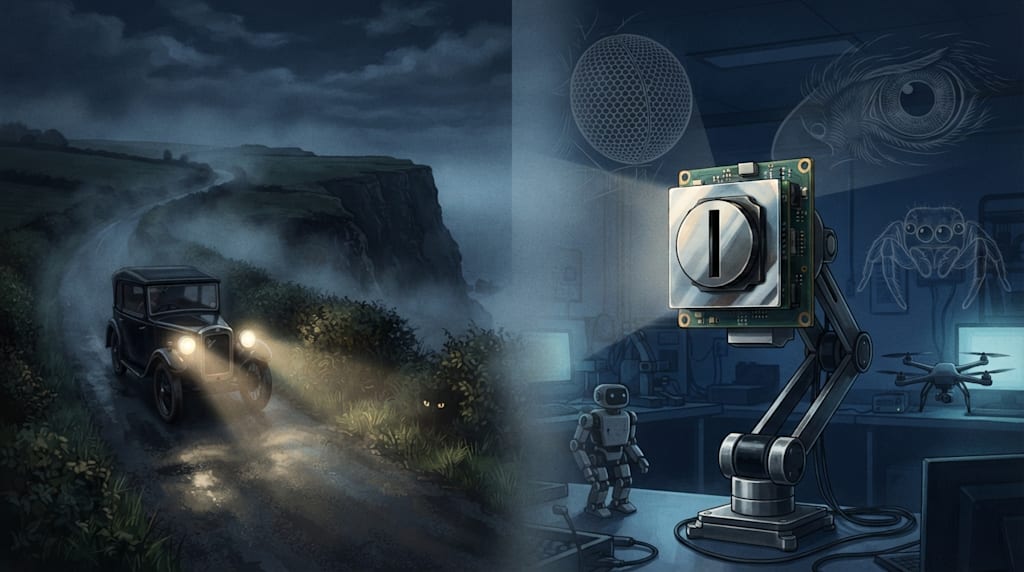
1933, England. Fog covered the road. Percy Shaw drove home. His headlights lit a short stretch ahead. Two points of light appeared at the roadside. He braked. The car stopped. He saw he was in the wrong lane. Ahead was a cliff. The light came from a cat’s eyes. The headlights hit them. The eyes sent the light back.
The story has been told many times. Some details have been smoothed. The result is clear. Shaw began testing glass beads. He did not talk about refractive index. He did not draw angle diagrams. He set glass beads into rubber pads and cast-iron housings. He placed them in the middle of the road. When headlights hit them, the beads sent light back to the driver. In Britain, people called them “cat’s eyes.” By the time Shaw died in 1976, about 15 million had been made. Variants are still on roads around the world.
The cat’s eye road stud has no retina, no pupil, no tapetum lucidum. It borrowed one action from that foggy night: send the light back.
Inside a cat’s eye is a layer called the tapetum lucidum. Latin for “bright tapestry.” It sits behind the retina. Brady Foote, a veterinary ophthalmologist at the University of Tennessee, says humans do not have this structure. Light enters a cat’s eye. If it misses a photoreceptor, it would be lost. At this reflective layer, light bounces back and gets another chance at a photoreceptor. At night, the cat’s pupil opens wide. More light comes in. More light bounces out. A person sees the eyes shine. The color can be orange, yellow, or green, depending on pigment in the tissue. Dogs, cats, horses, and cattle all have this layer.
The first lesson cat eyes gave engineers was how to give every beam of light another chance.
KAIST. Professor Young Min Song wanted a camera. For robots. For drones. For self-driving cars. It had to see in dim light. It had to pick a target out of a messy background. He looked at cat eyes.
The reflective layer in a cat’s eye is made of rod-shaped crystals containing riboflavin and zinc. Copying that chemistry is too hard. Song changed the material. He placed silver behind the image sensor. Silver reflects. Test result: visible-light absorption improved by 52%. In dim light, the sensor catches more of the light that would have leaked away.
For a robot, 52% has consequences. A night patrol robot moves down a warehouse aisle. The camera catches more reflection from the edge of a shelf. A self-driving car crosses a country road with no streetlights. The sensor picks out one more road sign. A robotic arm in a low-light factory sees the position of a black part. When light is scarce, catching more light makes the robot safer.
Song then looked at the cat’s pupil.
In bright light, a cat’s pupil narrows into a vertical slit. The shape helps a cat judge distance and lock onto prey among grass and branches. Song made a vertical aperture. He shot the same target with a round opening and a vertical opening. With the round aperture, the target was clear, and the background was clear too. With the vertical aperture, the target stood out, and background clutter fell back.
This test changes where the work happens. Modern computer vision can separate a person from a background. A phone’s portrait mode can blur the street behind someone. But that takes computation and power. Song moved part of the work onto the aperture. Before light reaches the sensor, it passes through a vertical pupil. The target is stronger and the background is quieter. The algorithm does less, so the robot reacts faster.
Right now, this aperture still has to be changed by hand. Song wants it to adjust itself like a cat’s eye. Bright light, pupil narrows. Low light, pupil opens. If that happens, a robot camera can change its eyes in different environments.
Song does not study only cat eyes.
He built a camera based on a fly’s compound eye. A fly has bulging eyes. They see in many directions at once. Wide field of view. Fast recognition of moving objects. A drone moving between buildings needs this kind of eye. A robot avoiding a person who appears suddenly needs it too.
He built a camera based on an eagle’s eye. The center of the field is sharp and magnified. The edge is wide but lower in resolution. When tracking a target, the center keeps detail. The edge keeps the environment. Like an eagle locking onto movement on the ground from high above.
He is now studying jumping spiders. A jumping spider has eight eyes. Front, side, and even back. The front eyes can judge depth with a single eye. A layered retina lets the spider jump accurately and not miss the target. Song thinks a camera built on the same principle could be used for tasks that need very high distance precision, such as missile guidance systems.
Song says you can think about which animal is best for a specific application.
That sentence shifts bionic cameras from appearance to function. Cat eyes fit low light and background filtering. Fly compound eyes fit wide fields and fast recognition. Eagle eyes fit sharp centers and wide edges. Jumping spider eyes fit precise distance measurement. Each task calls for a different eye.
Today, most cameras copy the human eye. That includes phone lenses, camera lenses, and surveillance lenses. The human eye is a familiar template. But robots do not live in a human environment. Robots go into warehouses, tunnels, farms, ruins, and night. They need cat eyes. They also need fly eyes, eagle eyes, and jumping spider eyes.
Back to Percy Shaw.
That foggy night, he saw cat eyes reflect light and stopped the car. Later, he put glass beads in the middle of the road. Later still, engineers put silver behind sensors, cut apertures into vertical slits, and put compound eyes, eagle eyes, and jumping spider eyes into lenses. That night in the fog led to a road stud, then to a lab, then to a robot’s lens.
In the lab, a silver reflector sits behind the sensor. The dark box closes. A test light turns on. Light enters, bounces back. On the screen, a target rises out of a messy background. Like the cat’s eyes in the fog, it flashes once.
About the Creator
Jin
Writer of reamstories
https://reamstories.com/jin
Enjoyed the story? Support the Creator.
Subscribe for free to receive all their stories in your feed. You could also become a paid subscriber, letting them know you appreciate their work.
Comments
There are no comments for this story
Be the first to respond and start the conversation.