
The Butterfly Effect Was Never About the Butterfly
A 1961 weather simulation, a rounded decimal, and the two-week limit that still shapes every forecast.
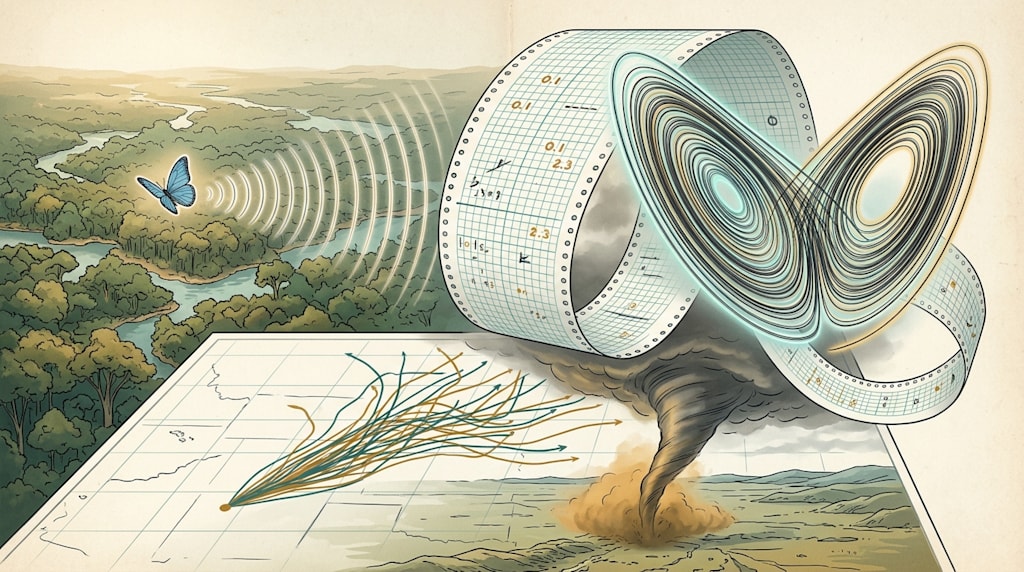
"Does a butterfly flapping its wings in Brazil set off a tornado in Texas?”
People quote this line everywhere. It shows up in management decks, motivational talks, and slogans about small actions changing the world. The usual reading: small cause, large effect. Butterfly flaps, storm arrives.
Meteorology says no. A butterfly’s wingbeat cannot cause a tornado. Lorenz posed that line as a question. He did not state a causal law. The metaphor explains how chaotic systems react to tiny differences in starting conditions.
The better question: why does a tiny initial difference get amplified inside a complex system, pushing two nearly identical paths toward different outcomes?
A Crude Computer in the Winter of 1961
The American meteorologist Edward Lorenz was in his laboratory, using a crude computer to simulate future weather. It was the early days of numerical weather prediction. Computers were weak. Models were coarse.
To save time, he rounded one initial value from 0.506127 to 0.506 and reran the calculation. The difference was about 0.000127, less than one-thousandth. By ordinary intuition, nothing should have happened.
The two runs started slightly apart. The gap grew. The final weather patterns differed sharply. Lorenz thought the computer had broken. He checked. The computer worked. The problem was the atmosphere.
In nonlinear systems like weather, small differences in initial conditions grow during the system’s own evolution. In 1963, Lorenz published Deterministic Nonperiodic Flow and laid out deterministic chaos. The word “butterfly” came later, in a 1972 lecture: Predictability: Does the Flap of a Butterfly’s Wings in Brazil Set Off a Tornado in Texas?
The butterfly effect began as a predictability problem. A vivid lecture title carried it into popular culture.
The Lorenz Attractor: Nonperiodicity in a Deterministic System
The familiar image shows two curves spiraling, approaching, separating, and forming butterfly-like wings. That is the Lorenz attractor.
The image shows nonperiodicity in a deterministic system. Given initial conditions and equations, the future can in principle be computed. The system is unstable. Tiny errors grow over time. Long-term trajectories become hard to predict. It is deterministic and unstable. Tiny errors grow over time.
Two starting paths may differ by a sliver. Evolution widens the sliver. After enough time, you cannot say which tiny disturbance caused a given outcome. Countless disturbances, nonlinear interactions, dissipation, saturation, and background flow all act at once. The butterfly’s wings are one unmeasurable disturbance. They may affect the path. Usually you cannot trace it or attribute it.
The effect describes how uncertainty grows. It does not promise that small things create big things.
A Butterfly Cannot Move a Tornado: The Energy Ledger
Literal question: can a butterfly’s wingbeat cause a tornado?
Energy first. A wingbeat releases about 10−210−2 joules, one-hundredth of a joule. A tornado’s kinetic energy can reach 10111011 to 10121012 joules. That is roughly tens to hundreds of tons of TNT, not hundreds of thousands. Hundreds of thousands of tons of TNT is 10151015 joules. The gap remains enormous.
Energy is not the only issue. Tornadoes need large-area instability, low-level moisture, strong vertical wind shear, and a trigger. Large-scale weather systems set those conditions. Tornado energy comes from solar heating of the ground, converted into atmospheric potential and kinetic energy. The butterfly sits outside that supply chain. It adds no moisture, no unstable stratification, no wind shear.
A tornado that will form will form with or without a butterfly. A tornado that will not form will not form because a butterfly flapped harder. If a butterfly disturbance gets amplified, the added energy comes from the background atmosphere. Lorenz said so. The disturbance may select one path among many. It does not power the storm.
A wingbeat does not create tornado energy. At most, in a critically sensitive system, it nudges the path left or right. Most of the time that influence is unmeasurable and untraceable. “A butterfly caused a tornado two weeks later” fails on causality. It also fails on correlation.
Why the Butterfly Effect Still Matters in Meteorology
The atmosphere is chaotic. Even a perfect model with a slightly wrong initial field can disagree with later weather. Observations have error. Data assimilation has error. Models have error. Computation has rounding error. Error always exists. Chaos erodes forecast accuracy. Long-range weather forecasts cannot be 100 percent accurate.
Two levels need separating. Day-to-day long-range weather forecasts hit a chaotic predictability limit around two weeks. Climate prediction is different. It leans on boundary conditions: external forcing, sea surface temperature, greenhouse gases, land use. It is not a stretched daily forecast. Chaos limits the initial-value problem. It does not make all climate information unpredictable.
Ensemble Forecasting: Put Uncertainty on the Table
Since forecasts cannot be perfect, meteorology stopped giving one answer. It gives a set of plausible answers.
Forecasters perturb the initial field into several slightly different starting states. They run all members. Each carries error. Results diverge. Typhoon track forecasts become a bundle of tracks. The bundle shows what the model considers possible.
Spread shows the range of atmospheric evolution. A tight cluster means a stable atmosphere and higher confidence. Wide spread means an unstable atmosphere and lower confidence.
Ensemble forecasting does not fight the butterfly effect or remove it. It displays uncertainty. Initial-field perturbations, model perturbations, and physics perturbations produce a probability distribution. It cannot erase initial error. It can show where error might take the system. Sometimes every member is wrong. The atmosphere has more disturbance space than any finite ensemble.
The Popular Misuse of “Small Cause, Large Effect”
The butterfly effect became shorthand for “small cause, large effect.” A tiny action gets amplified in a complex system and produces a huge result. That fits modern anxiety about uncertainty. Management, psychology, literature, film, success advice, and everyday warnings all use it. Do not ignore small things, the line goes, because you never know what they will do.
Many uses turn “sensitive to initial values” into “any small cause must produce a large effect.” That skips conditions. The system must be chaotic. The disturbance must enter the evolutionary chain. The error must grow. Growth must meet nonlinear saturation and dissipation. Not every small cause becomes a large effect. Often a small cause stays small. Dissipation averages it out. The background field swallows it.
The useful lesson is not “a small action can change the world.” It is “in a complex system, causal chains can be fragile, dispersed, and impossible to trace.” That should make us humbler about attribution. A storm has many causes. A result may have no single tiny starting point. The butterfly’s wingbeat is not the cause. It is one disturbance among countless others. Treating metaphor as causality creates cheap romance: find the butterfly, explain everything; or change everything.
Two Weeks
For years, forecasting aimed at accuracy: better instruments, finer models, more computing power. Chaos sets a predictability limit. Error is not only a technical problem. It belongs to the system. We cannot measure the initial field with infinite precision. We cannot make a flawless model. Error grows. Uncertainty accumulates.
Meteorology learned a sharper kind of knowing. Do not give one answer. Give the range of possible answers. Do not pretend uncertainty is absent. Measure it and express it. Ensemble forecasting embodies that approach. It stops asking “will it rain tomorrow, yes or no?” It asks “what is the chance of rain, where do members disagree, how confident is the forecast?”
A butterfly, a tornado, and a rounded number point to a simple fact: tiny disturbances deserve attention. The serious response is to measure them and quantify the uncertainty, then make honest judgments.
The butterfly effect’s lasting contribution is not the butterfly or the tornado. It is a limit on what we can know. The more we learn, the clearer that limit becomes.
Weather scales run about two weeks. After that, error grows as large as the signal. That is what the atmosphere tells us.
About the Creator
Jin
Writer of reamstories
https://reamstories.com/jin
Enjoyed the story? Support the Creator.
Subscribe for free to receive all their stories in your feed. You could also become a paid subscriber, letting them know you appreciate their work.
Comments
There are no comments for this story
Be the first to respond and start the conversation.