
The Bowl, the Ball, and the Fastest Way Down
Why the calculus of variations starts with a question your intuition gets wrong
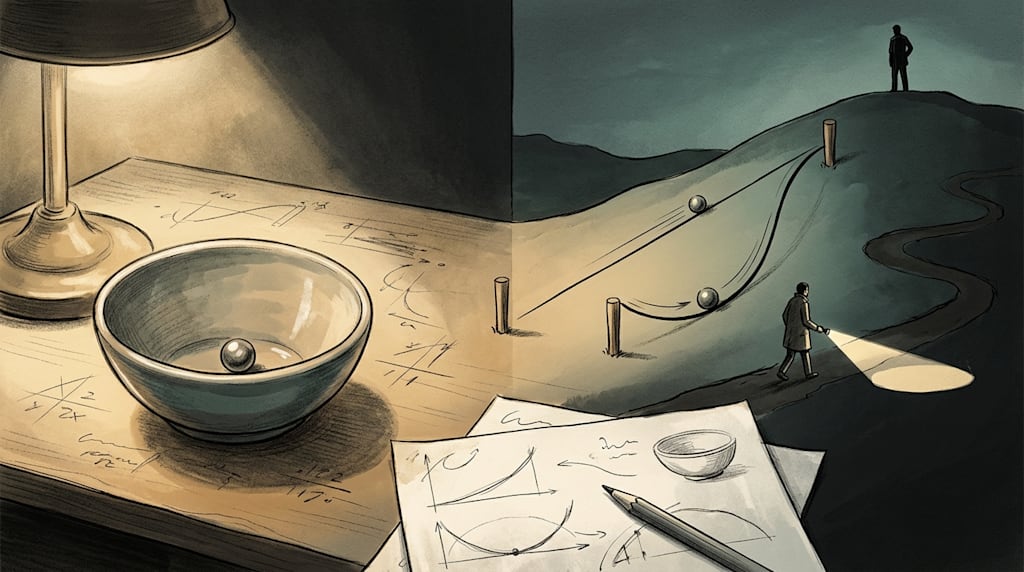
A small ball sits in a bowl. You let it go. It rolls, slows, and settles at the bottom. That bottom point is stable: the potential energy is lowest there. To find it, you take the derivative of the energy function and look for the place where the first-order change vanishes. The move is so familiar that we rarely ask what it compares. The derivative checks nearby values. Move a tiny distance away. Does the function rise or fall? When the first-order change is zero, you have a stationary point.
Now change the question. A ball slides from one point to another in a gravitational field. Which track gives the shortest travel time?
Intuition says a straight line. A straight line is the shortest path, so it should be fastest. That intuition fails. A straight line gives a constant slope and steady acceleration. A curve that starts steep and then flattens lets the ball gain speed early. The extra speed can more than pay for the longer path. The two effects compete. The winner is not obvious.
This is the brachistochrone problem. Johann Bernoulli posed it in 1696. The answer is a cycloid. Galileo guessed a circular arc. He was wrong.
The answer matters less than the shape of the question. The unknown is a whole curve. You compare entire routes. For every route, you can compute a total travel time. You want the route that makes that total time smallest.
That is the problem type the calculus of variations was built to handle. The mental move matches the bowl problem. The object changes from a point to a path.
What a functional does
In ordinary calculus, a function takes a number and returns a number. Give it a position; it gives you a height. Compare heights. Find the low point.
A variational problem is stranger. Give the rule a whole curve; it returns one number. That number might be total time, total length, total energy, or total action. The rule takes a function and returns a number. That makes it a functional.
For the brachistochrone, the rule is total time. Feed it a straight line; it returns one number. Feed it a circular arc; it returns another. Feed it a cycloid; it returns a smaller number than either. The task is to find the curve that makes the returned number stationary.
The brachistochrone works as an entry point because you can see it. Draw several curves between the same two points. Imagine the ball sliding down each one. The answer is a shape. Once that lands, a functional stops being an abstraction. It becomes a scoring rule for routes.
The derivative of a path
Ordinary differentiation compares a function at a point with its value at a nearby point. The derivative measures the first-order change. When that change is zero, the point is stationary.
Variation does the same thing for a whole path. Take one candidate curve. Nudge the entire curve a little. Keep the endpoints fixed, because the ball still starts and ends in the same places. Compare the total time of the nudged curve with the total time of the original. If the first-order change is zero for every allowed nudge, the original curve is stationary.
That is the idea. The derivative of a function becomes the variation of a functional. A stationary point becomes a stationary path. The first derivative vanishes; the first variation vanishes.
For the brachistochrone, you write the total time as an integral along the curve. You vary the curve and demand that the first-order change disappear. Integration by parts turns that demand into a differential equation for the curve. The equation is the Euler-Lagrange equation. Its solution is the cycloid.
The integration is routine. The viewpoint shift is the work. Stop asking which number to choose. Start asking which whole function to choose. Once that shift happens, the rest is technique.
Newton looks at the next step
The calculus of variations matters in physics because of least action.
Newtonian mechanics rests on a differential equation. Give initial positions and velocities. The motion unfolds step by step. At each moment, force sets acceleration. Acceleration changes velocity. Velocity changes position. The view is local. It is like walking at night with a flashlight that lights only the next step. You move forward one step at a time.
Least action takes another view. Among all possible paths between two times, the actual path makes the action stationary. Action is a total quantity, computed along the whole path. The view is global. It judges the entire route at once. The question is which route has a special overall property. It is like standing on a hill and looking down at all possible routes, then choosing the one that satisfies a condition on the whole.
The two views look incompatible. Newton’s view is local and stepwise. Least action judges the entire route at once. For mechanical systems, they are two languages for the same structure. Take the Lagrangian as kinetic energy minus potential energy. Demand that the action be stationary. The resulting Euler-Lagrange equation is equivalent to Newton’s second law. The global principle selects the whole path. The local equation describes the step-by-step evolution. They agree.
This matters because it shows what a good physical theory often does. It keeps the old theory and reorganizes it at a different level. Newton tells you how to take the next step. Least action tells you why the whole path is the one it is. One is a microscope. The other is a map. To understand motion, you need both.
Why textbooks hide the motive
Many textbooks lay out the calculus of variations in a clean order. Define a functional. Define the variation. Derive the Euler-Lagrange equation. Put the brachistochrone in the examples. The logic is complete. The formalism is correct. The student may finish the chapter able to compute without knowing why the subject exists.
The motive is missing. The textbook says a functional is a mapping. It does not say why anyone needed to invent such a thing. It says the variation is the first-order change of a functional. It does not say why ordinary differentiation is not enough. The brachistochrone sits in the exercises instead of at the beginning. The student misses the moment when the new tool becomes necessary.
A better order starts with the problem. Start with the brachistochrone. Let the student feel the difficulty: I want to minimize total time, but I do not know how to differentiate with respect to a whole curve. That difficulty is concrete. Then introduce functionals and variations. Now the language has a job.
Analogies are scaffolding. Understand variation as the derivative of a path by comparing it with the derivative of a function. Understand least action as a global selection principle by comparing it with Newton’s local evolution law. Once the scaffolding is stable, go back and fill in the definitions. Learning is not built in one pass. Understanding is not either.
After you close the book
You close the book. On the desk is a sheet of scratch paper. You have drawn two curves between the same two points: a straight line and a cycloid. The straight line is shorter. The cycloid is faster. You look at them for a moment.
Then you pick up a pencil and compare them in your head. You imagine the ball on the straight line, gaining speed at a steady rate. You imagine the ball on the cycloid, dropping steeply at first, picking up speed quickly, then using that speed on the shallower part. The trade-off is visible in the shapes. No formula needed.
In the corner of the paper, you have drawn a small bowl with a ball at the bottom. It is the same picture you started with. A derivative finds the bottom of the bowl. A variation finds the fastest path between two points. One is about a point. The other is about a route. The old idea is still there. It has grown a larger view.
About the Creator
Jin
Writer of reamstories
https://reamstories.com/jin
Enjoyed the story? Support the Creator.
Subscribe for free to receive all their stories in your feed. You could also become a paid subscriber, letting them know you appreciate their work.
Comments
There are no comments for this story
Be the first to respond and start the conversation.