
The Bowl of Blood by Your Bed Won’t Stop Mosquitoes. Here’s What Will.
A mosquito follows breath, heat, and skin odor. A still bowl offers none of them. That is why the bedside trick fails, and why the net works.
The Bowl of Blood by Your Bed Won’t Stop Mosquitoes. Here’s What Will.
The worst summer-night sound can be the dog downstairs or the air conditioner outside. Usually it is the “bzzz” by your ear. You turn on the light, and it is gone. You turn off the light and lie down, and it comes back.
So someone thinks: mosquitoes love blood. If I put a bowl of blood by my bed and let one drink its fill, will it stop biting me?
No. The bowl will not save you, and it may add new trouble.
1. Mosquitoes look for you, not a bowl of blood
Many people stop at four words: mosquitoes love blood. A mosquito does not see a bowl of blood, and it does not smell that the blood is sweet. It reacts to signals from living people and animals: carbon dioxide, body heat, skin odor, chemicals in sweat, humidity, and clothing color.
A bowl of still blood has no breathing, no body heat, and no skin volatiles. It will not fly over, drink its fill, and leave you alone. More likely, it will not notice the bowl at all. It will follow your breath and odor and land on your arm.
Only female mosquitoes bite people. Males live on plant nectar, fruit juice, and liquids from stems and leaves. Females bite to get protein for reproduction. Flavor has nothing to do with it. The bowl by your bed has no temperature, no carbon dioxide, and no human skin odor. It makes a poor decoy.
2. How a mosquito locks onto you
A mosquito’s search works like a multi-step tracking process.
Step one: it senses carbon dioxide. You breathe out, the airflow spreads, and the mosquito turns along the concentration gradient and flies toward you. Entomologists at the University of California, Riverside, studied female Aedes aegypti mosquitoes, which spread yellow fever and dengue. These mosquitoes first respond to exhaled carbon dioxide, then fly toward skin odor, then land on the body.
Step two: it senses body heat and humidity. A person is a heat source. The stable temperature and humidity near the skin work like a lamp.
Step three: it reads skin odor. Lactic acid, uric acid, ammonia in sweat, and volatiles from skin microorganisms all signal “there is a meal here.”
Mosquitoes do not use a blood-type radar. Existing research has no reliable evidence that different blood types differ in how attractive they are to mosquitoes. “Sweet blood” is folk belief, not a scientific conclusion.
3. Which people attract more mosquitoes
Mosquitoes do not pick blood types, but some people attract more bites.
Pregnant women have a faster metabolism, exhale more carbon dioxide, and may run a little warmer. She sits on the sofa, a thin blanket over her knees, a half-finished glass of milk by her feet. A mosquito circles her calf. She swats and misses.
Children have faster metabolisms than adults, move more, and produce more skin secretions. Beside the slide, a child in shorts runs around and comes back with two red spots on one knee. He does not feel them yet and keeps digging in the sand.
People who exercise sweat more. Their skin releases lactic acid, uric acid, ammonia, and other substances, and skin temperature and humidity rise. Mosquitoes have sensitive odor receptors and pick up these smells. You finish a run, sit by the road, and tie your shoelace. One lands on your ankle. You reach for it, and it flies off. After exercise you also breathe faster and exhale more carbon dioxide, which makes you more attractive.
4. Clothing color can make you more attractive
Dark clothes look slimming. They can also bring more mosquitoes.
Mosquitoes prefer dim light. Dark clothing reflects less light. Light clothing reflects more. Dark clothing also absorbs heat, and a warmer body sweats more easily.
You stand in the garden in a black T-shirt for five minutes and get three bites on your ankle. On the day you wear a white shirt, you get one. In mosquito-heavy places, skip black, dark blue, and dark red. Wear long sleeves and long pants. You lose a little style. You gain fewer bites.
5. Why a bite itches
A mosquito injects saliva into your skin. The saliva contains proteins. Your body recognizes foreign proteins and releases histamine. Histamine causes the itch and swelling.
The mosquito injects saliva. Your immune system answers with histamine. That response causes the itch.
After a bite, wash the area with alkaline soapy water to help prevent redness and swelling. For a swollen area, wrap ice in a towel and apply it cold. For itch, use calamine lotion. On the third shelf of the pharmacy, a white bottle. Shake it, dip a cotton swab, and apply. It feels cool. A child reaches to scratch, and you hold his hand down. Calamine has no hormones. For a baby, ask the pharmacist about the amount.
6. What keeps mosquitoes away
Physical methods include mosquito nets, electric swatters, palm-leaf fans, and long sleeves and long pants. A mosquito net looks old-fashioned and works. An electric swatter is simple. Long sleeves and pants are hot, and they help in mosquito-heavy places.
Mosquito-killing lamps come in different types. Some have a small fan that sucks mosquitoes in. Some release carbon dioxide or other odors as bait. Some use a heated lamp tube to mimic body temperature. These lamps carry some risk. Families with children should place them high. For photocatalyst lamps, turn them on two hours before use and leave the room.
Chemical repellents: the U.S. Environmental Protection Agency, the U.S. Centers for Disease Control and Prevention, and Health Canada list DEET, picaridin, IR3535, lemon eucalyptus oil, PMD oil, and methyl nonyl ketone as effective ingredients. Higher concentrations usually last longer. For young children, choose a low concentration. Pregnant and breastfeeding women can use repellent after an allergy test.
7. Pour out the bowl
Back to the question: will mosquitoes still bite you if you put a bowl of blood by your bed?
Yes. A mosquito wants a living target that breathes, gives off heat, sweats, and has skin odor. The bowl has no carbon dioxide, no body heat, and no skin volatiles. It cannot block bites. Left out, it may breed bacteria and attract other insects.
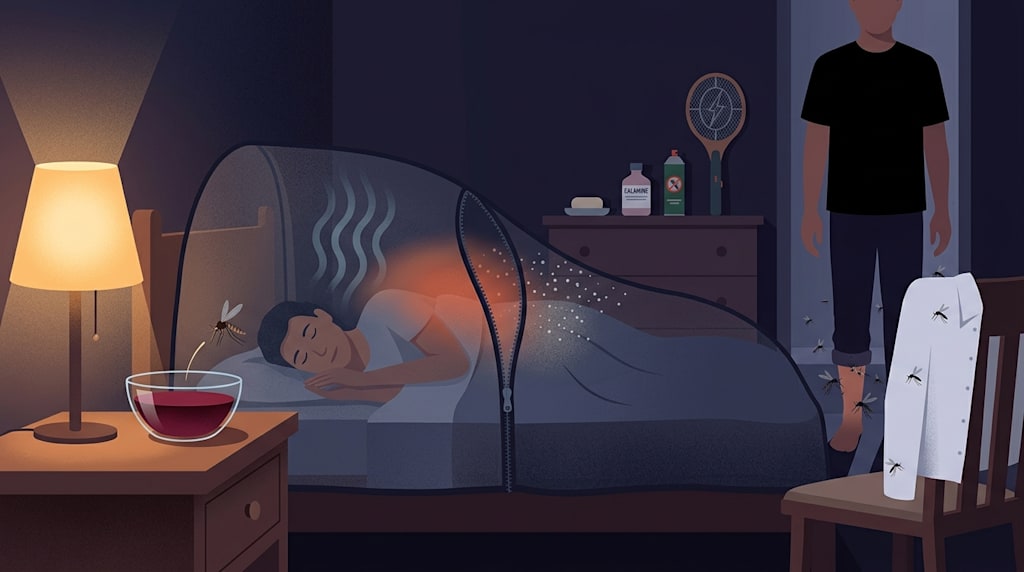
The bowl sits on the bedside table. A film forms on the surface. You carry it out and pour it away. You come back, hang the net, and zip it. The mosquito circles outside and lands on the mesh. You turn off the light. You hear it. It is outside. You are inside.
The net, long sleeves, effective repellent, and the zip you close after lights out do the work. The bowl does nothing.
About the Creator
Jin
Writer of reamstories
https://reamstories.com/jin
Enjoyed the story? Support the Creator.
Subscribe for free to receive all their stories in your feed. You could also become a paid subscriber, letting them know you appreciate their work.
Comments
There are no comments for this story
Be the first to respond and start the conversation.