
The body in the lab was once someone’s father
A revised rulebook can close a case. It cannot teach a student to bow.
The previous notice did not calm the argument. The school has now added a response about management. That response says what needed to be said. The rules themselves are old. Many were already on paper. The effects reach beyond one school. Every medical school will face follow-up inspections, corrections, and teaching reviews.
The harder question remains. With VR, 3D modeling, and AI tools in wide use, why do medical schools still need human specimens? And when students learn to treat the body as a set of structures to open, label, and practice on, why should ethics stay in the room?
Start with what technology can do. A 3D printed skull can teach bones, foramina, and landmarks. Digital anatomy can quiz a student on the same points. A multi-material model can train a suture, a needle stick, a drill. These tools work. They save time. They let students repeat a movement until the hand remembers it.
Then the training gets harder. A body on the table is not a standard diagram. Tissue layers vary. Vessels run where the atlas says they should not. Nerves sit close to structures that matter. Fascia has a feel that no screen gives you. A model can train a motion. A body teaches a student to recognize what is in front of them.
That gap is where ethics has to enter. If a student only learns to see a specimen as material, the person behind it disappears. A school can rewrite a policy. A policy can set a boundary and punish a violation. A policy cannot make a student understand why the boundary exists.
Awe does not arrive by notice.
In August 2022, Soochow University held a farewell ceremony for a body donation. The donor was a 51-year-old father. He and his wife ran a hardware store. His son was studying at Soochow University Medical College.
The father had little schooling. When his son got into university, he was happy. He told his wife he wanted to go to Soochow University too. She laughed and said he had probably missed his chance.
He had already found another way.
He died of heatstroke in August 2022. His family followed his wish and donated his body to the medical school his son attended. After the ceremony, his wife, Xu Weiwei, signed up as a body and organ donor.
A man spent half his life raising a son. Then he went to college with him in the only way left.
At Nanjing Medical University, another donor had once been a student in the room.
In 2011, a young woman from a rural family in Jiangsu entered the nursing program. Two months later, she was diagnosed with advanced melanoma. She died a year later. Before she died, she asked that her body go to her school. She wanted her experience to help research. She wanted later students to learn from her.
She never finished her degree. Her story is still kept in the school’s medical ethics hall. Anatomy classes hold a moment of silence for body donors.
One person left school before she could finish. Then she stayed.
I had heard stories like these before. One ceremony made the weight concrete.
I was new to the hospital and unhappy. I felt like the bottom of the hospital chain. Every task landed on me. The shifts were long. The families were sometimes angry. Online, everyone had a complaint. I began to think my work meant nothing. A senior colleague saw me sulking. A body donation ceremony was scheduled that day, and each department had to send someone. She said I should go and take a break. I went because I thought it would be short.
On the bus, I was half asleep. I complained about the distance. Then I walked into the room and woke up.
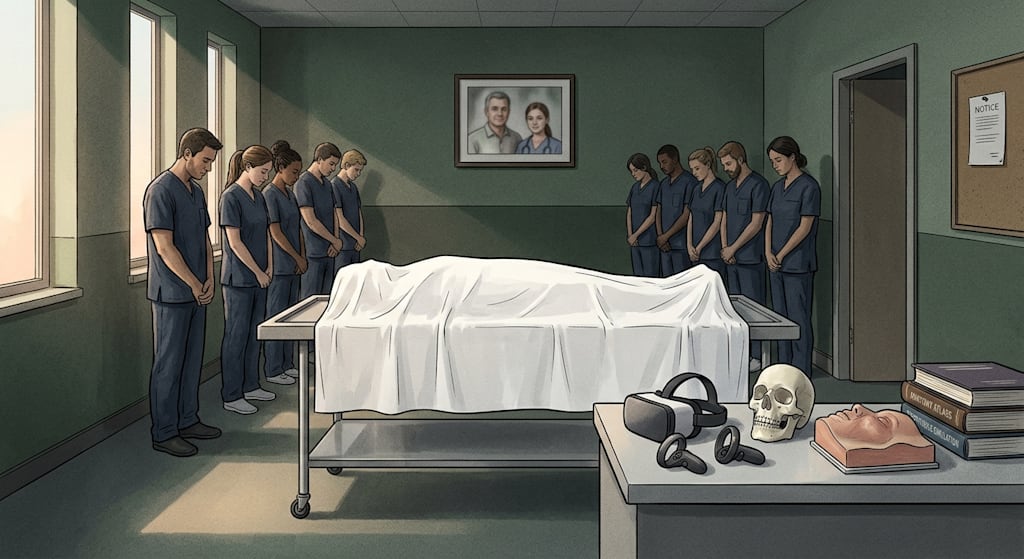
The room was quiet in a way that made noise feel rude. Teachers and students stood in lines. People bowed. Each person bent low, paused, and rose. Then they walked to the front and placed a flower. The family cried, but the tears were different from the ones I saw in the ward. There was relief in them. There was comfort.
I had seen the ICU. It made me feel helpless. This room made me feel something else. The donor had trusted doctors. The doctors had made a promise back.
The donor was a woman from Rui’an, Zhejiang. She had malignant melanoma. She went through four rounds of chemotherapy and two rounds of radiation. The treatment did not save her. During her illness, strangers raised money and helped her. She decided to leave her body to medicine.
Some people use the end of their life to light a path for others. They are few. Their weight is heavy. They trusted medicine when they had little reason left to trust anything.
I thought about my complaints. They felt small.
I had spent enough time in hospitals to think our work only delayed the inevitable. Then I walked through the human science museum. I saw charts on the wall. I saw specimens in preservative. I felt the opposite of despair. People had kept working on this problem for generations. That work was still in the room.
My anatomy teacher said something in the first class that I still remember. He said we were not only standing on the shoulders of giants. We were learning from ordinary people.
Some of them had bad luck. They still expected something from medicine. They were a small number among millions. They gave their bodies to students they would never meet. That trust asks for care.
So yes, the school should revise its rules. But the work cannot stop at punishment. Ethics needs to come before the first cut. It needs donor stories, a moment of silence, respect for donor records, consequences for violations, and training for teachers. It also needs public responses that do not blame every medical student for one person’s act.
Rules can constrain behavior. They cannot teach awe.
One student makes a mistake, and the whole group carries the shame. Most medical students do not have a public platform. They will not become famous department directors overnight. They study, take exams, do internships, and work night shifts. The ones who make the news are few. The people I met in medicine were mostly quiet, steady, and tired.
Many had no medical family behind them. They got into medical school through their own work and their family’s sacrifice. They do not talk much about what it cost. They do not have a list of achievements to perform.
Ordinary is the base of this profession. Silence is how many people survive it.
The body donors were ordinary too. Some were parents. Some were students who once sat in the same classrooms. One family sent a child to medical school. Another person gave their body to a medical school. We study structure from a book. The donor in front of us had a life outside the book. They worried about money. They thought about family. They left things undone.
The medical oath has eight words: health entrusted to us, life entrusted to our care. That promise is made to patients. It is also made to the people who donate their bodies. Technology will keep improving. Models will look better. Digital anatomy will spread. Medical education still has to teach students to see a person.
A notice can close a case. It cannot teach a student to bow.
About the Creator
Jin
Writer of reamstories
https://reamstories.com/jin
Enjoyed the story? Support the Creator.
Subscribe for free to receive all their stories in your feed. You could also become a paid subscriber, letting them know you appreciate their work.
Comments
There are no comments for this story
Be the first to respond and start the conversation.