
The 3-second UFO claim that falls apart at the division stage
A black triangle supposedly crossed 2.4 kilometers in 3 seconds. The speed is the least interesting problem.
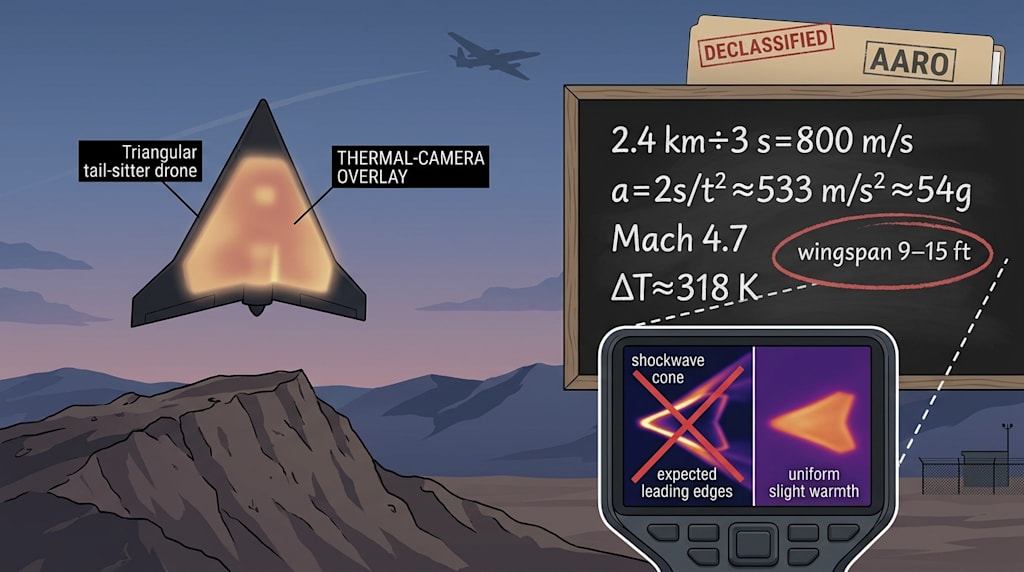
2.4 kilometers in 3 seconds. Average speed: 800 meters per second, or Mach 2.35.
That number is not absurd for a fighter jet. An F-15 can dash to about Mach 2.5. But it gets there by accelerating the whole way, and it has exhaust, intakes, shock waves, and heat signatures. It also does not go "absolutely silent" a few kilometers from an observer. The reported object, by contrast, supposedly starts from a hover and covers 2.4 kilometers in 3 seconds. Speed is only the first issue.
1. 54g is not even the most absurd part
Assume it starts from zero and accelerates uniformly, covering 2,400 meters in 3 seconds. The acceleration works out to about 533 meters per second squared, or roughly 54g.
A fighter pilot in a g-suit tops out around 9g. In 1954, John Stapp endured 46.2g on a rocket sled and suffered temporary blindness, fractures, lost teeth, and a hernia. For an unmanned structure, 54g is not impossible; short-duration high acceleration is an engineering discussion.
But under the uniform-acceleration assumption, the final velocity is about 1,600 meters per second, or roughly Mach 4.7. The report says "Mach 2.35," which treats average speed as flight speed. If you take "starts from hover, covers 2.4 kilometers in 3 seconds, uniform acceleration" literally, the terminal speed is close to Mach 4.7. The simplification is already wrong at this step.
So the first conclusion: if this dataset is a strict measurement, it is anomalous enough to deserve serious study. But "anomalous" does not equal "alien." More likely, the data was not measured. It was estimated.
2. Heat and shock waves do not cooperate with the performance
At an average speed of 800 meters per second, the air compressing at the nose produces a stagnation temperature rise of roughly 318 kelvin, or over 300 degrees Celsius. At a terminal speed of 1,600 meters per second, the rise is about 1,270 kelvin. The nose leading edge and wing leading edges would show obvious hot spots. A thermal imager should see a blazing leading edge, not "the whole body uniformly slightly warm, just above ambient." The reported "uniform slight warmth" looks more like a matte-black object that has been sitting in the sun.
The same goes for shock waves. At Mach 2.35 at low altitude over a ridge, a sonic boom is unavoidable. Terrain, direction, and a short acceleration distance can complicate how the boom propagates, but "absolutely silent within a few kilometers" barely holds up physically. An object can be quiet, but it is hard to simultaneously have no exhaust, no navigation lights, no sonic boom, and no hot spots. These are not independent decorations. They all point to the same question: where did the energy go?
3. The 2.4-kilometer figure has a measurement problem
A single thermal-imaging station can measure angular position, angular velocity, and infrared radiation. It cannot directly measure range. To know how far it flew, you first need to know how far away it is. To know how far away it is, you first need to know how big it is. The report says the target had a "wingspan of 9 to 15 feet." The later range and speed were likely derived from that first prior estimate. If the prior is off by a factor of two, the speed is off by a factor of two.
This is the classic observation loop: you do not know how big it is, so you do not know how far away it is; you do not know how far away it is, so you do not know how fast it is. Single-station optical or thermal observation gives angular change, not absolute scale. Breaking the loop requires synchronized multi-station ranging, laser ranging, radar data, or at least two observation points with a known baseline. If the report has none of these, "2.4 kilometers" is most likely an estimate with assumptions baked in.
Add a matte-black target, a dive into a canyon, and a background that shifts abruptly from sky to dark hillside, and tracking becomes easy to lose. At the moment the target merges into the background, human eyes and thermal imagers can both produce the illusion that "it suddenly disappeared." The observers were excited and tense; their mental timing of "3 seconds" is also unreliable. Three seconds may just be a literary expression of "it felt very fast." Stack these errors together, and an ordinary high-speed target can be imagined into "instant acceleration and disappearance."
4. The ready-made answer explains half of it
If you take only the qualitative features, vertical climb, hover, transition to level flight, low noise, matte black, black delta wing, and uniformly slight warmth across the body, there is a ready-made answer on the market: a tail-sitter flying-wing drone.
This type of drone takes off nose-up, climbing vertically like a helicopter, then pitches over at altitude and becomes a fixed-wing aircraft in cruise. Its power comes from electric motors and propellers, essentially inaudible a few hundred meters away. A matte-black coating left in the June sun for a while will be uniformly above ambient temperature, which is exactly what a thermal imager would read as "uniform slight warmth." Delta wing, vertical takeoff and landing, transition to level flight: none of this requires alien technology.
But an ordinary tail-sitter drone flies at tens of meters per second. It cannot cover 2.4 kilometers in 3 seconds. So this ready-made answer explains the shape and thermal signature, not the absurd speed. Conversely, if the shape, thermal signature, and silence all look more like a drone, while the speed data is absurd enough to imply 54g, Mach 4.7, no hot spots, and no sonic boom, then the most reasonable inference is severe distortion in the speed and time data.
5. UFO history has written this script before
A 1997 CIA historical study noted that, according to later estimates by project officials, more than half of American UFO reports in the late 1950s and 1960s could be explained by secret reconnaissance aircraft such as the U-2. High-altitude reconnaissance aircraft flew high and fast; test pilots and witnesses did not know what they were looking at, and "unidentified flying objects" were born.
The AARO 2024 historical report is more direct: no verifiable evidence has been found that the U.S. government or private companies have encountered alien technology. This leaves open the possibility of aliens in the universe. At the level of these reports, however, there is no verifiable evidence of alien technology.
The phrase that carries the most information is "near a secure facility." The "2.4 kilometers" figure gets the attention, but the location does more work. A drone loitering around a sensitive facility is either something the U.S. military is testing itself, or something someone else sent to reconnoiter, harass, or test reactions. Aliens are a weaker fit. The thing looks increasingly like something we built ourselves: black delta wing, vertical takeoff and landing, low noise, uniform infrared signature.
6. The claim should stay uncertain
Back to the opening claim: silent hover, 2.4 kilometers in 3 seconds. The claim is uncertain, and physically it should stay uncertain. If this dataset is a strict measurement, it is anomalous enough to deserve serious study. But more likely, it is a rough estimate in a secondhand account, treated as precise data and then calculated until it looks like alien technology. The 2.4 kilometers may come from a size prior. The 3 seconds may come from mental timing. The absolute silence may come from distance and background illusion. The uniform slight warmth may come from a matte-black surface heated by the sun. Each link looks reasonable on its own. Together, they manufacture a physically self-contradictory UFO story.
The scientific attitude here is to interrogate the measurement chain: How was the range measured? How was the size determined? Who timed it? Is there multi-station data? What were the thermal imager's parameters? Is there a shock-wave record? If none of these exist, it is a good story backed by weak evidence.
As for whose drone it is, that may have to wait for the next batch of documents. Given American secrecy habits, that could take many years. Before then, finish the division: 2.4 divided by 3.
About the Creator
Jin
Writer of reamstories
https://reamstories.com/jin
Enjoyed the story? Support the Creator.
Subscribe for free to receive all their stories in your feed. You could also become a paid subscriber, letting them know you appreciate their work.
Comments
There are no comments for this story
Be the first to respond and start the conversation.