
The 2026 Nobel Prize in Medicine Has Two Clear Lanes. One Is a Weight-Loss Drug.
GLP-1 is the favorite. Orexin, optogenetics, Rett syndrome, and local protein translation are all waiting in the neuroscience lane.
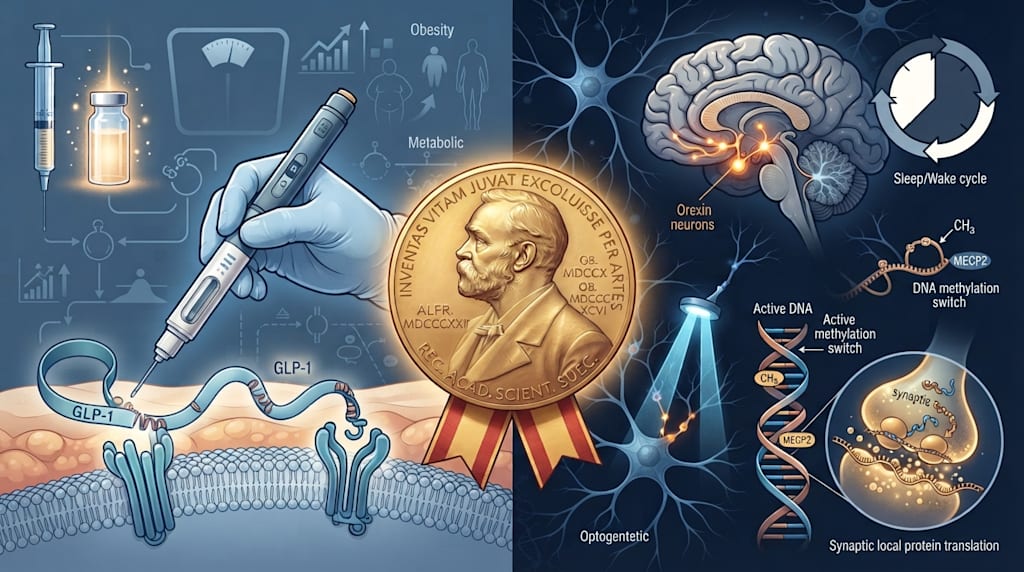
The 2026 Nobel Prize in Physiology or Medicine will be announced on October 5. This year's award indicators point in two directions. In clinical medicine, GLP-1 research is the leading candidate because of its global clinical impact. In neuroscience, orexin, optogenetics, Rett syndrome, and local neuronal translation form four parallel tracks.
1. Indicators: Five Prizes Draw Two Main Lines
The Clarivate Citation Laureates gave its physiology or medicine honor to Daniel Drucker, Jens Juul Holst, and Svetlana Mojsov. The citation reads: "for the discovery and identification of glucagon-like peptide-1 (GLP-1) and the systematic elucidation of its biological activity." The award uses highly cited papers and has a strong record in Nobel prediction.
The Lasker Basic Medical Research Award went to Emmanuel Mignot and Masashi Yanagisawa. They discovered orexin, a brain peptide that maintains wakefulness, and showed that orexin deficiency can cause narcolepsy. The Lasker Awards have a strong record in basic medicine.
The Kavli Prize in Neuroscience went to Christine Holt, Kelsey Martin, Erin Schuman, and Oswald Steward. They discovered local protein translation in neurons. The Kavli Prize and the Nobel Prize overlap in neuroscience. O'Keefe, the Mosers, David Julius, and Ardem Patapoutian all won the Kavli before the Nobel.
The Horwitz Prize awarded two groups this year. One group is Adrian Bird and Huda Zoghbi, for work on epigenetic regulation in the nervous system and Rett syndrome. The other group is Karl Deisseroth, Peter Hegemann, and Gero Miesenböck, the three founders of optogenetics. The Horwitz Prize split into two groups shows how crowded neuroscience has become.
2. Clinical Medicine: GLP-1 Has a Complete Chain and One Variable
The GLP-1 story began in the 1980s. Joel Habener cloned the proglucagon gene at Massachusetts General Hospital. He found that the gene also encodes an unknown molecule, GLP-1. Around the same time, Svetlana Mojsov independently identified the active form of GLP-1 at Rockefeller University. With Habener, she proved it is a hormone. Denmark's Jens Juul Holst developed a reliable radioimmunoassay. He confirmed that GLP-1 is secreted by the gut and independently discovered that it stimulates insulin release. Canada's Daniel Drucker then mapped the physiological functions of GLP-1. That work laid the molecular foundation for drug development.
The discovery led to GLP-1 receptor agonists such as semaglutide. About 900 million adults worldwide have obesity. Prevalence is 40% in the United States and close to 25% in Europe. GLP-1 drugs are the first safe and effective pharmacological intervention. David Pendlebury, research director at Clarivate, said: "GLP-1 has had a huge impact in global clinical use, and the clamor is extremely high."
The variable is that Joel Habener died in December 2025. The Nobel Prize is not awarded posthumously. If GLP-1 wins, the most likely three-person combination is Drucker, Holst, and Mojsov. That is exactly the Citation Laureates list.
Mojsov's situation is worth a separate look. Her contribution was long underrecognized. A 2023 Science article headline said: "Her work paved the way for blockbuster weight-loss drugs. Now she is fighting for recognition." Since then, she has received the King Faisal Prize in Medicine, the Broermann Medical Innovation Award, and the Elaine Redding Brinster Prize. All three excluded Holst and Drucker. Award committees are compensating her. As a female scientist, she also fits the Nobel's recent trend of more female laureates.
Judgment: GLP-1 is very likely to win. The most likely combination is Drucker, Holst, and Mojsov.
3. Neuroscience: Four Tracks, One Finish Line
Neuroscience is a frequent Nobel category. Historically, it comes around every four to five years. With GLP-1 likely to take clinical medicine, neuroscience is almost certain to form the other main line. The question is which direction.
Orexin: Lasker Boost, Strongest Momentum
Mignot and Yanagisawa began on two independent paths. Yanagisawa was studying orphan G protein-coupled receptors at UT Southwestern Medical Center. He purified a brain peptide. He first thought it was related to hunger and named it orexin. Mignot was studying the genetic cause of narcolepsy in dogs. Through forward genetics, he traced it to a defect in orexin receptor 2. The two lines converged on one signaling pathway. Orexin deficiency is the core cause of narcolepsy.
The discovery explained narcolepsy and drove the development of orexin receptor antagonists such as suvorexant for insomnia. The 2026 Lasker Basic Medical Research Award moved this pair from long discussed to most likely to be honored this year in neuroscience. The two already shared the Citation Laureates and the Breakthrough Prize in Life Sciences. Their award chain is complete.
Optogenetics: Longtime Favorite, Uncertain Timing
The optogenetics work of Karl Deisseroth, Peter Hegemann, and Gero Miesenböck has been in Nobel discussion for years. Hegemann and Miesenböck discovered the light-sensitive channel protein ChR2. Deisseroth showed that ChR2 can be stably expressed in mammalian neurons and control neural activity with millisecond precision. In Nikkei's prediction model, Deisseroth ranks second in physiology or medicine. He also ranks high on the chemistry candidate list.
The question for optogenetics is timing, not qualification. Deisseroth has won nearly every major biomedical award: the Lasker, the Breakthrough Prize, the Kyoto Prize, and the Heineken Prize. The Nobel Committee sometimes waits for a technology's impact to settle. The 2026 Horwitz Prize went to both the optogenetics trio and Bird/Zoghbi. That suggests the committee has not formed a single consensus on this year's neuroscience direction.
Rett Syndrome and Epigenetics: A Complete Scientific Story
The case for Bird and Zoghbi is a textbook Nobel narrative. Bird discovered CpG islands, a key DNA structure. He identified the MeCP2 protein. He showed that MeCP2 acts as a molecular switch. It recognizes DNA methylation and shuts down gene activity. In 1999, Zoghbi proved that mutations in the MECP2 gene cause Rett syndrome. That established the first direct link between epigenetic regulation and a severe neurological disease.
Rett syndrome is a rare disease. Its scientific significance goes beyond the disease itself. It proved that severe neurodevelopmental disorders may be reversible in principle. It also pushed gene therapy into the clinic. The 2020 Brain Prize and the 2026 Horwitz Prize give this pair a complete award history.
Local Neuronal Translation: New Faces from the Kavli Prize
The work of Holt, Martin, Schuman, and Steward changed how we understand neurons. The traditional view held that all neuronal proteins are made in the cell body and then transported to synapses. These four researchers proved that proteins can be produced on site in axons and dendrites. That allows synapses to respond independently and quickly to stimuli. The mechanism provides a molecular basis for learning and memory.
Among the four winners, Holt and Schuman are female scientists. Holt is at Cambridge. Schuman is at the Max Planck Institute. But a four-person Kavli combination exceeds the Nobel's three-person limit. The final combination is uncertain.
Overall judgment for neuroscience: The orexin combination has the clearest momentum. The Lasker boost makes it the first choice in neuroscience this year. Optogenetics is a longtime favorite and may be waiting for its moment. The Rett syndrome direction is a mature option that can be honored at any time.
4. Cross-Disciplinary Fields and "One More Thing"
Protein Folding and the Unfolded Protein Response
Ulrich Hartl and Arthur Horwich discovered the cellular pathway by which the chaperone Hsp60 regulates protein folding. Kazutoshi Mori and Peter Walter revealed the unfolded protein response, the mechanism by which cells respond to protein misfolding. Together, their work forms the basic framework for protein quality control. It is directly related to neurodegenerative diseases such as Alzheimer's and Parkinson's. The four shared Spain's Frontiers of Knowledge Award in 2024. The Nobel's three-person limit means only one pair will be honored, Hartl/Horwich or Mori/Walter. Which is honored first depends on the committee's priorities.
mTOR Signaling Pathway
In the 1990s, Michael N. Hall discovered the rapamycin target TOR in yeast. Joseph Heitman participated in key genetic screening experiments. Stuart Schreiber explained the molecular mechanism of rapamycin-TOR. The mTOR pathway is a central hub through which cells sense nutrients and regulate growth and metabolism. Its dysregulation is closely linked to cancer, diabetes, and neurodegenerative diseases. Hall received the 2017 Lasker Basic Medical Research Award. He has long been seen as a Nobel candidate. This direction feels less urgent than GLP-1 and orexin.
Noninvasive Prenatal Testing and Dennis Lo
Yuk Ming Dennis Lo discovered cell-free fetal DNA in maternal plasma. He developed noninvasive prenatal testing. The test has accuracy above 99%. It has been applied in more than 100 countries and reaches more than 10 million pregnant women each year. He is widely regarded as the Hong Kong scientist closest to a Nobel. He has received the Lasker Award and the Breakthrough Prize in Life Sciences. But the Nobel's clinical medicine focus this year is almost certainly on GLP-1. Lo's opportunity is more likely in a future clinical medicine year.
5. Final Judgment
If a prediction must be made today:
First choice: the GLP-1 combination, Drucker, Holst, and Mojsov. The Citation Laureates signal is clear. The global clinical impact is enormous. Mojsov has received compensatory recognition as a long-underrecognized female scientist. These three factors make this group the most complete and most likely option this year.
Second choice, neuroscience direction: the orexin combination, Mignot and Yanagisawa. The Lasker boost gives it a temporary lead in the neuroscience lane. The Nobel may also save orexin for another year and first honor optogenetics or Rett syndrome.
If the Nobel does not take the GLP-1 main line, the most likely alternative is some combination in neuroscience. The Bird/Zoghbi Rett syndrome direction, with the Horwitz Prize, the Brain Prize, and a complete bench-to-bedside narrative, is the safest choice. The Deisseroth optogenetics combination is the most obvious choice. Being taken for granted is sometimes itself a reason for Nobel Committee hesitation.
The announcement is only hours away. The support for GLP-1 is, at this moment, the loudest.
About the Creator
Jin
Writer of reamstories
https://reamstories.com/jin
Enjoyed the story? Support the Creator.
Subscribe for free to receive all their stories in your feed. You could also become a paid subscriber, letting them know you appreciate their work.
Comments
There are no comments for this story
Be the first to respond and start the conversation.