Science
Science
The Advantages of Buying a Used Vertical Turret Lathe
In the competitive world of modern manufacturing, companies are constantly looking for ways to increase productivity while keeping operational costs low. One effective way to achieve this is by purchasing used machinery, particularly Vertical Turret Lathes (VTLs). These powerful and versatile machines are a staple in industries that require precision turning of large, heavy workpieces such as aerospace, automotive, and energy production.
By Machinestation2 years ago in FYI
How Omeprazole Revolutionized Treatment of Acid-Related Digestive Disorders
The Evolution of Acid-Suppressing Medication Omeprazole, first introduced in 1989, marked a significant turning point in the treatment of acid-related gastrointestinal disorders. As the first proton pump inhibitor (PPI) to enter, it revolutionized the management of conditions like gastroesophageal reflux disease (GERD), peptic ulcers, and other acid-related disorders. The medication's success story began when Swedish pharmaceutical company Astra AB (now AstraZeneca) developed it, leading to one of the most successful drug launches in pharmaceutical history.
By carollakra2 years ago in FYI
Discover the Power of Acupuncture | A Timeless Path to Health and Wellness
Acupuncture is one of the oldest and most widely practiced healing techniques in the world. With its origins tracing back over 2,000 years in Traditional Chinese Medicine (TCM), this time-tested therapy continues to be a trusted solution for a wide range of physical and emotional ailments. As individuals increasingly turn toward natural and holistic health solutions, acupuncture has become a sought-after method for promoting balance, relieving discomfort, and enhancing overall well-being.
By Jayanth Acupuncture2 years ago in FYI
Tips for Buying a Used CNC Plasma Cutter Without Regrets
Buying a used CNC plasma cutter can be a smart investment—if you know what to look for. With the right knowledge and inspection techniques, you can acquire a high-performing machine for a fraction of the cost of a new one. However, if you're not careful, you could end up with outdated technology, hidden repair costs, or inefficiencies that hurt your bottom line.
By Machinestation2 years ago in FYI
The Silent Sun: How the Atomic Bomb Changed the World Forever
The Silent Sun: How the Atomic Bomb Changed the World Forever A Tale of Power, Destruction, and the Birth of a New Era In the early morning of July 16, 1945, a blinding light erupted in the desert of New Mexico, forever altering the course of human history. This was the Trinity test — the world's first successful detonation of an atomic bomb. It marked not only a scientific breakthrough but also the beginning of a new era defined by power, fear, and unprecedented destruction. The invention of the atomic bomb reshaped politics, war, society, and even human psychology. It was a moment when mankind harnessed the fundamental forces of nature — not to explore or heal, but to annihilate. The atomic bomb was the brainchild of the Manhattan Project, a secret U.S. military endeavor during World War II. Thousands of scientists, engineers, and workers labored in secrecy to develop the ultimate weapon. Led by physicist J. Robert Oppenheimer, the project brought together some of the most brilliant minds of the time. But what began as a race to defeat Nazi Germany quickly became a test of human morality and responsibility. When Germany surrendered in May 1945, Japan remained the only Axis power still fighting. The United States, eager to end the war swiftly and decisively, made a choice that would reverberate through history. On August 6, 1945, the U.S. dropped the first atomic bomb, codenamed "Little Boy," on the Japanese city of Hiroshima. Within seconds, the city was engulfed in fire and ash. Tens of thousands of people perished instantly. Three days later, a second bomb, "Fat Man," was dropped on Nagasaki, killing thousands more. The devastation was beyond comprehension. Entire neighborhoods turned to dust, shadows of people burned into walls, and survivors — the hibakusha — carried scars for life, both physical and psychological. Six days later, Japan surrendered. World War II was over. But the age of nuclear terror had just begun. The use of the atomic bomb raised haunting moral questions. Was it necessary to drop the bomb to end the war? Could Japan have surrendered without it? Was the targeting of civilians justifiable? Historians and ethicists have debated these questions for decades. Supporters argue that the bombings saved millions of lives by avoiding a prolonged invasion of Japan. Critics argue that it was an act of sheer terror — a demonstration of power more than necessity. What is undeniable is that the bomb fundamentally changed the rules of warfare. No longer was victory about numbers or strategy alone. Now, a single bomb could erase a city. The impact of the atomic bomb went far beyond Japan. It triggered an arms race between the United States and the Soviet Union, plunging the world into the Cold War. Nuclear weapons became symbols of geopolitical power and tools of deterrence. The doctrine of mutually assured destruction (MAD) meant that no nation could use nuclear weapons without risking its own annihilation. This paradoxical balance of terror kept a fragile peace, but also brought humanity to the brink of extinction more than once — during the Cuban Missile Crisis, the Korean War, and other tense moments. Beyond politics, the atomic bomb left a deep scar on human consciousness. It became a symbol of mankind’s ability to destroy itself. Literature, art, music, and film began to explore the terrifying implications of living in a nuclear age. From the haunting photos of Hiroshima to dystopian novels and apocalyptic cinema, the bomb reshaped our imagination. The very idea of progress was questioned. Was technological advancement truly a blessing, or a curse in disguise? In the decades that followed, nuclear weapons proliferated. India, Pakistan, China, the UK, France, and others joined the nuclear club. Treaties like the Non-Proliferation Treaty (NPT) tried to limit the spread, but tensions remained high. Despite calls for disarmament, over 13,000 nuclear warheads still exist today, many on high-alert status. The threat of nuclear war has never completely disappeared. With emerging powers, rogue states, and global instability, the danger remains — silent, distant, but ever-present. Yet, amid the fear, there have been moments of hope. Survivors of Hiroshima and Nagasaki have shared their stories to warn future generations. Activists, scientists, and diplomats have worked tirelessly to reduce the nuclear threat. In 2017, the International Campaign to Abolish Nuclear Weapons (ICAN) won the Nobel Peace Prize. Still, the question remains: can humanity truly control the power it has unleashed? The story of the atomic bomb is not just about destruction. It is also a story of awakening. It forces us to confront the dual nature of human intelligence — capable of creating life-saving vaccines and horrifying weapons. It challenges us to reflect on our values, our priorities, and our future. As the mushroom cloud rose over Hiroshima, Oppenheimer recalled a line from the Hindu scripture, the Bhagavad Gita: “Now I am become Death, the destroyer of worlds.” Those words still echo today — a reminder that the choices we make with our knowledge can either light the way forward or darken the skies forever.
By Mr haqqani2 years ago in FYI
5 Superior Features of Stainless Steel Pipes
When searching for metal pipes for construction or other applications, stainless steel pipes are consistently highly rated and frequently chosen. Let's take a look at five outstanding features of stainless steel pipes that make this product so popular.
By giacongthanhphat2 years ago in FYI
"Fireflies: The Enchanted Lanterns of the Night"
When the sun sets and darkness falls, nature doesn't go to sleep — it transforms. One of the most magical sights you might witness on a warm summer night is the soft, glowing dance of fireflies. These tiny insects, also known as lightning bugs, have captivated the imagination of humans for centuries with their silent, blinking lights. But beyond their enchanting glow lies a world of fascinating biology, evolutionary brilliance, and even potential scientific breakthroughs. Let’s dive into the mysterious world of fireflies and uncover why these glowing insects are so much more than a pretty sight. --- A Light from Within: How Fireflies Glow Fireflies produce light through a process called bioluminescence, a chemical reaction that occurs in special light-emitting organs usually located in their lower abdomen. The key ingredients involved are luciferin (a light-producing chemical), luciferase (an enzyme), oxygen, and ATP (an energy molecule). When these elements combine, the firefly emits light — and incredibly, almost 100% of the energy is converted into light, with virtually no heat. That’s something even our most efficient LED bulbs can't do! The light can be yellow, green, or even pale red, and it blinks in patterns unique to each species. --- More Than Just Decoration: The Purpose of the Glow You might think fireflies glow just to look pretty — but their light has real survival and reproductive functions: Attracting Mates: Each species of firefly has a unique flashing pattern that males use to signal females. The females respond with a different flash, and this light “conversation” helps them find suitable partners in the dark. Warning Predators: Some fireflies produce chemicals that make them taste bitter or toxic. Their glow acts as a warning signal to potential predators like birds and frogs. Deceptive Tactics: Interestingly, in some species, females of one type mimic the light signals of another species to lure unsuspecting males — and then eat them! Nature can be brutal, even in glowing beauty. --- Fireflies Across the Globe Fireflies are found on every continent except Antarctica. They thrive in warm, humid environments — forests, marshes, meadows, and near water. Asia, North America, and parts of South America are especially rich in firefly diversity. In some regions, like parts of Japan, Thailand, and the U.S., synchronized firefly displays are major tourist attractions. Imagine thousands of fireflies flashing in perfect harmony — a natural light show that seems almost too magical to be real. --- In Danger: A Disappearing Glow Sadly, firefly populations are declining in many parts of the world due to habitat destruction, pollution, pesticides, and especially light pollution. Artificial lights from cities and towns disrupt their mating signals and confuse their natural rhythms. Conservationists are now working to protect firefly habitats and educate the public on how to reduce light pollution. Keeping dark areas near water bodies, planting native vegetation, and avoiding chemical pesticides can help bring these glowing creatures back. --- Fireflies in Science and Medicine Fireflies aren't just a wonder of nature — they’ve also contributed to scientific progress. The enzyme luciferase used in their light reaction has become a powerful tool in medical and genetic research. Scientists use it to track gene expression, detect cancer cells, and test for bacteria in water or food. This tiny glowing bug has helped us light the path in some of the most advanced areas of human health and environmental science. --- Cultural Symbolism and Myth Fireflies hold a special place in many cultures. In Japanese folklore, they are often seen as the souls of the dead, while in other cultures they represent hope, guidance, or transformation. Artists, poets, and filmmakers frequently use fireflies as metaphors for fleeting beauty, love, or even childhood innocence. Their appearance in literature and cinema speaks to how deeply humans are moved by their mysterious glow. --- Final Thoughts The next time you see a flickering light in the summer darkness, pause and appreciate the tiny creature behind the glow. The firefly, with its soft and silent light, reminds us of the beauty that exists in nature’s smallest corners. It teaches us that even in the darkest times, a gentle light can speak volumes — about life, love, survival, and the interconnectedness of all things. Let the firefly’s glow inspire us not only to protect the wonders of nature but to find light within ourselves too.
By Insect Legends2 years ago in FYI
"Bombardier Beetle: Nature’s Tiny Chemical Warrior"
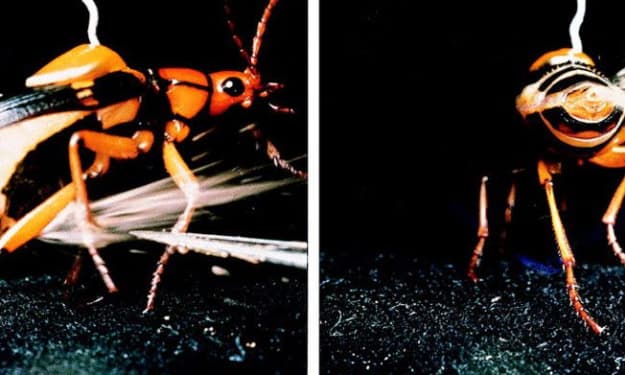
When we think about deadly creatures in the animal kingdom, we often imagine lions, snakes, or sharks. But some of the most fascinating — and dangerous — life forms are much smaller and more mysterious. One such creature is the Bombardier Beetle, a tiny insect that packs a powerful punch using chemistry straight out of a science lab. This remarkable beetle has developed one of nature’s most effective and explosive defense mechanisms: when threatened, it fires a boiling, toxic spray from its abdomen with a loud popping sound. This spray can repel and even injure predators many times its size. Let’s dive into the explosive world of the Bombardier Beetle and learn how it earned its dramatic name. --- A Natural Chemical Reactor What sets the Bombardier Beetle apart from other insects is its internal chemical weapon. Inside its body, it stores two separate chemical compounds — hydroquinone and hydrogen peroxide — in different chambers. When the beetle feels threatened, it quickly mixes these chemicals in a reaction chamber near the rear of its abdomen. The resulting chemical reaction is incredibly exothermic (heat-producing). The mixture instantly heats up to around 100°C (212°F) — the boiling point of water — and is expelled from the body as a hot, noxious gas and liquid spray. This is not just warm mist — it’s a mini chemical explosion, often accompanied by a loud pop sound, which can startle or harm predators like frogs, birds, or spiders. --- Precision and Control You might think such an explosive creature is always on the verge of blowing itself up. But the Bombardier Beetle’s body is engineered with incredible precision. The reaction happens in a reinforced chamber, and the beetle has a rotating turret-like tip at the end of its abdomen that allows it to aim in multiple directions — even backward over its own body! This directional spray gives it a serious advantage. If a predator tries to grab it from any angle, the beetle can twist and fire its hot spray in the exact direction needed. Some scientists describe this mechanism as a natural form of biological artillery. --- A Lesson in Evolution The Bombardier Beetle’s defense system has long fascinated biologists, chemists, and even military scientists. How did such a complex, controlled chemical reaction evolve in a tiny insect? Many believe it’s the result of incremental evolutionary changes. Over millions of years, the beetle’s ancestors may have used simpler chemical defenses that gradually evolved into this sophisticated reaction system. Today’s Bombardier Beetle represents one of the most advanced examples of chemical weaponry in nature. Interestingly, because the mechanism is so complex, some have used it as an argument in discussions about intelligent design — the idea that such features are too complex to evolve naturally. However, scientists have found evolutionary explanations that show how such systems could emerge step-by-step. --- Global Variants Bombardier Beetles aren’t a single species — they’re a group of over 500 species found across the globe, from rainforests to deserts. Most are found in Africa, Europe, Asia, and the Americas. While their appearances may vary slightly, their defense mechanism remains largely the same. They tend to live in leaf litter, under rocks, or in other moist environments where predators lurk. Despite their small size — often less than an inch long — they are highly respected by predators. Few animals attempt to eat them more than once! --- Human Curiosity and Research Because of their unique abilities, Bombardier Beetles have been studied for decades in laboratories. Scientists are especially interested in the fluid dynamics, heat control, and explosion timing involved in their spray. Understanding these could help develop new technologies in areas like medicine, material science, and even defense systems. For example, the beetle’s ability to store and mix volatile chemicals safely has inspired ideas for safe chemical storage and micro-injection devices. --- Final Thoughts The Bombardier Beetle might be tiny, but it stands as one of nature’s greatest examples of survival, adaptation, and raw scientific wonder. It reminds us that even the smallest creatures can be armed with astonishing powers — and that nature still holds many secrets waiting to be discovered. So the next time you’re walking through a forest or flipping a rock, remember: you might just be near one of the world’s tiniest warriors, quietly waiting, ready to fire.
By Insect Legends2 years ago in FYI