Science
Science
Web design trends 2023
The significance of web design Web design is crucial to a website's performance in terms of user experience and SEO ranking. However, new web design trends will emerge in 2023 as the digital world continues to evolve. To create memorable websites and experiences that entice customers or viewers to take the next steps, web designers need to use sound thinking.
By Bhavitra Techsolutions4 years ago in FYI
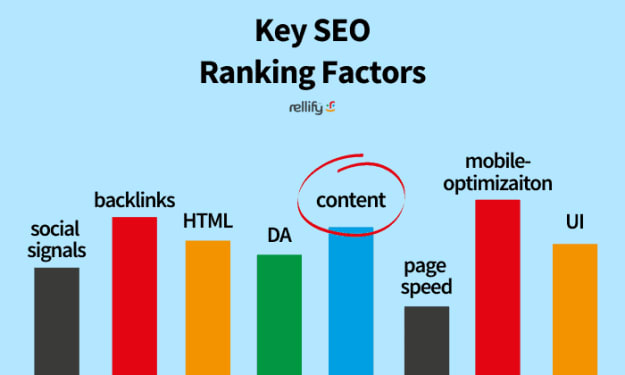
Find out about the essential SEO ranking factors are there
More than 39% of all clicks are made on the Google search result with the most traffic. This indicates that when a person searches for your targeted keyword phrase, four out of ten people will click the first result and disregard the others.If you could rank first for a few of your desired phrases, just imagine how that would affect your company.This guide aims to make it easier for you to implement the most crucial Google ranking factors on your website and increase traffic.
By Bhavitra Techsolutions4 years ago in FYI
Exploring the Rich and Diverse Culture of Brazil: A Comprehensive Guide
Brazil is a country known for its vibrant culture and diverse heritage. From its stunning beaches and lush rainforests to its dynamic cities and colorful festivals, Brazil has something to offer everyone. But beyond the surface level attractions, lies a rich tapestry of customs, traditions, and art that define the Brazilian people.
By Bernad Siagian4 years ago in FYI
Attract love using law of attraction
your life. This principle states that whatever you focus on, you will attract into your reality. Therefore, if you want to attract love into your life, you must focus on love and all the things that come with it, such as happiness, joy, and connection.
By VIDHYASAGAR4 years ago in FYI
Why law of attraction not working
The law of attraction is a popular concept that suggests that we can manifest our desires through the power of positive thinking and visualization. According to this principle, if we focus our thoughts and energy on a specific goal or outcome, the universe will respond by bringing that goal or outcome into our reality. However, despite its popularity, many people have found that the law of attraction is not working for them.
By VIDHYASAGAR4 years ago in FYI
Attract specific person using law of attraction
into your life. This principle states that we are able to manifest the things we desire through the power of positive thoughts and feelings. By focusing on the person you want to attract and visualizing a positive outcome, you can bring them closer to you.
By VIDHYASAGAR4 years ago in FYI
Law of attraction True or Not
The law of attraction is a powerful and often misunderstood concept that has gained significant attention in recent years, particularly in the self-help and personal development communities. It is based on the idea that our thoughts and beliefs shape our reality and that we can use this principle to manifest our desires and achieve our goals. In this essay, we will explore the law of attraction in greater detail, including its origins, key principles, and practical applications.
By VIDHYASAGAR4 years ago in FYI
The Role Of HVAC In Preventing Mold Growth In Buildings
Mold can be a serious problem for any building, as it can cause damage to the structure and adverse health effects among occupants. It is important to take measures to prevent mold growth, and proper heating, ventilation, and air conditioning (HVAC) systems are an integral part of this effort. In this article, we will explore the role of HVAC in preventing mold growth in buildings.
By Muhammad Hassan4 years ago in FYI
What is NASA?
I. Introduction NASA, also known as the National Aeronautics and Space Administration, is an independent agency of the United States federal government responsible for civilian space programs as well as aeronautics and space research. NASA's mission is to drive advances in science, technology, aeronautics, and space exploration in order to enhance knowledge, education, innovation, economic vitality, and stewardship of Earth. Brief history of NASA NASA was established on July 29, 1958, by the National Aeronautics and Space Act. The agency was created in response to the Cold War and the Soviet Union's launch of Sputnik 1, the first artificial satellite. NASA's first major project was the Mercury program, which aimed to put a human into orbit around Earth. This was followed by the Gemini program, which aimed to develop technology for long-duration spaceflight, and the Apollo program, which aimed to land humans on the Moon. NASA continued to achieve significant milestones in space exploration, including the launch of the Space Shuttle, the deployment of the Hubble Space Telescope, and the establishment of the International Space Station. II. Purpose and objectives The main purpose of NASA is to drive advances in science, technology, aeronautics, and space exploration in order to enhance knowledge, education, innovation, economic vitality, and stewardship of Earth. NASA's objectives are to: Exploration of space: NASA sends spacecraft and robotic probes to explore the solar system and beyond, to search for evidence of water and life on other planets, and to study the origins of the universe. Scientific research: NASA conducts research in a variety of fields including Earth science, planetary science, heliophysics, and astrophysics. Aeronautics and space technology development: NASA develops new technologies and advances in aeronautics, such as supersonic and hypersonic flight, to improve air travel, safety, and efficiency. Earth observation and environmental monitoring: NASA monitors the Earth's environment, including changes in climate, weather, oceans, and land, to improve our understanding of the planet and to help mitigate the effects of human activity on the environment. III. NASA Programs and Missions NASA has several ongoing programs and missions across various scientific fields: Human spaceflight: NASA has several human spaceflight programs including the Apollo program, which successfully landed humans on the Moon, the Space Shuttle program, and the International Space Station (ISS) program, which is a collaboration between NASA, other space agencies, and private companies to conduct scientific research in space. Planetary exploration: NASA has several missions exploring the solar system, including the Mars Rover mission, which has been sending rovers to Mars to study its geology, atmosphere, and search for signs of past or present life, and the Cassini-Huygens mission, which explored Saturn and its moons. Earth science: NASA has several missions that study the Earth and its environment, including Landsat and Terra, which observe the Earth's land surface, oceans, and atmosphere to improve our understanding of the Earth's systems and to help mitigate the effects of human activity on the environment. Heliophysics: NASA has several missions that study the Sun and its effects on the solar system, including the Parker Solar Probe, which is studying the Sun's outer atmosphere, corona, and solar wind. Astrophysics: NASA has several missions that study the universe beyond our solar system, including the James Webb Space Telescope, which is set to be the most powerful space telescope ever built, and will study the first galaxies, stars and planets formed after the Big Bang.
By King of Earth4 years ago in FYI