Mystery
Are Labubu dolls evil? Everything you need to know about these little monsters. Content Warning.
The Labubu dolls are all the rage all over the planet because they have an original design, they are funny and it works as a toy among children and is a fashion accessory among young women, who adopted these little monsters because of the trend set by celebrities.
By Ninfa Galeanoabout a year ago in FYI
The Quranic Prediction of the Roman Victory: A Testament to Faith and History
History often surprises us with its patterns, coincidences, and the seeming foreshadowing of future events. But what happens when a sacred text, revealed over 1,400 years ago, appears to predict a geopolitical turn of events with astonishing precision? Such is the case with the Quranic prophecy about the Roman victory over the Persians, an episode that blends spiritual belief, historical record, and miraculous foresight. For Muslims, this event is not just an affirmation of faith but also a reminder of the Quran’s divine origin and its engagement with the real world.
By Emad Iqbalabout a year ago in FYI
New Illness Spreading In China: What To Know About The Chikungunya Virus
A mosquito-borne virus that has infected more than 7,000 people across at least 13 cities in China has sparked precautions similar to those imposed during the COVID pandemic in attempts to stop its spread despite the virus not being transmittable from person to person.
By Muhammad Sabeelabout a year ago in FYI
The Morning Lake Mystery continues after the school bus and a survivor emerge four decades later. AI-Generated.
I read a Facebook post and later watched a video about a The Morning Lake Mystery. This was a situation that I just knew was complete fiction. I decided to allow AI to gather information from across the web for my readers. Enjoy and please leave your opinions in the comment section.
By Cheryl E Prestonabout a year ago in FYI
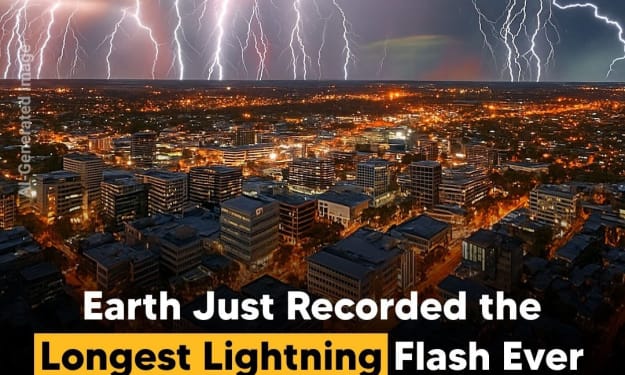
⚡ The 515-Mile Megaflash: Nature’s Longest Fingerprint in the Sky
🌩️ The Night the Sky Refused to Be Ignored It was just another quiet evening in October 2017 — or so it seemed. In the small towns scattered across eastern Texas, dusk arrived with its usual palette of gold and blue. Windshields glinted on the freeway. The last autumn leaves twirled lazily through gas station parking lots. And above, thick, dark clouds were rolling in with silent intensity. No one knew what was coming. Suddenly, the sky ripped open. From horizon to horizon, a brilliant white-hot flash arced across the sky — a line of light so long, so vast, it seemed to defy logic. It didn’t strike down like lightning usually does. Instead, it traveled sideways, stretching across multiple states, a luminous snake slithering silently across the ceiling of the atmosphere. It lasted just over seven seconds. And in that brief moment, the longest lightning bolt ever recorded in human history was born. 🧭 The Path of the Megaflash The bolt’s journey began in eastern Texas, a region familiar with violent storms and turbulent skies. From there, it spread northeast — racing across Oklahoma, weaving through the darkness, and finally fading somewhere near Kansas City, Missouri. Measured at 515 miles (829 kilometers) long, it would later be officially recognized by the World Meteorological Organization (WMO) as the longest single lightning flash ever documented. To put that in perspective: It’s longer than the entire state of California. It surpasses the distance from Washington, D.C. to Detroit. It’s more than double the length of England from north to south. And it happened in less than the time it takes to microwave a cup of tea. 🧪 Not Just a Flash — A Megaflash This wasn’t just a pretty storm. This was a scientific revolution in motion. Researchers had long suspected that megaflashes — horizontal lightning bolts that span massive distances across the sky — existed. But they were nearly impossible to detect with traditional tools. Most lightning bolts strike down, finding the shortest route to ground. But megaflashes? They crawl sideways across thundercloud anvils, remaining invisible to most ground-based detection systems. For years, they were whispers in meteorological circles — stories backed by anecdotal sightings and speculation, but lacking hard evidence. That all changed in 2017, thanks to space technology. 🛰️ Satellites See What We Cannot The 515-mile lightning bolt was captured not by a human, but by a satellite. Specifically, a Geostationary Lightning Mapper (GLM) aboard the GOES-16 weather satellite, operated by NOAA (National Oceanic and Atmospheric Administration). From more than 22,000 miles above Earth, this instrument stared constantly at the Western Hemisphere, taking 500 images every second, looking not for beauty, but for data — for evidence of light flashes in storms. And in that stormy night sky, the satellite spotted something unprecedented: A bolt so long it connected multiple storm systems, across multiple states, without ever striking the ground. The image was surreal — like a neural circuit firing across the American Midwest. It wasn’t just a discovery. It was confirmation. 📜 Lightning Records Through History Before this record-setting flash, the world had been stunned by an earlier event — a 2018 lightning bolt that stretched 477 miles across southern Brazil. That bolt had held the previous record. And yet, even that paled in comparison to the new king of the sky, which exceeded the Brazilian bolt by nearly 40 miles. And while the 2017 bolt set the record for distance, another flash, in 2020, would later set the record for duration — a single bolt over Argentina and Uruguay that lasted more than 17 seconds. The two records — distance and duration — tell us that lightning is far more versatile, diverse, and unpredictable than we ever imagined. It’s not just a zap. It’s a cosmic dance of electrons, shaped by wind, water, heat, and chaos. - What Makes Megaflashes Possible? Megaflashes form in an unusual way. Rather than being triggered by a cloud-to-ground discharge, they spread within and between thunderclouds, especially in large storm systems called Mesoscale Convective Systems (MCS). These storms are massive — often hundreds of miles wide — and form over flat terrain where air masses can move freely, such as the Great Plains of the United States. In an MCS, the cloud tops form a broad, continuous sheet of electrically active sky. Under just the right conditions, a single lightning bolt can travel from one end to the other, never touching the earth, but stretching out laterally across the entire structure. The result? A megaflash. A silent leviathan of energy, unseen by most eyes — unless you’re watching from space. 🎬 If You’d Been There... If you were a trucker driving up Highway 69 that night… If you were a teenager stargazing from your backyard in Tulsa… If you were a pilot flying over Arkansas airspace… You might have seen it — the sky glowing brighter than a city, for just a few seconds, then falling dark again. It would’ve looked like the universe cracked open, the world lit up in ghostly white, then everything went back to normal. But for scientists, everything had changed. 🧬 What Does This Mean for Earth — and Us? So why does this matter? After all, lightning happens every day. In fact, about 44 lightning bolts strike somewhere on Earth every second. That’s nearly 4 million strikes per day. But most of those are short, relatively harmless, and well-understood. Megaflashes, however, are a different story. They: Can span multiple states Can ignite wildfires, especially in dry regions Are often accompanied by heavy rain and wind damage Could potentially interfere with aviation and satellite systems May tell us something new about climate change and storm evolution Understanding megaflashes means understanding the atmosphere at its most extreme. It helps us build better warning systems, protect people and infrastructure, and uncover the full power — and fragility — of our planet’s weather. 💡 Lightning Facts That Will Blow Your Mind The temperature of a lightning bolt can reach 30,000°C (54,000°F) — five times hotter than the sun’s surface. Lightning bolts are typically just 2-3 centimeters wide, but they appear broader due to their blinding light. A single lightning strike can contain up to a billion volts of electricity. Every second, there are about 100 cloud-to-ground lightning strikes around the world. Lightning detection networks are now using AI and satellites to track patterns in real-time. 👀 The Future of Lightning Research The WMO says this is only the beginning. With more satellites launching, including those equipped with infrared sensors, LIDAR, and global positioning technology, we’re entering a new era of atmospheric observation. “We believe much longer flashes are out there,” said Randall Cerveny, WMO’s rapporteur on extreme weather and climate events. “We just haven’t found them yet.” In the coming years, we may discover bolts that stretch from Mexico to Canada, or even transcontinental flashes, linking distant storms like electrical webs. It’s both thrilling and humbling. The sky is still full of unknowns. 🌌 Final Thoughts: Lightning as Poetry and Power There’s something poetic about lightning. It’s ancient. It’s terrifying. It’s beautiful. And now, thanks to satellites and science, it’s becoming legible. The 515-mile megaflash wasn’t just an electrical discharge. It was a natural epic, a glowing sentence scrawled across the continent, too fast for most to see — but not too fast for history to remember. So next time a storm rolls in… Turn off your phone. Turn off the lights. And just watch. You might witness the next record breaker… ...or even the sky writing a story just for you.
By Muhammad Abbas khanabout a year ago in FYI
The Rise of Madison Zhao: Local Girl to Global Icon
In the quiet corners of a small town, where dreams often remain dreams and the world feels far away, Madison Zhao’s story began. Her rise wasn’t overnight. It didn’t come with shortcuts or sudden fame. Instead, it was a journey shaped by grit, vision, and a deep-rooted desire to turn every opportunity into something meaningful.
By Madison Zhao Fan Pageabout a year ago in FYI
My Name Is Pink: Why TikTok’s Opposite Trend Speaks Louder Than You Think
It started with a whisper — a soft, lo-fi voice says, “My name is Pink,” followed by another voice answering, “And I’m the opposite.” Then came a flood: couples, best friends, siblings, even pets. The TikTok screen would split in two, and across millions of pages, a new trend would bloom like a neon flower in a grayscale garden.
By Echoes of Lifeabout a year ago in FYI
The Room That Never Stopped Breathing. AI-Generated.
Some rooms make you feel watched. Others just feel cold. But the one I moved into last year it breathed. It wasn’t obvious at first. Just a studio apartment in a crumbling, early 1900s building, cheap rent, and close enough to the subway for my daily commute. I’d lived in far worse. But on my very first night, I noticed something strange.
By Abdullah Khanabout a year ago in FYI
The Book Of Shadows: esotericism available for those who want to learn. Content Warning.
I was intrigued by The Book of Shadows all my life, even more so after my parents' death many years ago, since I wanted to know how they manifested themselves in the afterlife. Since I never had children because I never wanted to, I felt free to enter this unknown world. American and British practitioners guided me to understand the Wicca religion and to know how to read this famous book. The truth is that these texts are very interesting, even my cats are fascinated when I open the book, I start reading and they tease me amusingly.
By Ninfa Galeanoabout a year ago in FYI