Humanity
Humanity
The Secret Staircase: Unveiling Hidden Mysteries of a 19th Century Victorian Home
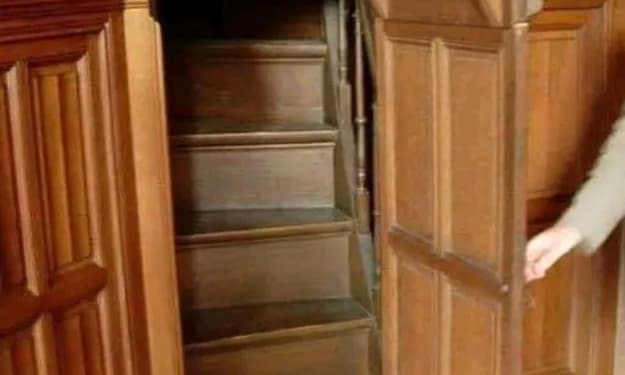
Nestled within the intricate design of a 19th-century Victorian home lies a hidden gem that has captivated historians, architects, and dreamers alike: a concealed staircase leading to a secret room. Such architectural curiosities are a testament to the ingenuity and charm of the Victorian era, where homes were not only built for function but also for intrigue and wonder. This particular staircase, discovered during a routine renovation, has shed light on the secrets of its era. Steeped in history, the hidden passageway is a tangible reminder of the social norms, architectural innovations, and fascinating stories that defined Victorian life. The Discovery The staircase was unearthed in a sprawling Victorian mansion, its entrance cleverly disguised within a paneled wall in the drawing room. At first glance, the wall seemed like an ordinary part of the room's décor, blending seamlessly with the ornate woodwork and wallpaper typical of the period. However, a slight gap and an unusual echo led renovators to investigate further. When the panel was removed, it revealed a narrow, winding staircase. The air was thick with dust, and the wooden steps creaked underfoot, but the passage was remarkably well-preserved. The stairs spiraled upwards to a small, hidden room tucked away under the eaves of the house. The Secret Room The room itself was a modest space, roughly eight feet by ten, with a low, slanted ceiling. A single, small window overlooked the sprawling gardens below, its thick glass distorting the view like a scene from a dream. The walls were adorned with faded floral wallpaper, and remnants of a simple life lay scattered across the floor: a cracked porcelain teacup, a tattered book, and an old oil lamp. The purpose of the room remains a mystery. Was it a servant’s quarters, a refuge for clandestine meetings, or perhaps a hideaway for someone seeking solace from the demands of Victorian society? Each theory adds a layer of intrigue to this already fascinating discovery. The Role of Secret Spaces in Victorian Homes Hidden staircases and secret rooms were not uncommon in Victorian architecture. These features often served practical purposes or reflected the era's fascination with mystery and concealment. 1. Servant Access: In many large Victorian homes, hidden staircases allowed servants to move discreetly between floors without being seen by the household's upper class. This upheld the strict social hierarchies of the time, ensuring that the "downstairs" staff remained invisible to the "upstairs" residents. 2. Safety and Security: Some hidden spaces were designed as refuges during times of unrest. With the memory of events like the English Civil War still lingering, secret rooms offered a place to hide valuables—or people—in times of danger. 3. Religious Practices: In some cases, secret rooms were used to conceal priests or religious artifacts during periods of persecution. While this was more common in earlier centuries, the Victorian era saw a revival of interest in Gothic and medieval traditions, which may have inspired such features. 4. Aesthetic Appeal: The Victorian period was marked by an appreciation for the whimsical and mysterious. Architects and homeowners alike delighted in incorporating hidden compartments, sliding panels, and secret doors into their designs as a nod to the era's literary fascination with intrigue and adventure. Restoring the Staircase and Room After its discovery, the staircase and room became the focus of a meticulous restoration effort. Craftsmen worked to preserve the original woodwork, replacing only the most damaged elements with historically accurate materials. The faded wallpaper was carefully cleaned and stabilized, while the artifacts found within the room were cataloged and displayed in the house’s newly established museum wing. The restoration also revealed clues about the room's use. A concealed compartment in the floor contained a small box of letters, written in a flowing hand and dated to the late 1800s. While their contents remain private, historians believe they may offer insight into the lives of the home's occupants and the role the secret room played in their daily lives. The Modern Fascination with Hidden Spaces Today, the hidden staircase and secret room have become a highlight for visitors to the Victorian home, offering a glimpse into a world of mystery and elegance. Modern homeowners and designers have also embraced the charm of secret spaces, incorporating hidden doors and rooms into their own homes as a nod to the past. The enduring allure of such features lies in their ability to ignite the imagination. They remind us that even in the most ordinary settings, extraordinary secrets may be waiting to be uncovered. Conclusion The hidden staircase and secret room of this Victorian home are more than just architectural curiosities—they are a window into the complexities of life in the 19th century. From their practical uses to their symbolic significance, they capture the time of an era that valued both form and function, mystery and practicality. As visitors climb the narrow staircase and step into the secret room, they are transported back in time, walking in the footsteps of those who once sought solace, safety, or simple curiosity within its walls. The discovery serves as a powerful reminder that history is not only found in grand monuments and sweeping narratives but also in the quiet corners of our everyday lives.
By Deji Akomolafe2 years ago in FYI
What Countries Are Socialist? Understanding the Global Socialist Movement Today
The Most Socialist Countries: A Look at Their Political and Economic Systems Being a student of political systems and global affairs, I have always come across the various ideologies that are responsible for the intricate existence of our world. Add to these the socialist system and you have a system that has played an enormous part in the histories of so many nations and is still so doing today. I'm focusing on the neighbourhood of socialist countries and giving the global socialist movement a contemporary look in this article.
By CityStateInfo (New Media)2 years ago in FYI
"Optimal Health Blueprint: Your Path to Wellness"
Creating and maintaining a healthy lifestyle is an ongoing journey that requires commitment, knowledge, and the willingness to adapt to new habits. While there are countless guidelines and recommendations available, understanding the core principles of a healthy lifestyle can make the process more approachable and personalized. This comprehensive guide explores essential components of a professional and effective health regimen, offering practical advice and insights to help you on your path to better health and well-being.
By youssef mohamed2 years ago in FYI
Freemasons, Elites, and Scandal: Cameroon’s Rumor Mill
An bizarre and intriguing modern book has been composed by two anthropologists, called Trick Accounts from Postcolonial Africa: Freemasonry, Homosexuality, and Illegal Enhancement. It investigates an progressing scheme hypothesis in Cameroon and neighboring Gabon that degenerate elites spread homosexuality through their associations to mystery orders like the Freemasons. They follow the roots of the trick hypothesis to a ethical freeze in Cameroon in 2005. They at that point move back in time to get it what it all implies. We inquired the creators to tell us more.
By Shams Says2 years ago in FYI
Prostate Cancer Risk Higher for African Men: Study
What did your inquire about see into and why? Prostate cancer excessively influences men of African plunge. Thinks about from the US and African nations report a higher event of prostate cancer in men of African family line when compared with men of other parentages. Men of African and African Caribbean family line were moreover found to be at higher chance of creating a more forceful frame of prostate cancer and of creating it at a more youthful age when compared with men of European parentage. Prostate cancer too accounts for about one-quarter of all cancer cases analyzed in Africa.
By Shams Says2 years ago in FYI
Reptilians: myth or reality?. Content Warning.
Reptilians come from distant star systems, such as Alpha Draconis. They developed on planets with extreme conditions, which gave them remarkable endurance and superior physical abilities. Thanks to their advanced technology and vast knowledge, these beings began to explore other star systems, including our own.
By Ninfa Galeano2 years ago in FYI
Where Do Letters to Santa Really Go?
American life is on show in letters that start with “Dear Santa.” Yes, numerous of these letters include kids endearingly inquiring for toys: Ayden from Tennessee says, “I’m 11 a long time ancient and I think I’ve been truly great this year. My favorite things are dinosaurs and space.” Included in Ayden’s wish list for Santa is a “velociraptor plushie,” of course.
By Shams Says2 years ago in FYI
Understanding Dreams: What It Means When You Dream About Someone
Interestingly, as I move on to the world of dreams, I always find myself reflecting on the true core of having a dream about someone. In the research I conducted as a dream scientist, I have come to learn that these nightly revelations indeed harbor some deep understanding of our subconscious thoughts. Thus, today, I will share with you my knowledge about the phenomenon of you dreaming about someone and how every one of these dreams can influence our everyday lives.
By NewbieWordNerd2 years ago in FYI
Pleiadians: what are they, who are they?. Content Warning.
Pleiadians are multidimensional spiritual entities originating from the Pleiades star system, located in the constellation of Taurus. These beings, who have reached a high level of spiritual and technological evolution, are dedicated to the welfare and development of humanity. Their fundamental purpose is to guide human beings towards a deeper awakening of consciousness and universal harmony.
By Ninfa Galeano2 years ago in FYI
5 Most Expensive Roads Ever Built
1. The Gotthard Base Tunnel, Switzerland The Gotthard Base Tunnel, a marvel of modern engineering, is the world's longest railway tunnel. It stretches for 57 kilometers (35 miles) through the Swiss Alps, significantly reducing travel time between northern and southern Europe. The project, which took over 17 years to complete, cost a staggering $12 billion.
By Moharif Yulianto2 years ago in FYI