
STD Diagnostics Market Set to Reach US$ 30.84 Billion by 2033 as Early Detection and Home Testing Transform Global Sexual Healthcare
Growing Awareness, Rapid Diagnostic Technologies, and Expanding Public Health Programs Are Reshaping the Future of STD Detection Worldwide

Sexually transmitted diseases (STDs) continue to represent one of the most significant public health challenges worldwide. Despite remarkable advancements in healthcare, millions of people are diagnosed with sexually transmitted infections every year, highlighting the urgent need for accessible, reliable, and rapid diagnostic solutions.
As governments, healthcare providers, and global health organizations intensify efforts to combat sexually transmitted infections, the STD diagnostics market is witnessing unprecedented growth. From laboratory-based molecular testing to rapid home-testing kits, innovative diagnostic technologies are transforming how infections are detected, monitored, and managed.
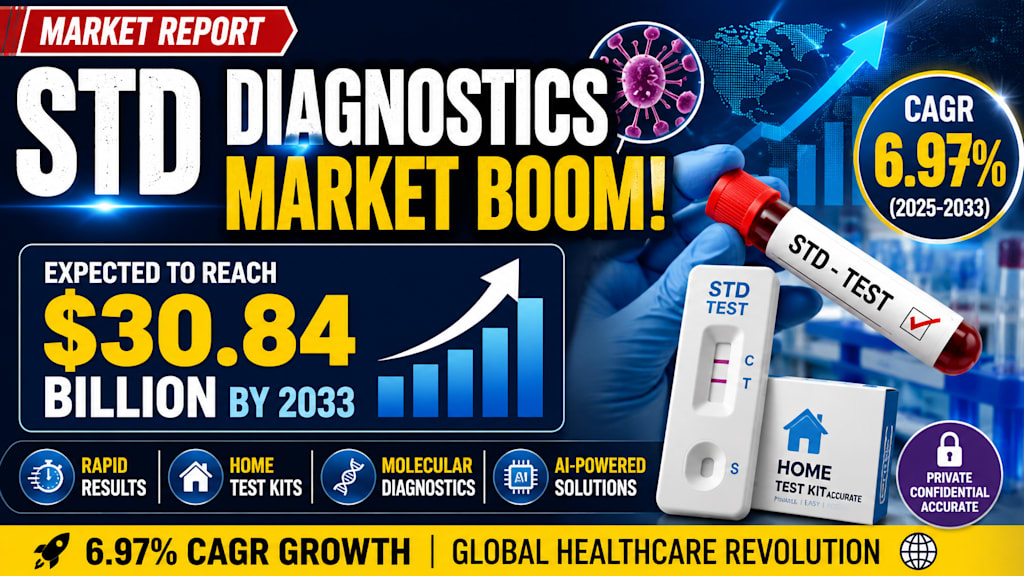
According to Renub Research, the Global STD Diagnostics Market was valued at US$ 16.82 Billion in 2024 and is projected to reach US$ 30.84 Billion by 2033, growing at a CAGR of 6.97% during the forecast period 2025 to 2033. Rising awareness about sexual health, increasing prevalence of sexually transmitted infections, and growing demand for accurate and rapid testing solutions are among the primary factors fueling market expansion.
Why STD Diagnostics Matter More Than Ever
Sexually transmitted diseases remain a major healthcare concern because many infections often show no symptoms during their early stages. Conditions such as chlamydia, gonorrhea, syphilis, human papillomavirus (HPV), and HIV can silently progress for months or even years before serious complications emerge.
Early diagnosis plays a critical role in preventing disease progression, reducing transmission rates, and improving treatment outcomes. Untreated STDs can lead to infertility, chronic pelvic pain, pregnancy complications, neurological disorders, and an increased risk of HIV infection.
Diagnostic testing serves as the first line of defense, enabling healthcare providers to identify infections quickly and initiate appropriate treatment before long-term damage occurs.
Rising STD Cases Are Driving Demand Worldwide
One of the strongest growth drivers for the STD diagnostics industry is the increasing incidence of sexually transmitted infections worldwide.
Health organizations continue to report rising infection rates across multiple regions. Young adults, adolescents, and high-risk populations remain particularly vulnerable to STDs due to changing lifestyles, limited awareness, and inconsistent access to healthcare services.
The growing number of infections has created a pressing need for routine screening and early diagnosis. Governments and healthcare institutions are investing heavily in testing programs aimed at reducing disease transmission and improving patient outcomes.
As awareness increases and social stigma gradually declines, more individuals are seeking testing services, further accelerating market growth.
Technological Innovation Is Revolutionizing STD Testing
The STD diagnostics industry has experienced a technological transformation over the past decade.
Traditional laboratory testing methods, while highly accurate, often required lengthy processing times and specialized facilities. Today, modern diagnostic technologies are delivering faster, more convenient, and highly accurate results.
Some of the most impactful innovations include:
Rapid Diagnostic Tests
Rapid diagnostic tests have significantly improved accessibility by providing results within minutes rather than days. These tests are increasingly used in clinics, pharmacies, community health centers, and outreach programs.
Point-of-Care Testing
Point-of-care testing allows healthcare professionals to diagnose infections during a patient visit. Immediate diagnosis enables quicker treatment decisions and reduces the risk of further transmission.
Molecular Diagnostics
Molecular diagnostic technologies, particularly Nucleic Acid Amplification Tests (NAATs), have become the gold standard for detecting several sexually transmitted infections.
These tests offer exceptional sensitivity and specificity, allowing clinicians to identify infections even when pathogen levels are extremely low.
Home-Based Testing Kits
Home testing represents one of the fastest-growing segments of the market. Consumers increasingly value privacy, convenience, and accessibility.
Modern home testing kits enable individuals to collect samples at home and receive laboratory-confirmed results through secure digital platforms, reducing barriers associated with traditional clinic visits.
Government Initiatives Continue to Strengthen Market Growth
Public health initiatives are playing a crucial role in expanding STD testing worldwide.
Governments and international organizations such as WHO and UNAIDS continue investing in awareness campaigns, screening programs, prevention initiatives, and diagnostic infrastructure.
Several countries have introduced nationwide screening programs focused on high-risk populations, pregnant women, and young adults.
These efforts are helping increase testing volumes while reducing the societal burden of untreated infections.
Healthcare funding directed toward sexual health services is also encouraging healthcare facilities to adopt advanced diagnostic technologies and expand testing accessibility.
The Growing Importance of Chlamydia Testing
Among all STD categories, chlamydia testing remains one of the most important segments.
Chlamydia is often referred to as a "silent infection" because many infected individuals experience no symptoms. Left untreated, the disease can result in infertility, reproductive complications, and chronic pain.
As awareness increases regarding the long-term consequences of untreated chlamydia, routine screening programs are becoming more common worldwide.
Healthcare providers increasingly rely on highly sensitive molecular diagnostic techniques to ensure accurate detection and timely treatment.
The growing emphasis on preventive healthcare is expected to support continued expansion of the chlamydia testing market.
HIV Diagnostics Remain a Cornerstone of Global Testing Programs
HIV diagnostics continue to represent one of the largest segments within the STD diagnostics industry.
Despite substantial progress in HIV prevention and treatment, early diagnosis remains essential for controlling transmission and improving patient outcomes.
Advancements in rapid testing technologies have dramatically improved HIV screening accessibility. Individuals can now access testing through clinics, pharmacies, community programs, and self-testing kits.
The availability of confidential and convenient testing options has encouraged more people to undergo regular screening.
Global efforts to achieve HIV elimination targets will continue supporting long-term demand for advanced diagnostic solutions.
Molecular Diagnostics Lead the Industry
Molecular diagnostics currently dominate the STD diagnostics market because of their unmatched accuracy and reliability.
NAAT-based testing has become the preferred approach for diagnosing infections such as:
Chlamydia
Gonorrhea
HIV
Syphilis
Trichomoniasis
The ability to detect pathogens at very low concentrations enables earlier diagnosis and more effective treatment interventions.
Healthcare institutions continue investing in molecular diagnostic platforms because they reduce false-negative results and improve overall patient care.
As technology costs gradually decline, adoption is expected to expand further across emerging economies.
Next-Generation Sequencing Represents the Future
Next-Generation Sequencing (NGS) is emerging as a transformative technology within STD diagnostics.
Unlike traditional testing methods that focus on individual pathogens, NGS can simultaneously identify multiple infections while detecting genetic mutations and antimicrobial resistance markers.
This capability provides clinicians with comprehensive diagnostic insights and supports personalized treatment strategies.
Although currently concentrated in advanced healthcare systems and research institutions, declining sequencing costs are expected to make NGS increasingly accessible in the coming years.
Industry experts believe NGS could significantly reshape the future of infectious disease diagnostics.
Hospitals and Clinics Continue to Dominate Testing Services
Hospitals and clinics remain the largest end-user segment within the STD diagnostics market.
These facilities offer comprehensive testing services, including rapid screening, confirmatory diagnostics, counseling, and treatment management.
Patients often prefer healthcare facilities because they provide access to qualified medical professionals and integrated care pathways.
Government-funded screening programs further contribute to high testing volumes within hospitals and clinics.
While self-testing is growing rapidly, traditional healthcare facilities remain indispensable for complex cases requiring specialized treatment and follow-up care.
Regional Market Insights
United States
The United States remains one of the world's largest STD diagnostics markets. Rising infection rates, advanced healthcare infrastructure, strong public health initiatives, and widespread adoption of innovative diagnostic technologies continue supporting market growth.
Germany
Germany benefits from a highly developed healthcare system and proactive public health campaigns. Growing acceptance of self-testing solutions and widespread access to advanced laboratory diagnostics are driving market expansion.
India
India represents one of the most promising growth opportunities in the global STD diagnostics industry. Rising awareness, urbanization, expanding healthcare access, and government-led initiatives such as the National AIDS Control Programme are increasing demand for testing services.
Brazil
Brazil continues to strengthen its diagnostic infrastructure through public health investments and subsidized testing programs. High infection rates and government support are creating favorable conditions for market growth.
Saudi Arabia
Healthcare modernization efforts under Vision 2030 are improving access to advanced diagnostic technologies. Increasing awareness and healthcare investments are expected to support steady market expansion in the coming years.
Key Challenges Facing the Industry
Despite strong growth prospects, several challenges remain.
Social Stigma
Many individuals still avoid STD testing because of social stigma, cultural taboos, and fear of judgment. This continues to limit early diagnosis and treatment in several regions.
Limited Awareness
Lack of education regarding sexual health and testing options remains a significant barrier, particularly in low-income and rural communities.
Affordability Concerns
Advanced molecular diagnostic tests often remain expensive, making widespread adoption difficult in resource-constrained healthcare systems.
Infrastructure Limitations
Many developing regions continue to face shortages of laboratory facilities, trained personnel, and diagnostic equipment.
Addressing these challenges will be essential for maximizing the public health impact of STD diagnostics worldwide.
10 Recent Developments from Leading Companies
1. Abbott Laboratories
Expanded its infectious disease testing portfolio with advanced molecular diagnostic solutions designed to improve STD detection accuracy.
2. F. Hoffmann-La Roche AG
Strengthened its PCR-based diagnostic offerings through continuous innovation in molecular testing platforms.
3. Hologic Inc.
Continued expanding its Panther molecular diagnostics ecosystem for sexually transmitted infection testing.
4. Becton Dickinson and Company
Enhanced laboratory automation capabilities supporting faster infectious disease diagnostics.
5. Danaher Corporation (Cepheid)
Advanced rapid molecular testing technologies that enable near-patient STD detection.
6. Siemens Healthineers AG
Invested in integrated diagnostic workflows aimed at improving laboratory efficiency and testing accuracy.
7. bioMérieux SA
Expanded its infectious disease diagnostic portfolio with innovative molecular solutions.
8. Thermo Fisher Scientific Inc.
Strengthened its molecular testing capabilities through enhanced research and diagnostic product development.
9. Qiagen N.V.
Continued improving sample preparation and molecular detection technologies for infectious disease diagnostics.
10. Bio-Rad Laboratories Inc.
Focused on expanding advanced PCR technologies supporting highly sensitive STD testing applications.
Final Thoughts
The global STD diagnostics market is entering a transformative era characterized by technological innovation, expanding healthcare access, and growing public awareness. As sexually transmitted infections continue to affect millions of individuals worldwide, early diagnosis remains one of the most effective tools for disease control and prevention.
Rapid testing solutions, molecular diagnostics, home-based testing kits, and next-generation sequencing technologies are reshaping how healthcare providers detect and manage infections. Meanwhile, government initiatives and public health campaigns continue to increase testing accessibility across both developed and emerging markets.
With the market projected to grow from US$ 16.82 billion in 2024 to US$ 30.84 billion by 2033, the future of STD diagnostics appears exceptionally promising. Companies that continue investing in innovation, affordability, and accessibility will be best positioned to capitalize on the next wave of growth while contributing to improved global sexual health outcomes.
About the Creator
Enjoyed the story? Support the Creator.
Subscribe for free to receive all their stories in your feed.
Comments
There are no comments for this story
Be the first to respond and start the conversation.