
No, You Won't Catch HPV From a Train Seat
Doctors say the viral chart is misleading. Here's what is on the seat, and what helps.
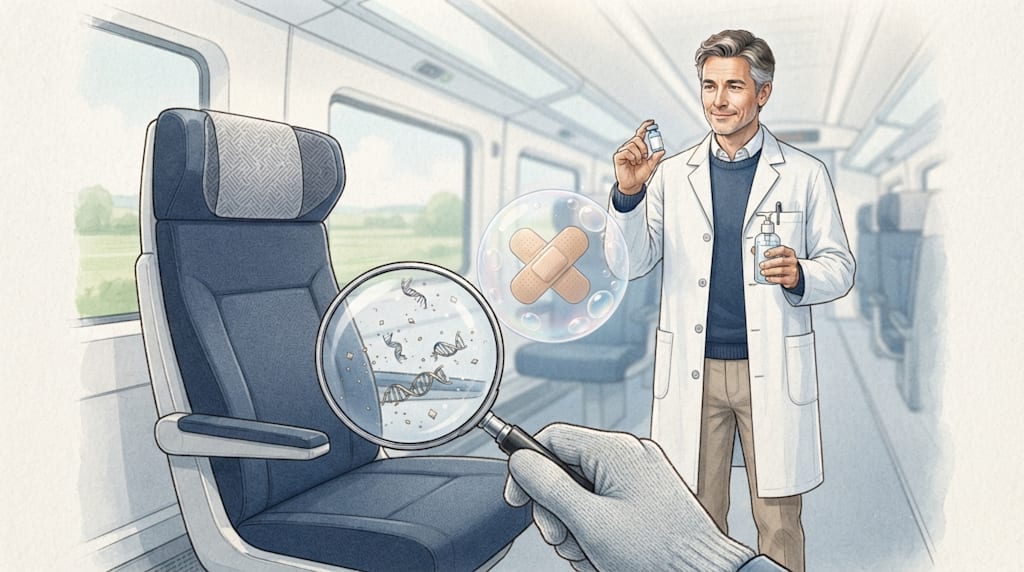
A chart has been going around online. It puts high-speed rail seats near the top of a table of HPV sources. Hotel toilet seats, armrests, and tray tables show up too. The chart has arrows, percentages, and a warning tone. That format makes it look like evidence. The science underneath is thin.
The first problem is what a positive surface test means. Many of these charts lean on studies that used PCR to detect HPV DNA. PCR is sensitive. It can find a fragment of viral DNA. A fragment is not a whole virus. A whole virus is not always infectious. To infect someone, a virus has to be intact and able to enter a cell and copy itself. A positive swab on a seat can mean a DNA trace is there. It does not mean a live, infectious virus is waiting.
Think of a fire that has burned out. Ash can still hold chemical traces of what burned. The ash cannot start the next fire. A PCR-positive surface is closer to that ash than to a live flame.
Li Tongzeng is chief physician in the Department of Infectious Diseases at Beijing Youan Hospital, Capital Medical University. He said the chart is unreliable and the public does not need to panic. HPV is fragile outside the body, he said. It survives poorly on dry surfaces. On fabric or hard plastic, such as a train seat, it is very unlikely to stay intact and infectious. HPV spreads mainly through sexual contact or close, direct skin-to-skin contact. Indirect transmission through public objects is extremely low, almost negligible.
What HPV is and how it spreads
HPV is a small DNA virus. More than 200 types have been identified. They fall into two broad groups.
Skin types infect the skin. They cause common warts, plantar warts, and flat warts. These can spread through skin contact, often when there is a small break in the skin.
Mucosal types infect mucous membranes. Low-risk types can cause genital warts. High-risk types are linked to cervical, anal, and oropharyngeal cancers.
HPV does not travel through the blood. It infects epithelial cells. For mucosal HPV to reach a train seat, a person would have to leave virus from genital, anal, or oral mucosa on the seat. Clothing blocks the genital and anal route. Spitting on a seat is not normal behavior. That leaves skin HPV as the only plausible source on a seat.
Skin HPV can shed from a wart. Even then, the next passenger would need several things at once: enough active virus, a break in the skin, and prolonged rubbing or friction at the contact point. Sitting down for a moment does not meet those conditions. A quick brush against a seat does not meet them either. No official public health agency has reported a case of HPV infection linked to a public seat.
What is on the seat
This does not mean train seats are sterile. They are public surfaces. They can carry bacteria, fungi, and skin scales. A passenger with athlete's foot who takes off their shoes and steps on the seat can leave fungal scales behind. A passenger who puts feet on a tray table can leave dirt and skin cells there. These are reasons for basic hygiene. They are not reasons to fear HPV.
Wang Chun is associate chief physician in the Department of Dermatology at Southwest Hospital, Army Medical University. Wang noted that the risk from indirect contact depends on the person. People with weaker immunity, diabetes, or other underlying conditions may be more likely to pick up bacteria or fungi from public objects. People with broken skin, recent shaving or friction wounds, or heavy sweating during long, hot rides may also face a slightly higher exposure risk. For them, physical barriers and hand hygiene can lower the chance of an accidental exposure.
Do disposable seat covers help?
For HPV, no. Li Tongzeng said alcohol wipes and disposable seat covers mainly provide psychological comfort. They may help against ordinary bacteria and fungi. They do very little to reduce HPV risk.
A seat cover can block grease, dust, and some skin scales. If it makes a long trip feel cleaner, use one. Do not treat it as armor against HPV. The virus does not spread through a dry seat surface in the way the chart suggests.
What works
Get the HPV vaccine. It lowers the risk of high-risk HPV infection and precancerous changes.
Wash your hands. Do it after touching handrails, seat belts, and tray tables. Do it before eating. Do not touch your mouth, nose, or eyes with unwashed hands.
Cover cuts. If you have a fresh wound, put a bandage or sterile gauze over it. That keeps bacteria and fungi in the environment away from broken skin.
Wear long pants or a long skirt if your skin is sensitive. It creates a simple physical barrier between you and the seat.
Do not put your feet on the tray table or the back of the seat in front of you. Do not take off your shoes and stand or sit on the seat. Those habits leave skin scales, dirt, and fungi for the next passenger. They also make the ride worse for everyone around you.
The cleaning standard
Railway 12306 customer service has said that high-speed rail seat cushions are removed and sent for deep cleaning every 120 to 180 days. In sleeper cars, bedding is changed for each passenger. The railway says these practices meet its sanitation and disease-control standards.
A train seat is not sterile. It is a public surface with a cleaning schedule. That schedule is not the same as an HPV hotspot.
What to do
The claim that high-speed rail seats are a leading source of HPV does not hold. A positive PCR result on a surface can be a DNA trace. It is not proof of a live, infectious virus. HPV spreads through sexual contact or close skin-to-skin contact. A dry seat is a poor route for it.
Use a seat cover if it makes you comfortable. Wash your hands. Cover a cut. Get vaccinated. Keep your feet off the tray table and the seat. Those steps address the risks that are present. The HPV hotspot label is not one of them.
About the Creator
Jin
Writer of reamstories
https://reamstories.com/jin
Enjoyed the story? Support the Creator.
Subscribe for free to receive all their stories in your feed. You could also become a paid subscriber, letting them know you appreciate their work.
Comments
There are no comments for this story
Be the first to respond and start the conversation.