

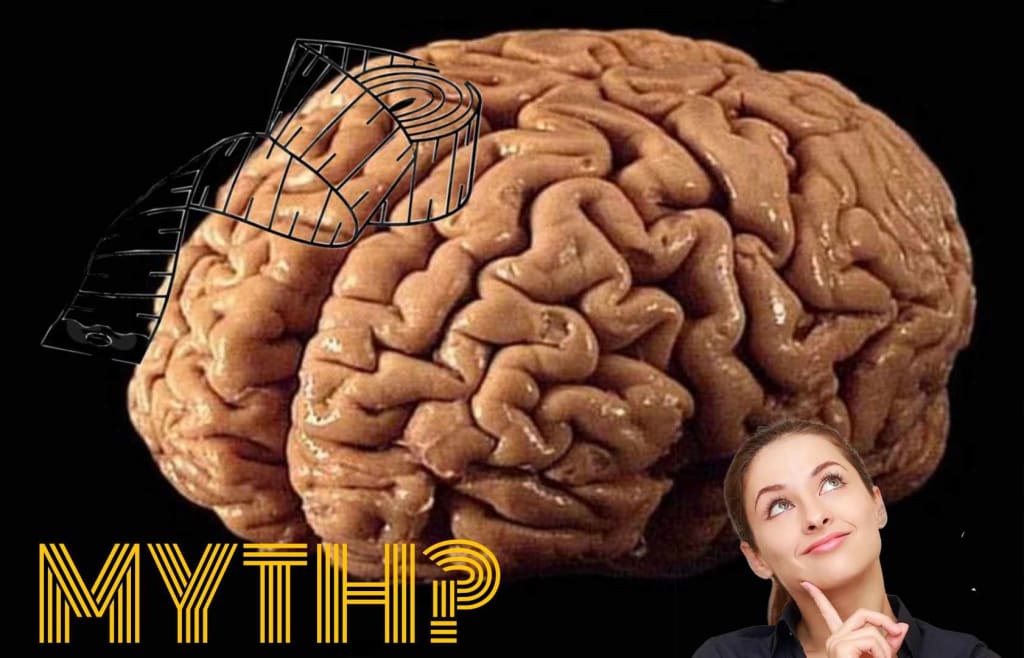
PEOPLE’S MISCONCEPTION ABOUT BRAINS
Today, we will be dispelling misconceptions about the human brain. Contrary to popular belief, the intelligence of a creature is not determined solely by the size of its brain. Although some might assume that a larger brain equates to greater intelligence, this is not the case. In reality, there exist creatures with brains larger than ours, yet these brains might not be as intricate.
The size of a creature's brain is, in fact, influenced by its body proportions. Take the example of a massive brown bear, which possesses a brain much larger than ours. However, this does not automatically translate to superior intelligence. While this assertion lacks comprehensive research, one can observe instances like chimpanzees. Despite having smaller brains compared to ours, chimpanzees are widely acknowledged to be on par with our level of intelligence.
In essence, the magnitude of the brain does not hold the key to intelligence. Rather, it is the complexity and development of distinct brain regions that play a crucial role. Humans exemplify this through areas like our language centers, which are significantly more advanced in comparison to those of animals like cows or chimpanzees.
The notion that we only utilize 10% of our brains is erroneous. In reality, our brain is engaged across its entirety, although not continuously. For the most part, a percentage of our brain is active during various tasks. This misconception emerged around the early 1800s when researchers sought to comprehend why brain injuries led to disabilities. Psychologists of the time speculated that only around ten percent of our brain was in use, and those who were more intelligent employed a larger portion.
Yet, contemporary understanding contradicts this idea. This knowledge has been shaped by the utilization of PET MRI and functional MRI studies. Our brain comprises distinct regions with specialized functions. At the frontal lobe, an array of tasks including motor skills, language processing, and executive functions are managed. The parietal lobe, located at the brain's rear, functions as our sensory cortex. Meanwhile, the occipital lobe processes visual information, and the temporal lobe, especially on the left side, is integral to memory and language comprehension.
For instance, when reading, both the frontal and temporal lobes come into play. Additionally, the visual cortex at the rear processes the visual input, allowing comprehension. When dissecting the brain further, the brain stem, akin to a "lizard brain," governs primal functions like arousal, breathing, heart rate, and blood pressure. Motor functions and the cerebellum, located beneath, also contribute to motor control and planning.
Engaging in a task activates multiple segments of the brain, though not all simultaneously. Therefore, the notion of using only a fraction of our brain's capacity is far from accurate.
The misconception that "left-brained individuals are logical while right-brained individuals are creative" can be traced back to the 1800s. During this era, neurologists were exploring the brain's distinct functions and noted that the left hemisphere of most people tends to dominate language and verbal memory tasks. Conversely, the right hemisphere appeared to handle visual-spatial functions. However, it's important to clarify that there is no structural difference in the brains of individuals who lean towards logic versus creativity. Instead, the influence often stems from their upbringing and environment.
In neurology, discussions of brain hemispheric dominance primarily revolve around language and verbal memory. For right-handed individuals, which comprise around 90% of the population, left hemisphere dominance is common. Consequently, activities related to memory, speech production, and comprehension are associated with the left side of the brain. On the other hand, left-handed individuals exhibit more variability in hemispheric dominance.
The truth is that designating someone as "left-brain dominant" or "right-brain dominant" doesn't neatly equate to one person being more creative while the other is more logical. These traits and abilities are developed through a combination of inherent tendencies and personality factors. Importantly, they are not intrinsically tied to the specific brain hemisphere an individual utilizes more.
About the Creator
Earth Goings
This page covers current events on Earth, information and research about living organisms, and relatable topics.
Enjoyed the story? Support the Creator.
Subscribe for free to receive all their stories in your feed.
Comments
There are no comments for this story
Be the first to respond and start the conversation.