
Light Is Not a Wave or a Particle. The Double Slit Shows Why the Question Breaks Down
A plain-English walk through interference, path information, and delayed choice, without the “present changes the past” hype
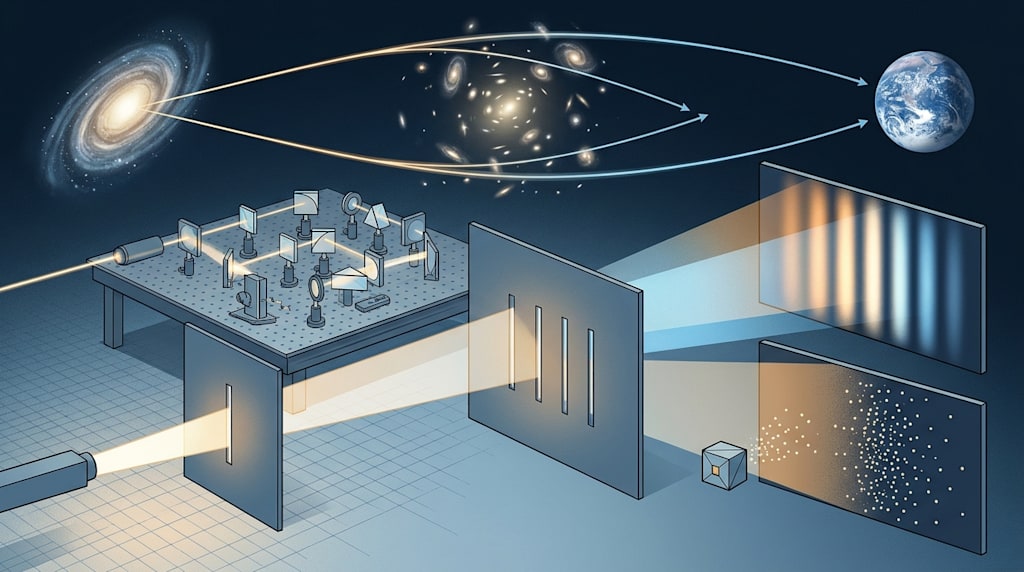
Light is a quantized excitation of the electromagnetic field. In one setup it produces localized detection events. In another it produces interference fringes. The apparatus decides which phenomenon appears. It does not rewrite the emission event.
That claim is easy to state and hard to absorb. The way to absorb it is to follow the experiments.
Maxwell: light looks like an electromagnetic wave
In the nineteenth century, Maxwell wrote down the equations of electromagnetism. The equations predicted that electromagnetic disturbances could travel through space as waves. The predicted speed matched the measured speed of light.
That agreement was strong evidence. If electromagnetic waves travel at the speed of light, and light travels at the speed of light, then light is reasonably identified as an electromagnetic wave. The inference rested on theory plus measurement.
Physics is not mathematics. A theoretical identification needs experimental support. Saying that a fast runner is “like a rabbit” does not make him a rabbit. You need evidence of rabbit behavior. For light, that evidence came from interference.
Young’s double slit: interference shows wave behavior
In 1803, Thomas Young used a rough apparatus: a candle, a cardboard screen with two narrow slits, and a viewing screen behind it. Light passed through the two slits and landed on the screen. The screen showed alternating bright and dark bands.
That pattern is interference. Where two waves arrive in phase, their amplitudes add and produce a bright band. Where they arrive out of phase, their amplitudes cancel and produce a dark band. Water waves do this. Sound waves do this. Light does this.
At that point, the wave picture had a theoretical basis and an experimental signature. It predicted the fringe pattern.
Then the wave picture hit a wall.
Blackbody radiation: the continuous-wave picture fails
A blackbody is an idealized object that does not reflect light and emits radiation according to its temperature. The Sun, a heated iron bar, and a human body in a dark room are approximate blackbodies. Their glow is thermal radiation.
At a fixed temperature, a blackbody emits a spectrum: energy distributed over frequencies. Classical physics treated light as a continuous electromagnetic wave and applied statistical mechanics. The calculation failed. At high frequencies, the classical result diverged. The predicted energy density went to infinity. This failure became known as the ultraviolet catastrophe.
Planck found a formula that fit the measured curve. The formula required a condition: the energies of the oscillators in the blackbody wall could not take arbitrary continuous values. They had to be discrete:
E=nhν
where hh is Planck’s constant, νν is frequency, and nn is an integer. Energy exchange was quantized.
Planck did not initially claim that light itself is made of particles. He quantized the energy of the emitting oscillators. The step was still decisive. A continuous classical quantity had become discrete at the microscopic level.
The photoelectric effect: frequency is a threshold
The photoelectric effect gave the next piece of evidence.
Light striking a metal surface can eject electrons. Classical wave theory offers a natural explanation: light is an electromagnetic wave, the wave carries energy, and the energy pushes electrons out. More intense light carries more energy, so it should eject more electrons and give them more energy.
Experiment disagreed in a specific way. Whether electrons are ejected depends on frequency, not mainly on intensity. High-frequency blue or green light can eject electrons even when the light is weak. Low-frequency red light does not eject electrons even when the light is intense. More precisely:
Frequency determines the energy of a single photon.
Frequency must exceed a threshold for electrons to escape.
Intensity determines the number of photons arriving per second, and therefore the number of emitted electrons, that is, the photocurrent.
Intensity does not change the energy of a single photon. A very intense red beam cannot make up for the fact that each red photon carries too little energy.
Einstein’s 1905 explanation was direct: light itself is quantized. A beam of light consists of photons, each with energy
E=hν
A photon with enough energy can eject an electron. A photon with too little energy cannot, no matter how many such photons arrive. Millikan later verified the photoelectric equation, and Compton scattering showed photon-like momentum exchange. The photon was no longer a mathematical patch.
Matter waves and the single-electron double slit
If light has particle-like behavior, what about electrons?
de Broglie proposed that electrons, and in fact all matter, have a wavelength:
λ=hp
where p is momentum. For everyday objects, the wavelength is absurdly small. A 3 kg ball moving at 10 m/s has a de Broglie wavelength around 10−35m. That is far below any practical observation. For electrons, the wavelength is large enough to matter.
In 1961, Jönsson performed an electron interference experiment with multiple slits. Later, in 1989, Tonomura and collaborators performed a single-electron double-slit experiment. The setup sent one electron at a time toward the slits. Each electron arrived at the screen as a single localized dot. A single electron did not produce a fringe pattern.
But as the dots accumulated, a fringe pattern appeared.
If electrons were classical particles, each electron would go through one slit, and the accumulated pattern would look like a target after many shots. It would not show interference. The pattern did show interference.
Quantum mechanics describes the electron with a probability amplitude. When the two paths are indistinguishable and no which-path information is recorded, the amplitude includes contributions from both paths. Those contributions interfere. Each detection is a localized event. The fringe pattern is a statistical distribution built from many single events.
One event looks particle-like. The ensemble looks wave-like.
Which-path detectors: interference disappears because information exists
Now add detectors at the slits. Suppose each detector can record which slit the photon or electron passed through. The interference pattern disappears. The particles behave as if each one went through one slit.
A common shorthand claims that looking turns the particle into a particle and not looking turns it into a wave. That phrasing suggests that consciousness or looking is the key. It is not.
Path information controls the outcome.
When a detector interacts with the particle and records which path was taken, the particle’s state becomes entangled with the detector. The two paths become distinguishable. Distinguishable paths do not produce the same interference term. The environment has acquired information about the path. The coherence between the two path amplitudes is lost. This is decoherence.
A human does not need to read the detector. If which-path information is in principle available in the environment, the interference term vanishes. Even if no one reads the record, the information has leaked. The interference is gone.
“Observation” in quantum mechanics means a physical interaction that records information. It does not mean a conscious observer.
Delayed choice: choosing the measurement, not rewriting the past
In the late 1970s, Wheeler proposed a delayed-choice experiment. The idea is to let the particle pass the slits first, and then choose the measurement setup afterward. Will we measure which path it took, or will we combine the paths and look for interference?
The results are often described misleadingly: “The present choice changes the past.” That phrasing invites retrocausality. It is not what the experiment shows.
The quantum state does not carry a pre-labeled tag saying “I am a wave” or “I am a particle.” The measurement context determines which complementary phenomenon can be observed. If the apparatus is set to obtain which-path information, no interference appears. If the apparatus is set to erase the path information and combine the paths, interference can appear.
The delayed choice selects the measurement question. It does not send a signal back to the emission event. It does not change the photon’s past. It does not allow superluminal communication.
Wheeler also described a cosmic version. Light from a distant galaxy can be gravitationally lensed into two images. The two paths arrive at Earth after billions of years. An observer on Earth can choose to measure one image in a way that reveals path information, or combine the images to look for interference. The choice on Earth does not alter the emission event billions of years ago. It determines which measurement context is realized now. The photon’s history is not a classical trajectory with a definite “wave” or “particle” label attached at emission.
The popular “teacher takes attendance” analogy can be repaired. The teacher’s decision now does not change whether you wore a suit or sports clothes in the past. The teacher now chooses whether to check the attendance record or the basketball-court camera. The choice determines which kind of record you can obtain. In the quantum case, the complementarity is stronger: which-path information and interference are not simultaneously defined. The measurement setup determines which phenomenon is observed. It does not change macroscopic facts or transmit information backward in time.
Quantum erasure: interference returns only in the right subset
Quantum-eraser experiments extend the same logic. Suppose which-path information is recorded, so interference disappears. If that information is erased in the right way, and if the data are sorted into the correct coincidence subsets, interference can be recovered.
This is not a magic eraser that deletes the past. The recovery is conditional. It appears in coincidence counts, not in the total pattern. It depends on how the measurement results are correlated. It cannot be used to send a signal faster than light. What it shows is that coherence and path information are tightly linked, and that the choice of measurement and data selection determines which complementary phenomenon is visible.
The modern picture: complementarity, not a switch
In quantum field theory, light is described as a quantized excitation of the electromagnetic field. A photon is a quantum of that excitation. The theory does not say that a photon is sometimes a classical wave and sometimes a classical bullet. It says that the quantum object is described by a state, and that measurements produce outcomes according to probabilities.
Different experiments reveal different aspects:
A photodetector, a photographic plate, or a single-photon detector records localized events. The events look particle-like.
A double slit or interferometer with indistinguishable paths produces interference. The probability distribution looks wave-like.
If which-path information is recorded, interference disappears.
If the path information is erased and the data are sorted correctly, interference can reappear in the appropriate subset.
The wave aspect and the particle aspect are complementary. They are not two simultaneous classical properties.
Macroscopic objects also have quantum properties. Their de Broglie wavelengths are extremely small, and their interactions with the environment rapidly destroy coherence. That is why everyday objects do not show interference. The classical world is not a separate world. It is what quantum systems look like when coherence is lost.
The working answer
Light is not a classical water wave, and it is not a classical bullet. It is a quantized excitation of the electromagnetic field. It exhibits wave-like and particle-like behavior under different experimental conditions.
The double slit shows that single events can be localized while the accumulated distribution shows interference. Which-path detectors show that interference disappears when path information is in principle available. Delayed choice shows that the measurement context determines which complementary phenomenon is observed. It does not change the past and cannot send signals backward in time. Quantum erasure shows that interference can be recovered in the correct coincidence subset. It is not retrocausal magic.
The question “Is light a wave or a particle?” is less useful than the question “What does the apparatus allow us to measure?” The apparatus determines the measurement context. It does not determine what happened in the past. The photon has no independent, pre-labeled “wave” or “particle” identity apart from the experimental conditions under which it is measured. Wave and particle are complementary descriptions of a quantum object.
About the Creator
Jin
Writer of reamstories
https://reamstories.com/jin
Enjoyed the story? Support the Creator.
Subscribe for free to receive all their stories in your feed. You could also become a paid subscriber, letting them know you appreciate their work.
Comments
There are no comments for this story
Be the first to respond and start the conversation.