
Light Is Not a Wave or a Particle. The Double-Slit Experiment Proves Something Stranger.
No, your observation does not rewrite the past. Quantum mechanics is more precise, and more unsettling, than the viral version.
1. Maxwell Calculated the Speed of Light, but “Same Speed” Does Not Mean “It Is Light”
In the nineteenth century, Maxwell wrote down his equations of the electromagnetic field. The solutions showed that electromagnetic disturbances can propagate through space, and that the propagation speed is determined by the vacuum permittivity and permeability. Substituting the values measured at the time gave a speed that matched the speed of light.
This was a strong clue. But physics is not mathematics; elegant equations cannot replace experimental verification. Just because something travels at the speed of light does not mean it is light. In 1887, Hertz experimentally confirmed the existence of electromagnetic waves, and only then did people gradually accept that light is a kind of electromagnetic wave.
This step incorporated light into classical wave theory. It had frequency, wavelength, and could interfere and diffract. By the end of the nineteenth century, classical physics seemed to have given light a complete identity.
But classical wave theory had a premise: energy can vary continuously. That premise shattered in the face of blackbody radiation.
2. Young’s Double Slit: Light Interferes, but the Word “Wave” Conceals Too Much
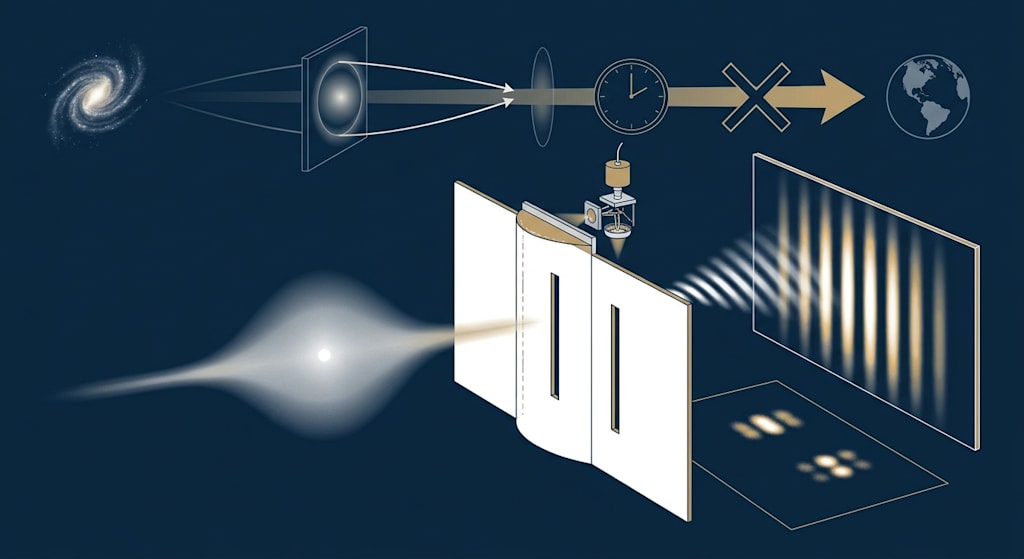
In 1803, Thomas Young performed the double-slit experiment. The apparatus was simple: a light source, a barrier with two slits, and a screen. After passing through the two slits, the light hit the screen and produced alternating bright and dark fringes.
If light were a classical particle, the particles coming through each slit would hit the screen independently, and the screen would show at most two bright bands. But what was observed was a series of bright and dark fringes. This meant that two light waves superimposed on the screen: where crest met crest, they reinforced; where crest met trough, they canceled.
The conclusion seemed clear: light is a wave.
But this conclusion contained a hidden assumption: interference is a behavior only continuous waves have. At the time, no one asked: if the light were so weak that only one photon passed through at a time, what would appear on the screen? That question had to wait until single-photon experimental technology matured before it could be seriously answered. And the answer was far more complicated than “light is a wave.”
3. Blackbody Radiation: The Continuous-Wave Picture Produced an Infinite Curve
A blackbody is an idealized object that does not reflect light and only emits its own thermal radiation. The sun, a red-hot piece of iron, and the human body can all be approximated as blackbodies. At a given temperature, the energy of blackbody radiation has a specific curve as a function of frequency.
Classical statistical mechanics treated light as a continuous electromagnetic wave and assigned energy to each frequency mode. This approach barely worked at the low-frequency end, but at the high-frequency end, the predicted energy tended toward infinity. This was the “ultraviolet catastrophe”: the curve given by classical theory shot up in the short-wavelength region and seriously disagreed with the experimentally measured curve.
Planck stepped in. At first he only wanted to find a mathematical formula to fit the experimental curve. But he found that for the formula to hold, he had to assume that the energy of the oscillators in the blackbody cavity was not continuously variable, but exchanged in discrete portions. The concept of energy quantization was born.
Planck initially did not say “light is particles.” What he introduced was the quantization of energy exchange. Extending quantization to light itself was Einstein’s next step.
4. The Photoelectric Effect: Frequency Is the Threshold, Intensity Is the Number
The photoelectric effect experiment: light shines on a metal plate, and the metal plate emits electrons.
The classical electromagnetic-wave picture could naturally offer an explanation: light waves have energy, energy pushes electrons, and the electrons are knocked out. The stronger the light, the greater the energy, and the more and faster the electrons should be. But experiments found that whether electrons can be knocked out depends mainly on the frequency of the light.
High-frequency green light, blue light, and ultraviolet light, even when very weak, can cause electrons to escape. Low-frequency red light, even when very intense, cannot knock out electrons. There is a cutoff frequency. Below it, no matter how strong the light is, it is useless.
Einstein’s explanation was: light consists of photons, and the energy of each photon is E = hν. The higher the frequency, the greater the energy of a single photon. Whether an electron can escape depends on whether a single photon has enough energy to overcome the metal’s work function. Light intensity mainly affects the number of incident photons per unit time, and thus the number of escaping electrons.
So the accurate statement is: frequency determines the energy threshold of a single photon; intensity determines the number of photons. The popular claim that “how the electrons move has nothing to do with light intensity” is too absolute. More precisely, whether electrons can escape and their maximum initial kinetic energy are determined by frequency; saturation current and similar quantities are related to intensity.
At this point, the particle nature of light became explicit. But a problem followed: if light is particles, how is double-slit interference to be explained?
5. de Broglie: Electrons Also Have Wavelengths, and Macroscopic Objects’ Wavelengths Are Too Small to See
de Broglie proposed: if light has both wave and particle nature, do material particles such as electrons also have wave nature? He gave the relation λ = h/p. A ball with a mass of 3 kilograms and a speed of 10 meters per second has a wavelength as small as 10 to the negative thirty-something meters, far too small to observe. So macroscopic objects appear entirely classical. But in the microscopic world, the wavelengths of electrons, neutrons, and atoms can be large enough to compare with crystal lattice spacings, so diffraction and interference can be observed.
Later, electron diffraction experiments confirmed matter waves. In 1961, physicists performed the double-slit experiment with single electrons: only one electron was emitted at a time, and each time only one dot appeared on the screen; but after a large number of electrons were emitted, interference fringes appeared.
This result matters. It shows that interference is not a classical effect caused by many electrons colliding with one another, but that the quantum state of a single electron itself has wave nature. After each electron passes through the double slit, its probability amplitude covers both paths; after many electrons accumulate, the probability distribution shows an interference pattern.
“A single electron passes through both slits at the same time, being here and there at once” is a colloquial expression. More rigorously: the electron’s quantum state is a superposition of the two paths; before measurement, one cannot impose on it a classically definite path. At measurement, we obtain only one result.
6. Which-Path Information and Complementarity: The Apparatus Determines the Information
The most counterintuitive variant of the double-slit experiment is to add which-path detectors.
If detectors are placed behind the double slit to watch which slit the photon actually goes through, the interference fringes disappear, and the photon behaves as a particle “coming through one slit.” If the detectors are removed and only the screen is left, the interference fringes reappear.
Popular science says: the photon knows we are watching it, so it chooses to be a particle. This statement is inaccurate.
The deciding factor is whether which-path information is recorded. When the experimental apparatus can in principle obtain the information “which slit the photon went through,” the quantum probability amplitudes of the two paths can no longer maintain a coherent superposition, and interference disappears. This is not the photon temporarily changing its personality; rather, the measuring apparatus physically couples with the quantum object, extracts which-path information, and destroys the coherence required for interference.
This is quantum complementarity: wave nature and particle nature are complementary descriptions. You can design an experiment to observe interference, or you can design an experiment to obtain which-path information, but you cannot fully see both in the same experiment at the same time. The photon is not choosing what to be; the experimental apparatus determines which class of phenomena we can see.
7. Wheeler’s Delayed Choice: There Is No Classical Script Before Measurement, and No Causal Reversal
In the late 1970s, Wheeler proposed the delayed-choice thought experiment. The core design is: let the photon first pass through the double slit, and after it has already passed, decide whether to insert a screen or measure which path. The question sounds tricky: if the photon has already gone through, and I then decide how to measure, will it be forced to change its earlier behavior?
Popular accounts often tell it like this: the photon has already passed through the double slit like a particle, but later we suddenly put up a screen, and interference fringes still appear on the screen; therefore the photon passed through both slits at the same time, and our observation changed the photon’s historical trajectory. Some go further and say: present choices can change the past.
This conclusion is over-interpretation.
A more accurate quantum-mechanical description is:
First, before the final measurement, the photon is in quantum-state evolution. It does not have a classically meaningful definite path or a definite wave/particle identity waiting to be revealed.
Second, the overall design of the experimental apparatus determines what statistical results the final measurement will yield. Delayed choice does not require going back in time to modify the photon state; the quantum state evolves according to the Schrödinger equation from the beginning until measurement occurs.
Third, the very question “was the photon originally a wave or a particle?” presupposes a classical fact. But in quantum mechanics, before measurement there is not always such a classically definite fact.
Fourth, delayed-choice experiments do not violate causality and cannot be used for superluminal signaling. What they display is quantum complementarity and measurement context, not causal reversal.
To use a less mysterious analogy: a quantum object does not have a script written in advance saying “today I am a wave” or “today I am a particle,” which measurement then exposes. More accurately, the experimental apparatus and the final measurement jointly determine the complementary way in which we describe it. Present choices do not rewrite the past; the past does not have a classical script independent of the measurement context.
8. Starlight from a Billion Light-Years Away: This Also Does Not Mean We Rewrite History
Wheeler also proposed a grand thought: starlight emitted by a distant galaxy is split into two beams by a gravitational lens and arrives at Earth separately. The gravitational lens is equivalent to a gigantic double slit. If we perform a coincidence measurement between the two light paths, we may see interference; if we measure the two paths separately, we obtain which-path information and interference disappears.
Popular accounts say: our choice on Earth determines whether the photon was a wave or a particle when it set out ten billion years ago. This sounds striking, but it is likewise not rigorous.
More accurately: the quantum state of the photon propagating over ten billion years has its information extracted by the measuring apparatus on Earth. Whether we choose to measure path or measure interference determines which kind of complementary information we obtain. It does not mean that experimenters on Earth send a signal backward and change the emission event ten billion years ago. Quantum mechanics does not allow this kind of superluminal causal influence.
9. So What Exactly Is Light?
If one must answer in one sentence: light is a quantum field, a quantized excitation of the electromagnetic field. Photons appear as discrete energy exchanges in detection, and as superpositions of probability amplitudes with wave behavior in coherent experiments.
“Wave-particle duality” is a historical term. It reminds us that classical language is insufficient to describe quantum objects completely. Wave and particle are not two sets of clothes that a photon can change into whenever it likes; they are two complementary approximations we obtain when we use classical concepts to approach the quantum world.
From a more modern perspective, quantum field theory: a photon is a quantum of the electromagnetic field. The so-called particle is the discrete excitation exhibited by the field in measurement; the so-called wave is the coherent evolution of the field. The two are not mutually exclusive entities, but complementary aspects of the same quantum structure.
10. What This Article Leaves Behind
First, the double-slit experiment shows that quantum objects have wave nature, but not in the sense of classical water waves. A single particle can also accumulate into interference, which shows that interference occurs at the level of probability amplitudes.
Second, the photoelectric effect shows that light exchanges energy with matter in discrete portions, but not as classical bullets. Photons have no classical trajectory.
Third, which-path information and interference are complementary. Once an experiment obtains the information of which slit was taken, interference disappears. Consciousness does not decide; the physical measuring apparatus determines how information is extracted.
Fourth, delayed choice does not change the past. It shows that before measurement one cannot impose a classically definite historical script on a quantum object; the final measurement determines which kind of complementary information we obtain, not that present choices retroactively rewrite events from ten billion years ago.
Fifth, quantum mechanics does not provide superluminal signaling, nor does it support the metaphysical conclusion that consciousness creates reality. What it requires us to give up is the intuition that quantum objects must possess classically definite properties before measurement, not causality itself.
So, is light a wave or a particle?
The more reliable answer is: light is a quantum object that we cannot fully describe with classical language, yet can calculate precisely with quantum mechanics. It forces us to admit that at the most fundamental level, the world does not always play out according to the classical script of “either wave or particle.” But this is not metaphysics; it is the precise rule of quantum mechanics.
About the Creator
Jin
Writer of reamstories
https://reamstories.com/jin
Enjoyed the story? Support the Creator.
Subscribe for free to receive all their stories in your feed. You could also become a paid subscriber, letting them know you appreciate their work.
Comments
There are no comments for this story
Be the first to respond and start the conversation.