Latest Stories
Most recently published stories in FYI.
Operation Bunyān Marsūs: Pakistan's Strategic Missile Response to Indian Airstrikes
What Do We Know About the 'Fateh Missile' That Initiated Operation Bunyān Marsūs? The government of Pakistan has announced that in the early hours of Saturday morning, it launched a retaliatory operation against India, named Operation Bunyān Marsūs. It is worth recalling that on the previous night, explosions were heard in several areas, including Rawalpindi in Punjab province. Shortly thereafter, Director General of the Inter-Services Public Relations (ISPR), Lt. Gen. Ahmed Sharif Chaudhry, claimed that during Indian airstrikes between Friday and Saturday night, missiles were launched targeting Noor Khan Airbase in Rawalpindi, Shorkot Airbase, and Murid Airbase. However, according to him, all air force assets remained safe. Soon after this information was shared, the launch of Operation Bunyān Marsūs was officially announced. According to ISPR, the operation began with Pakistan launching its Fateh-1 missile. ISPR also shared videos of the launch with BBC. According to the Pakistani military, “This operation is dedicated to the Pakistani children who were martyred as a result of India’s aggression against Pakistan.” It added, “Pakistan has not and will never forget the martyrdom of these innocent children.” What Does “Bunyān Marsūs” Mean? The term Bunyān Marsūs is derived from a verse in the Holy Quran and translates to “a solidly cemented wall.” This phrase appears in Surah As-Saff, verse 4, which states: > “Indeed, Allah loves those who fight in His cause in a row as though they are a solid structure.” According to ISPR, Bunyān Marsūs represents people who struggle in the path of Allah, standing firm like an iron wall — the most beloved to God. This spiritual sentiment inspired the naming of the operation. What Is the Fateh-1 Missile? According to ISPR, the operation began with the launch of the Fateh-1 missile. The public relations wing of the military also released videos of the launch, which have since gone viral on social media. The term “Fateh-1” has become one of the top trends in Pakistan. Fateh-1 is a modern, short-range, surface-to-surface guided missile developed by Pakistan with a range of up to 140 kilometers. On August 24, 2021, Pakistan successfully tested this locally developed rocket system. Fateh-1 is part of the “Fateh series,” which also includes Fateh-2. The Fateh-2 missile can reach targets up to 400 kilometers away and has precise targeting capabilities. The missile can carry a warhead weighing between 300–500 kg. Dr. Mansoor Ahmed, a lecturer in Strategic and Defence Studies at the National University of Canberra, notes that the Fateh missile represents a sophisticated addition to Pakistan’s long-range artillery rocket systems. These missiles can precisely strike high-value targets such as airbases, command and control centers, ammunition depots, logistic lines, and forward artillery. Dr. Ahmed explains that the key feature of these missiles is their stand-off capability — they can be launched from beyond the enemy's defensive perimeter. They also possess a “shoot-and-scoot” ability, meaning the launcher can relocate immediately after firing, reducing the risk of counter-strike. He likens them to the U.S.-made HIMARS system, currently used effectively in Ukraine. Since the Fateh series is locally produced, Pakistan is not dependent on external suppliers and can continue missile production independently. According to Dr. Ahmed, the Fateh series includes Fateh-1, Fateh-2 (both operational), and upcoming models like Fateh-3 and Fateh-4, with Fateh-4 expected to have a range of 700 km. Supersonic Accuracy and Tactical Maneuverability Defense analyst Syed Muhammad Ali, based in Islamabad, highlights that the Fateh missile series offers exceptional accuracy and operates at supersonic speeds. Its most significant feature is its terminal maneuverability — the ability to change direction during the final phase of flight. He draws a cricket analogy: just as Waqar Younis's late swing confused batters, the Fateh missile’s final-stage maneuvering confuses enemy defense systems, rendering interception nearly impossible. According to him, India has a three-layered defense system — the outermost being the Russian-made S-400 (range 300–400 km), followed by Israel’s Barak-8 surface-to-air missile, and the indigenous Akash system. He claims Fateh-1’s terminal-stage agility allows it to bypass all these layers, making it a vital tool in Pakistan’s full-spectrum deterrence strategy. Impact of the Fateh-1 on Airbases Targeting airbases with Fateh-1 yields strategic advantages. The missile can release hundreds of bomblets, destroying runways and creating craters that ground aircraft. Until runways are repaired, all air operations are effectively halted. Public Reaction and Naming Praise Many Pakistani social media users have praised the naming of the operation as Bunyān Marsūs. One user, Faraz, wrote on X (formerly Twitter): “I usually don’t favor naming military operations in any language other than Urdu, but considering the nature of our current adversary, Bunyān Marsūs is the perfect name.”
By Ikram Ullahabout a year ago in FYI
5 countries that have the most and largest financial institutions in the world
While it is challenging to pinpoint the exact number of financial institutions in each country and rank them definitively by quantity, we can discuss five countries that are recognized as having a significant presence of large financial institutions and are major global financial centers. Based on available data and general understanding, these countries are:
By Moharif Yuliantoabout a year ago in FYI
Dr. Jyoti Bansal — “How diabetes silently affects your bladder, kidneys, sexual health, and increases your risk of urological complications — and what you can do to protect yourself.”
Living with diabetes means paying attention to more than just blood sugar. Over time, high glucose levels can harm delicate organs — especially those in your urinary system. In this guide, you’ll learn in simple, easy-to-follow language:
By Dr. Jyoti Bansalabout a year ago in FYI
Why Laptop Rentals in Pune Are the Go-To Solution for Agile Tech Teams
Pune, often referred to as India’s emerging IT and startup center, is home to a growing number of tech companies—ranging from start-up innovations to global AI tech. In today’s swift-paced business eco system, the need for scalable, cost-efficient, and high-performance IT infrastructure is at an all-time high. That’s how laptop rentals play a pivotal role in helping tech teams struggling for flexibility and growth.
By C Prompt Solutions Pvt Ltdabout a year ago in FYI
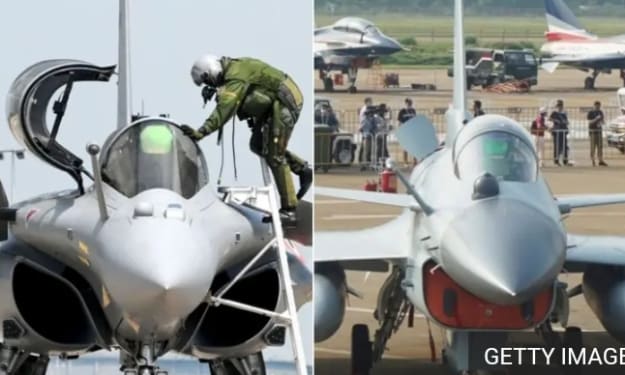
Rafale vs J-10C: The Dogfight Between India and Pakistan That Captivated the World
Islamabad, May 7 – In what could become one of the most significant aerial confrontations in modern military history, Pakistan has claimed that its air force downed five Indian Air Force (IAF) jets during an overnight engagement on May 6–7. The claimed kills reportedly include three Rafale jets — France’s pride in aerial warfare. While New Delhi has yet to comment officially, international media outlets and independent verification units have started to assess the available evidence. The BBC’s investigative team “BBC Verify” has confirmed three geolocated videos that appear to show wreckage consistent with a Rafale fighter aircraft, reportedly used by the IAF. The world is now closely watching the unfolding situation — not only due to the geopolitical consequences but also because this incident puts Chinese and Western fighter technologies in direct competition. What Sparked the Clash? According to the Pakistan Air Force (PAF), the skirmish occurred during a major nighttime air operation, involving over 100 aircraft from both sides — 70 Indian and 40 Pakistani jets. This scale of engagement, if confirmed, would be unprecedented in modern air combat history. PAF Deputy Chief of Air Operations, Air Vice Marshal Aurangzeb, described the battle as a Beyond Visual Range (BVR) conflict, lasting around an hour. He said Pakistan deployed JF-17s, F-16s, and the more advanced Chinese-built J-10C fighters. However, he did not confirm whether the long-range PL-15 missile was used in the engagement. “We initiated a multi-domain operation once Indian jets crossed our air defense detection range,” said Aurangzeb. He further claimed Pakistan’s air defense systems played a crucial role, with some kills achieved via surface-to-air weaponry. To ensure civilian safety, air traffic over major Pakistani cities, including Islamabad and Lahore, was temporarily rerouted. Aurangzeb also stated that Indian Rafale jets were specifically targeted: “In 2019, India said that if they had Rafales, the result would’ve been different. So, this time, we wanted to test that claim.” PAF claims that three Rafales were downed near Bhatinda, Jammu, and Srinagar, while a MiG-29 and Su-30MKI were allegedly shot down near Srinagar. These claims have not yet been independently verified. International Reaction and Verification India has neither confirmed nor denied the loss of any aircraft. Indian Foreign Secretary Vikram Misri, in a brief statement, said: “A formal response will be issued at an appropriate time.” However, international sources have begun to weigh in. A U.S. official, speaking anonymously to Reuters, confirmed that at least one Indian jet shot down was indeed a Rafale. A senior French intelligence official, quoted by CNN, corroborated the claim. The incident has attracted attention from strategic analysts in Washington, Beijing, and Paris — all closely monitoring how the Chinese J-10C measures up against the Western-built Rafale in an actual dogfight scenario. Jet vs Jet: J-10C vs Rafale – A Comparative Look The confrontation is not just a military standoff; it is also a technological face-off between Eastern and Western airpower philosophies. J-10C: China’s Answer to Western Air Supremacy The J-10C is a 4.5-generation multirole fighter jet developed by China’s Chengdu Aerospace Corporation. It features a delta-canard aerodynamic design, offering excellent agility and maneuverability. The jet is powered by the Russian-made AL-31FN turbofan engine, providing strong thrust and resilience against electronic warfare. Its key advantages include: AESA radar for tracking and engaging targets at long distances. Data-link compatibility with AWACS and UAVs for networked combat. PL-15 missile with a range exceeding 200 km, guided by an active radar seeker — giving the pilot “fire and forget” capability. Retired Air Vice Marshal Nasser Haq Wyne, Director at the Center for Aerospace & Security Studies, noted: “The J-10C cockpit and avionics significantly reduce pilot fatigue while enhancing battlefield awareness.” Rafale: Europe’s Battle-Tested Combat Jet The Dassault Rafale, operated by the Indian Air Force, is a versatile twin-engine fighter known for its combat experience in Libya, Mali, Iraq, and Syria. India purchased 36 Rafales from France after the 2019 Balakot airstrikes. Its strengths include: SPECTRA EW suite, providing comprehensive electronic countermeasures. Meteor missile, with superior guidance and a high “no-escape zone.” Advanced targeting and radar systems, making it one of the most survivable jets in modern warfare. India had hoped that Rafale's induction would shift the balance of power in South Asia. The aircraft was widely seen as a deterrent against Pakistan’s growing capabilities. What Does It Mean for the Future of Air Combat? This incident, if independently verified, could mark a turning point in the perception of Chinese defense exports. Analysts are now questioning whether lower-cost platforms like the J-10C, when properly integrated into air defense networks, can outperform or neutralize high-end Western fighters in real combat. This aerial showdown also adds a new layer to the already tense India-Pakistan rivalry — one that now serves as a real-world testing ground for competing military technologies. Conclusion The silence from New Delhi and the claims from Islamabad have put the world on alert. Behind the headlines lies a deeper question: Is this just another flashpoint in the India-Pakistan conflict — or the beginning of a new era in aerial warfare? As investigators examine the wreckage and intelligence agencies dig deeper, the truth — and its strategic consequences — may soon emerge. For now, the world watches, waits, and wonders.
By Ikram Ullahabout a year ago in FYI
From St. Peter to Today: Every Pope in History Matched to the Prophecy of the Popes
268 popes. Over 2,000 years. One chilling prophecy. For centuries, the Catholic Church has been led by a single spiritual figure: the Pope. But hidden within its long lineage lies a cryptic list attributed to St. Malachy, a 12th-century Irish archbishop who supposedly had a vision of all future popes — ending in the apocalypse.
By Rukka Novaabout a year ago in FYI
The New Pope Prophecy: What the Vatican Isn’t Telling You
Every time a pope steps down or passes away, the world stops. The white smoke, the balcony reveal, the name spoken in Latin—it’s one of the last true global rituals. But beneath the ancient robes and sacred pageantry lies a much darker question:
By Rukka Novaabout a year ago in FYI