Latest Stories
Most recently published stories in FYI.
Why Do Airplanes Fly at 35,000 Feet?
Why Do Passenger Planes Fly at Such High Altitudes? A Deep Dive into the Science and Safety Behind Cruising at 35,000 Feet When we board a passenger airplane, buckle our seat belts, and watch the world shrink beneath us, few of us stop to think: Why do planes fly so high? At cruising altitude, most commercial aircraft soar at around 35,000 feet, which is roughly 11 kilometers above sea level. This altitude might seem extreme to many, but there are several well-founded scientific, technical, and economic reasons behind this practice. Let’s explore why this specific altitude range is ideal for air travel, and what makes it beneficial from both a performance and safety perspective. --- 1. Fuel Efficiency and Operational Cost One of the primary reasons commercial aircraft fly at high altitudes is to maximize fuel efficiency. At around 35,000 feet, the atmosphere is much thinner than at sea level. Thinner air means less aerodynamic drag acting against the aircraft. With reduced resistance, the engines don’t have to work as hard to maintain speed, and as a result, they consume less fuel. This is crucial because fuel is one of the biggest operating costs for airlines. By flying at this optimal altitude, airlines save millions of dollars annually. The optimal cruising altitude for most commercial jets typically ranges between 35,000 and 42,000 feet (10 to 14 kilometers), depending on the type of aircraft, its weight, and flight conditions. However, there’s a limit to how high an aircraft can go. If it climbs too high, the air becomes too thin to support engine combustion efficiently. Jet engines require oxygen to function, and there’s simply not enough of it beyond certain altitudes. So, 35,000 feet becomes the “sweet spot” where the balance between efficiency and functionality is best maintained. --- 2. Reduced Air Resistance As mentioned above, the higher a plane flies, the thinner the air. At lower altitudes, air density is greater, which creates more friction or drag against the aircraft. This increased resistance would force the engines to work harder and burn more fuel to maintain speed and altitude. By cruising at higher altitudes, the airplane encounters less friction, enabling it to glide more smoothly and economically through the air. The reduced resistance at such altitudes not only improves speed and fuel consumption but also allows for longer travel ranges. Heavier aircraft, such as large international jets at the start of a journey with full fuel tanks, may begin at slightly lower altitudes and climb higher as fuel burns off and the plane becomes lighter. In contrast, lighter aircraft or those with shorter routes can afford to cruise at higher altitudes from the beginning. --- 3. Avoiding Bad Weather Weather systems—like storms, turbulence, and heavy clouds—typically occur in the troposphere, which is the lowest layer of Earth's atmosphere. This layer extends from ground level to about 7 to 12 kilometers (23,000 to 39,000 feet) depending on location and season. By flying at or above 35,000 feet, commercial planes can often avoid the worst weather conditions, including thunderstorms, rain, and turbulence caused by air currents. Although turbulence can still occur at higher altitudes due to jet streams or temperature differences between air layers, it is generally less intense and more predictable, allowing pilots to navigate it more safely. In essence, cruising above the weather makes for a smoother and more comfortable ride for passengers. --- 4. Reduced Air Traffic and Bird Hazards At lower altitudes, airspace is much busier with light aircraft, helicopters, and private planes that typically operate below 10,000 feet. Commercial planes avoid this crowded zone by flying much higher, thus reducing the risk of mid-air collisions and air traffic congestion. Moreover, birds and insects are usually found in the lower atmosphere, particularly below 10,000 feet. Flying at higher altitudes drastically reduces the chances of bird strikes, which can damage engines and compromise safety during critical flight phases like takeoff or landing. By staying at higher altitudes, commercial aircraft remain above most of these potential hazards, contributing to the overall safety of the flight. --- 5. Emergency Time and Safety Buffer In the unlikely event of an in-flight emergency—such as engine failure or cabin depressurization—altitude gives pilots valuable time to react, troubleshoot, and safely descend. A plane cruising at 35,000 feet has more room to glide if engines fail, giving the crew the opportunity to navigate toward the nearest airport or safe landing area. It’s also important to note that modern commercial aircraft are designed to fly and even land safely with just one engine, or glide for considerable distances in the rare case of total engine failure. So the altitude acts as a built-in buffer that enhances safety and provides margin for error in emergencies. --- 6. A Record of Extremes: The Highest Altitude Ever Flown While 35,000 feet is standard for passenger flights, aircraft can fly much higher under special conditions. The record for the highest altitude ever achieved by a jet aircraft was set in 1977 by Soviet pilot Alexander Fedotov, who flew the MiG-25M, a high-performance military reconnaissance aircraft, to an astonishing altitude of 123,520 feet—around 41 kilometers. This record, though, was achieved under very controlled circumstances and isn’t feasible for commercial travel. The MiG-25 was a specially designed military aircraft with features and protection systems that allow it to survive extreme altitudes where oxygen is scarce, and pressure is dangerously low. --- Conclusion: The Sky Has Its Limits—and Its Logic The decision to fly commercial aircraft at around 35,000 feet isn’t random—it’s a carefully calculated choice that balances economy, performance, safety, and comfort. From reducing fuel consumption to minimizing exposure to weather and air traffic, this altitude provides the best conditions for efficient air travel. Next time you look out the window and marvel at the clouds far below, remember: there's a fascinating mix of physics, engineering, and strategy that allows us to travel so high, so fast, and so safely—on nothing more than a few tons of metal and wings.
By Ikram Ullahabout a year ago in FYI
Why We Feel Nothing When Mosquitoes Bite Us (But Itches Later)
It’s a warm evening. You’re enjoying the outdoors, and everything feels perfectly normal—until a few hours later when an unbearable itch creeps up on your skin. You look down and see the familiar red bump: a mosquito bite. The strange part? You never felt the bite happen. It’s like the mosquito was never there. So why does something so small leave such a big, irritating aftermath—while making a silent entrance?
By Noman Khan about a year ago in FYI
My struggle with digital marketing
You see them everywhere. People making passive income while they sleep. A viral TikTok here, a fancy Instagram Reel there. All of them claiming that selling digital products is the ultimate ticket to financial freedom. They tell you how easy it is. Just open a Stan Store or Etsy. Upload a Canva designed planner, coloring page, or e-book. Market it with a cute caption and soon you are making thousands a month.
By Yvonne Knightabout a year ago in FYI
The Headless Survivor: Nature’s Most Resilient Insect
Did You Know? > There is a creature that can survive for a whole week even after its head is cut off! As unbelievable as it sounds, it’s absolutely true. There exists a creature in this world that can live for days—even up to a week—without its head. That creature is the cockroach. Yes, a cockroach can stay alive for several days, sometimes even a week, after being decapitated. It may sound astonishing, but there are fascinating scientific reasons behind this phenomenon. --- How Can a Cockroach Live Without Its Head? 1. No Blood Pressure Like Humans Cockroaches don’t have a circulatory system like humans. Their bodies don’t rely on blood pressure in the same way. Instead of a closed circulatory system (where blood is pumped through arteries and veins), cockroaches have an open circulatory system. This means their organs are bathed in a free-flowing fluid (hemolymph), which doesn’t require a heart to pump it forcefully. So, when a cockroach loses its head, it doesn’t bleed to death the way a human would. Its neck simply closes off, and because there’s no pressurized system, the fluid doesn’t gush out uncontrollably. 2. Breathing Without a Head One of the biggest reasons a cockroach can survive without its head is its unique respiratory system. Cockroaches don’t breathe through their nose or mouth. Instead, they have small holes called spiracles located along the sides of their body. These spiracles lead to a network of tubes (tracheae) that deliver oxygen directly to their tissues. So, even if the head is removed, the body continues to absorb oxygen and release carbon dioxide—no lungs or central nose required. This allows the body to function for several days after decapitation. 3. A Simple Nervous System Cockroaches have a decentralized nervous system. Their brain is relatively small and doesn’t control all bodily functions. In fact, many basic reflexes and survival mechanisms are managed by nerve clusters called ganglia located in different parts of their body, especially in the thorax and abdomen. Even without a brain, these ganglia can control locomotion (movement), simple responses to stimuli, and even coordination. This is why a cockroach can still move, crawl, or twitch without a head. It's almost like a biological autopilot mode. --- Then Why Do Cockroaches Eventually Die Without Their Head? Despite these amazing abilities, headless cockroaches don’t live forever. The primary reason they die after a few days is that they can’t eat or drink. With their head gone, they lose the ability to consume food or water. As a result, they eventually die of starvation or dehydration, not from the injury itself. This process usually takes about 5 to 7 days, depending on the surrounding temperature and humidity. --- Why Is This So Fascinating? This strange survival trait of cockroaches fascinates scientists and biologists because it reveals how evolution has shaped insects differently from mammals. It shows how some organisms can function without a centralized command center (like a brain), relying instead on decentralized systems that allow parts of the body to continue independently for a short time. Additionally, this has inspired biomimetic research—where scientists study how to design robots or systems based on the cockroach’s biology. For example, researchers are developing search-and-rescue robots modeled on cockroach movement, especially for navigating tight or dangerous spaces during disasters. --- Bonus: More Amazing Cockroach Facts They can hold their breath for up to 40 minutes. They can survive without food for over a month. They’ve been around for millions of years, even before dinosaurs. Some species can survive radiation levels far higher than humans. --- Conclusion: A Humble Yet Incredible Creature The cockroach may be one of the most disliked creatures in our homes, but its biological capabilities are truly remarkable. Being able to live without a head for days is not just a bizarre survival trick—it’s a window into how diverse life on Earth can be. These insights remind us that even the smallest creatures possess powerful adaptations that can inspire science, challenge our understanding of life, and even push us to think differently about resilience, survival, and the boundaries of biology.
By Ikram Ullahabout a year ago in FYI
The Electric Eel: Nature’s Living Power Plant
The Astonishing Creature That Generates Electricity: The Electric Eel Among the countless wonders of nature, the Electric Eel (scientific name: Electrophorus electricus) stands out as a truly fascinating and extraordinary creature. This amazing animal possesses the rare and powerful ability to generate electricity within its body—up to a staggering 600 volts! Such immense power allows it not only to stun or paralyze its prey but also to defend itself against predators. The electric eel is a living example of nature’s ingenious design, combining biology and bioelectricity in a way that scientists are still striving to fully understand. --- A Living Battery: The Internal Powerhouse One of the most incredible features of the electric eel is the presence of specialized electric organs in its body. These organs are made up of thousands of unique electrocyte cells, which work together much like the cells of a battery. When triggered, these electrocytes generate an electrical discharge by building up a voltage difference across the body. The electric eel has three primary electric organs: the Main organ, Hunter’s organ, and Sachs’ organ. Each of these plays a role in emitting either high-voltage or low-voltage electric charges. The low-voltage discharges are often used for navigation and communication, while the high-voltage bursts are used for hunting and defense. Imagine walking around with a built-in battery that can light up a bulb or charge your phone—except the electric eel uses this electricity for far more primal tasks: survival and domination in its environment. --- Master of the Hunt: Paralyzing Prey with Power The electric eel’s hunting technique is as fascinating as it is deadly. In the murky waters of South America—where visibility is poor—the eel uses its low-voltage pulses to detect nearby movement and locate prey such as fish, amphibians, and small invertebrates. Once it zeroes in on its target, the eel delivers a rapid, high-voltage shock, temporarily paralyzing the prey. The jolt not only incapacitates the target but also gives the eel a tactical advantage: a completely defenseless meal. It then swiftly captures and consumes its stunned victim. In fact, scientists have observed that electric eels often emit multiple pulses in rapid succession to ensure the prey is fully immobilized. It’s like nature’s version of a stun gun—powerful, efficient, and built-in! --- Nature’s Electrical Shield: A Defense Mechanism In the dangerous wetlands and river basins of the Amazon and Orinoco regions where the electric eel resides, predators such as caimans, birds, and even humans can pose a threat. But the electric eel isn’t easy prey. When threatened, it can instantly unleash a powerful shock of up to 600 volts—enough to cause serious pain or even temporary muscle paralysis in larger predators. This electrical defense is often enough to startle or repel any would-be attacker, making the electric eel a creature most predators learn to avoid. Interestingly, researchers have also found that electric eels may leap out of the water while shocking threats, maximizing the electrical contact with the intruder—another remarkable demonstration of how effectively they use their built-in weapon. --- Ecological Importance: Balancing the Aquatic World Beyond its shocking abilities, the electric eel plays a vital role in maintaining the balance of its ecosystem. Found mostly in slow-moving, freshwater environments such as marshes, rivers, floodplains, and lakes, it helps regulate fish populations and contributes to the food chain as both predator and prey. By controlling the number of smaller aquatic species, it helps prevent overpopulation and maintains the ecological equilibrium of its habitat. In this way, the electric eel is not just a curiosity—it’s a key player in the health and function of South American freshwater ecosystems. --- A Marvel for Science and Technology The electric eel is not just a biological marvel but also a source of inspiration for modern science. Researchers in the fields of bioengineering, robotics, and renewable energy have studied the eel’s electric organs to develop technologies such as self-charging batteries, sensors, and artificial electric systems. One area of active research is the development of soft power cells that mimic the eel’s electrocyte networks—potentially leading to safer, biocompatible energy sources for medical implants or wearable tech. Nature, it seems, still holds many blueprints for the technologies of tomorrow. --- Fascination Beyond Biology For centuries, the electric eel has fascinated not only scientists but also explorers, writers, and artists. In the 18th century, the famous explorer Alexander von Humboldt documented his experience watching horses wade into shallow water to attract eels, which then shocked the animals in self-defense—a dramatic display of nature’s raw power. Culturally, electric eels have also found their place in myth, storytelling, and even superhero lore—often symbolizing raw energy, hidden power, or mysterious forces of nature. --- Conclusion: A Living Testament to Nature’s Genius In every sense, the electric eel is a remarkable creature—a combination of beauty, danger, and brilliance. It reminds us of the intricate designs and hidden wonders within the natural world. Not only does it reveal nature’s ability to innovate, but it also inspires humans to look deeper into how biology can inform technology. From its ability to navigate in darkness, to its electric weaponry and ecological impact, the electric eel is more than just an animal—it’s a living testament to the power, mystery, and wisdom of the natural world. So the next time you hear about a creature that can generate electricity, remember: it’s not science fiction—it’s the electric eel, nature’s own thunderbolt!
By Ikram Ullahabout a year ago in FYI
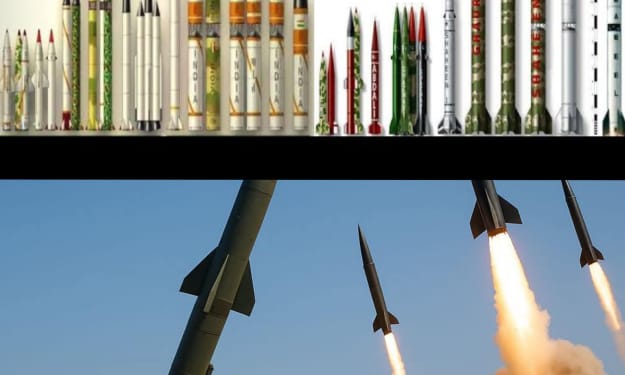
The Science and Strategy of Modern Missiles
The Science of Missiles A missile is essentially an automatically guided projectile that consists of a rocket engine, a guidance system, a control system, and a warhead. The rocket engine propels the missile at speeds reaching thousands of kilometers per hour, enabling it to cover long distances rapidly. The guidance system—such as GPS (Global Positioning System), inertial navigation, or radar—directs the missile along an accurate trajectory towards its target. The control system constantly adjusts the missile’s altitude, angle, and speed during flight to maintain precision. Upon reaching the target, the warhead detonates, causing destruction. Warheads can vary from conventional explosives to highly destructive nuclear payloads, depending on the missile's design and purpose. --- Types of Missiles Missiles come in different types based on their range, speed, and intended use. Each type is designed with specific capabilities to suit various military requirements. --- 1. Ballistic Missiles Ballistic missiles follow a curved, parabolic trajectory through the atmosphere and space before descending onto their target. These missiles are capable of carrying nuclear warheads, making them some of the most strategic and devastating weapons in modern arsenals. Examples include Pakistan’s Shaheen missile series and India’s Agni missiles. Ballistic missiles are launched with tremendous force from the ground or submarines. After the initial powered flight phase, they coast along a ballistic trajectory, relying on gravity to guide them to their target. Because of their high speeds and long ranges—often spanning hundreds to thousands of kilometers—they can strike distant targets with high precision. Ballistic missiles are central to deterrence strategies due to their ability to deliver nuclear warheads quickly and unpredictably. --- 2. Cruise Missiles Cruise missiles are designed to fly at low altitudes over long distances to target specific ground locations. They use advanced navigation systems to avoid detection by enemy radar and defenses by flying under radar coverage, often just above the terrain (terrain-following flight). Pakistan’s Babur missile and India’s BrahMos missile are examples of cruise missiles. Unlike ballistic missiles, cruise missiles maintain powered flight throughout their journey, often using jet engines. This allows them to maneuver around obstacles and avoid defenses. For example, India employed SCALP cruise missiles during the May 7, 2025 attacks, launching them from Rafale fighter jets. These missiles are specifically designed to target underground or fortified enemy installations with high accuracy. --- 3. Tactical Missiles Tactical missiles are intended for short-range engagements, typically used in battlefield scenarios to attack enemy troops, armored vehicles, or command centers. They are designed for quick deployment and rapid strikes on localized targets. Pakistan’s Nasr missile is a notable example. Tactical missiles can be equipped with nuclear or conventional warheads. Nasr, for instance, is tailored to counter enemy tank brigades and troop concentrations with precise strikes. It’s a strategic tool for delivering a swift, limited nuclear response or conventional strike on the battlefield, providing a deterrent against conventional military threats. --- 4. Air-to-Surface Missiles (ASM) These missiles are launched from fighter jets or other military aircraft to strike targets on the ground or at sea from a safe distance. They provide air forces the capability to destroy enemy infrastructure, vehicles, or fortifications while minimizing risk to the aircraft and pilot. Examples include Pakistan’s Ra’ad-II missile and India’s Nirbhay missile. Air-to-surface missiles can be equipped with advanced guidance systems like infrared or laser targeting to enhance accuracy. Their ability to be launched from high-speed aircraft increases the range and flexibility of air strikes during combat operations. --- 5. Surface-to-Air Missiles (SAMs) Surface-to-air missiles are defensive weapons used to intercept and destroy enemy aircraft, drones, or incoming missiles like cruise missiles. These systems are a critical component of a nation’s air defense network. SAMs launch vertically or at an angle and rapidly accelerate to high altitudes to intercept hostile targets mid-flight. Pakistan’s LY-80 and India’s Astra missile are examples of such air defense systems. These missiles often use radar guidance or infrared homing to track and neutralize threats, thereby protecting key installations, cities, and military forces from aerial attacks. --- 6. Anti-Ship Missiles Anti-ship missiles are specialized weapons designed to target and destroy enemy naval vessels at sea. They typically fly at low altitudes over the water surface, making detection by radar more difficult. Pakistan’s Zarb missile and India’s Dhanush missile are examples of anti-ship missiles. These missiles combine the speed and maneuverability of cruise missiles with warheads capable of crippling or sinking large warships. Their use in naval warfare is crucial for controlling sea lanes and denying enemy fleets freedom of movement. --- 7. Drone-Like Missiles (Loitering Munitions) A recent innovation in missile technology is the development of drone-like missiles, also called loitering munitions or “suicide drones.” These are hybrid weapons combining aspects of traditional missiles and unmanned aerial vehicles (UAVs). Loitering munitions can fly within a designated area for an extended period, searching for targets with onboard sensors. Once a target is identified, the missile crashes into it, detonating its warhead. This approach allows for dynamic target selection and engagement in real time. India, for example, has used the SkyStriker loitering munition developed with Israeli cooperation in recent military operations. These weapons represent a growing trend in precision warfare, enabling highly flexible and adaptive strike capabilities. --- Summary Missiles have transformed modern warfare with their speed, precision, and destructive power. Whether delivering nuclear deterrence through ballistic missiles or conducting surgical strikes with cruise or tactical missiles, these weapons are critical assets for national defense and strategic operations. Advances such as drone-like loitering munitions are expanding the battlefield capabilities further, introducing new dimensions to missile science and military technology. Understanding missile types, their mechanisms, and their strategic roles provides insight into the complexity and evolving nature of modern defense systems.
By Ikram Ullahabout a year ago in FYI
The Invisible Force of Water: Understanding Surface Tension. AI-Generated.
Have you ever wondered how a drop of water can hold a fly on its surface? Or why a tiny sewing needle, despite being made of iron, floats on water? At first glance, these phenomena may seem magical or strange. But behind these everyday wonders lies a fascinating scientific principle: surface tension. What is Surface Tension? Surface tension is the invisible but powerful force that acts on the surface of liquids—most commonly water. To understand this, let’s zoom in to the molecular level. Every molecule in a liquid pulls on its neighboring molecules due to cohesive forces—the natural tendency of like molecules to stick together. In the middle of the liquid, these cohesive forces are balanced in all directions. But at the surface, it's a different story. Molecules at the top have no liquid molecules above them, only air. As a result, they experience a stronger pull inward from the molecules below and beside them. This unbalanced force creates a sort of "skin" on the liquid's surface—a thin, elastic-like layer that resists external force. This is what we call surface tension. Why Are Water Droplets Spherical? One of the most common and beautiful examples of surface tension is the shape of water droplets. Why are they round? Because a spherical shape has the smallest possible surface area for a given volume. Surface tension naturally tries to minimize the surface area, so water droplets form into nearly perfect spheres. Next time you see a raindrop hanging delicately on a leaf, know that it’s not just gravity or beauty at play—it’s science working silently through surface tension. How Does It Work in Real Life? Surface tension can be observed in several real-world scenarios: Floating a Needle: A metal needle is denser than water, so it should sink. But if placed gently, the surface tension keeps it afloat by creating a dip on the surface—like a tiny trampoline holding it up. Break that tension with soap or detergent, and the needle will immediately sink. Water Strider Insects: Some insects like water striders can actually walk on water. Their long legs distribute their weight evenly and don’t break the surface tension, allowing them to "skate" across ponds and streams. Droplet Formation: When water flows out of a tap, it doesn’t come out in a smooth stream forever. Instead, it forms droplets that fall one by one. Each droplet is a mini marvel of surface tension striving to maintain a balanced form before falling due to gravity. Wicking in Plants: Plants use surface tension to pull water from the roots to their leaves through thin tubes (xylem). This is part of a larger process called capillary action, which wouldn't be possible without surface tension. Surface Tension in Human Biology The importance of surface tension isn't limited to physics or nature—it plays a crucial role in human biology, especially in the lungs. Our lungs contain tiny air sacs called alveoli, where oxygen and carbon dioxide are exchanged. These alveoli are lined with a thin film of liquid. If surface tension in this film were too high, the alveoli would collapse, making breathing nearly impossible. Thankfully, our lungs produce a substance called surfactant that reduces surface tension, allowing the alveoli to expand and contract easily with each breath. In premature babies, the lungs are often underdeveloped and don’t produce enough surfactant. This is why they may struggle to breathe on their own. In such cases, doctors administer artificial surfactant to help the lungs function properly. It’s a lifesaving application of understanding and managing surface tension. Breaking Surface Tension: The Role of Detergents You might have noticed that when you add soap to water, it spreads more easily and quickly wets surfaces. That’s because soaps and detergents reduce surface tension. These substances interfere with the cohesive forces between water molecules, making the surface "weaker" and allowing it to spread out. This is incredibly useful for cleaning, as it allows water to penetrate dirt, grease, and fabrics more effectively. It's also why you can't float a needle or hold a water droplet on a greasy or soapy surface—the surface tension has been compromised. Conclusion Surface tension is an invisible force with visible effects. It shapes our world in ways most of us never notice—from water droplets on a flower to the very act of breathing. It’s a perfect example of how seemingly simple things are actually supported by deep and intricate science. The next time you see a floating insect, a drop of water, or breathe without difficulty, take a moment to appreciate the silent but powerful role of surface tension. Whether in nature, in science labs, or within our bodies, it is a force that keeps things together—literally and figuratively.
By Ikram Ullahabout a year ago in FYI
How SPU Students Are Making Money While Studying , And You Can Too
Being a student at Sol Plaatje University (SPU) in 2025 is no joke ,between lectures, res life, and assignment overload, it's easy to feel broke and overwhelmed. But what if you could earn cash without sacrificing your studies or social life? That’s exactly what these SPU hustlers are doing. From slippers to study notes, here are real side hustles run by students right here on campus , and how you can start your own.
By sol sessionsabout a year ago in FYI