
If Saturn Was As Close as The Moon
What Saturn and the other planets would look like if they were the same distance to Earth as the moon

The moon is 238,900 miles from Earth. As humans, from our perspective, that's far. But given the distance from us and the next closest planet, Venus, and how vast our galaxy is, the moon is practically our next door neighbor.
We take seeing the moon, a glowing silver-white sphere in the night sky for granted.
It's been there in the sky for as long as humanity has been around and longer.
That faint reddish orange dot in the sky. That's Mars. 212 million miles away.
This got me wondering.
That tiny red dot we know as Mars. What would it look like in the night sky if it was as close to us as the moon is?
What about the other planets? Imagine the monstrosity Jupiter would be looming in the sky! Or the rings of Saturn?
Mercury
With its own craters, Mercury would look a lot like the moon. Only noticeably larger and a bit darker, appearing approximately 40% wider than the moon in our night sky.
It would appear as brownish grey orb in the sky and like the moon, we would be able to clearly see and point out its craters.
Venus
Venus would appear even bigger. About four times larger than the moon. When you gaze up, you'd see a giant yellow-white orb in the sky made up of sulfuric acid. You'd probably be able to sit out and read. No light needed. Venus would shine noticeably brighter in the night sky than the moon.
Mars
The red planet would appear two times as big as the moon. Look up and you'd immediately recognize it as a reddish-orange sphere - undoubtedly the most distinguishable object in the sky.
Since Mars is bigger than the moon, it would shine brighter covering the Earth in a reddish tint.
Much like how we can see the moon's craters, we'd be able to point out the canyon systems on Mars as well as its polar ice caps and its largest volcano, Olympus Mons - all with the naked eye!
Jupiter

Jupiter would be absolutely unfathomable and terrifying to see! It would be so massive, you wouldn't even see it as an orb in the sky. Instead, being about 40 times larger than the moon, it would take up a significant portion of the sky where you'd see nothing but a wall of swirling clouds. So massive you wouldn't be able to see the planet in its entirety at once.
You would also be able to point out its Great Red Spot and as well as several of its largest moons - Europa, Callisto, Lo, and Ganymede. All with the naked eye.
Jupiter would loom with a brightness that would light up the Earth similar to twilight.
If Jupiter really was that close, Earth would be taken by its gravitational pull and become just another of Jupiter's many moons.
Saturn
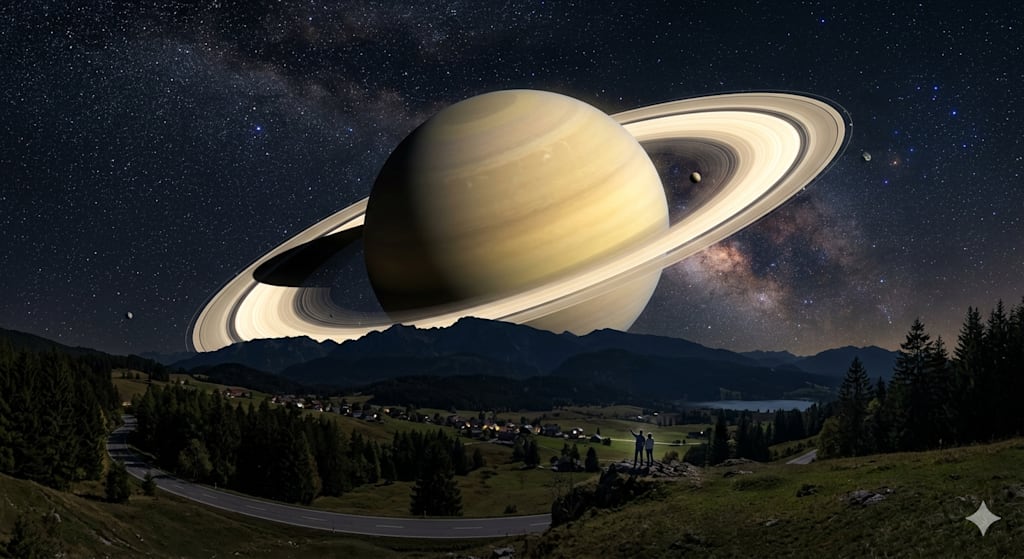
Seeing Saturn fill up the sky would be stunning and unfathomable. Its rings would stretch across the horizon making Saturn, without a doubt, the most visible object in the sky. All you would see as you looked out at the horizon would be Saturn's shimmery and translucent rings made up of ice and rock.
Breath taking would be an understatement. Saturn would be so massive and bright, night as we know it wouldn't exist. No lights whatsoever would be needed. As for size comparison, it would be like comparing a dime (the moon) to a beach ball (Saturn).
Uranus
The seventh planet in our solar system would appear as another massive sight filling the sky. Look up and you'd see a gigantic cyan colored orb that glowed with a haze.
Though most likely not as stunning as Saturn's, its rings would also be visible, being angled in a vertical position in the sky. Cyan colored Uranus would tint the Earth blue.
Neptune
This planet would appear about 14 times larger than the moon so you can imagine how enormous such a sight would be. Similar to Uranus, Neptune would loom in the sky as a blue colored orb. Just more of a stunning electric blue. It would have a marble like appearance - breath taking swirls of white and electric blue.
Due to its size and how it reflects sunlight, Neptune would be yet another planet that would light up the whole landscape at night.
With the naked eye, you'd also be able to see Neptune's biggest moon, Triton.
Pluto
Okay, technically Pluto isn't classified as a planet anymore. It's been downgraded to a dwarf planet. I thought it should still get an honorable mention. Besides I'm sure there are plenty of Pluto fans out there that would be curious to see what Pluto might look like if it were as close to us as the moon.
Its appearance would be quite different because unlike the other planets, Pluto is smaller than the moon.
Look up and you'd see a glowing creamy white and rust colored orb. Despite being smaller, because it reflects sunlight more than the moon, Pluto would most likely shine brighter.
While not as unfathomable as Planets like Jupiter and Saturn, Pluto would still be a sight to see!
* Of course, if many of these planets really were as close to us as the moon, the effects on Earth would be absolutely catastrophic!
Sources:
About the Creator
Jasmine Aguilar
Fascinated by pop culture and its effect on society... movies, music, books.. and pretty much anything.
I love writing and write a little bit of everything including a science fiction WIP!
https://www.buymeacoffee.com/J.A.Rose
Enjoyed the story? Support the Creator.
Subscribe for free to receive all their stories in your feed. You could also become a paid subscriber, letting them know you appreciate their work.
Comments
There are no comments for this story
Be the first to respond and start the conversation.