
How AI Enhances CI/CD Pipelines for Faster and Safer Deployments?
Leveraging AI to Optimize CI/CD Pipeline Efficiency and Security

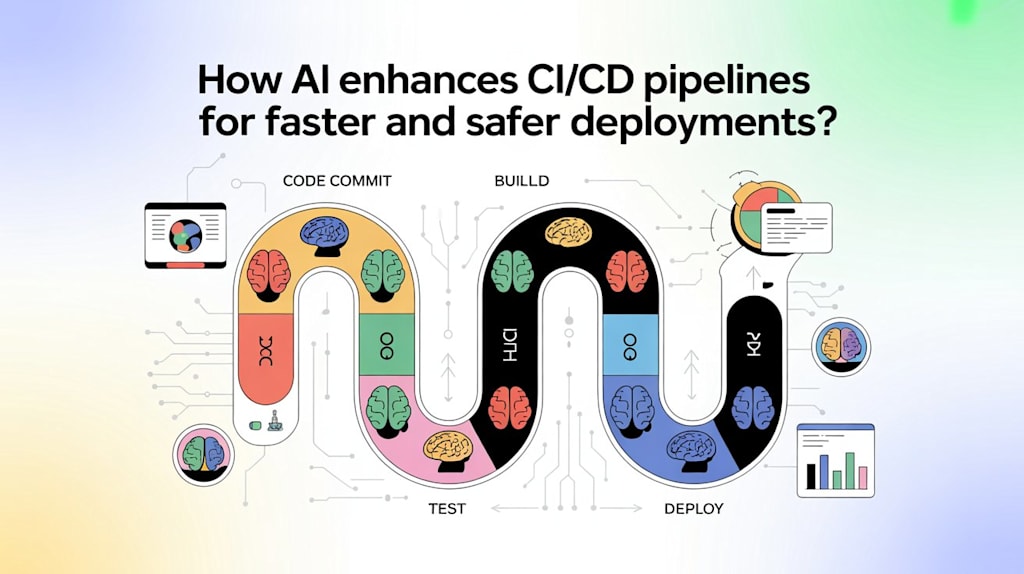
Continuous integration and continuous deployment (CI/CD) pipelines have become essential for modern software delivery in today’s rapidly advancing digital world. However, enabling large-scale delivery to manage CI/CD pipelines effectively and securely remains a challenge for many organizations. This is where Artificial Intelligence (AI) is now proving to be transformational.
Organizations are adopting AI in CI/CD pipelines so that they can have quicker and consistent deployments without any human error. Today, we are going to discuss how AI is transforming CI/CD activities and how companies implement devices and DevOps services with AI integration to gain a competitive advantage in their market.
Deliver Smarter, Faster, and Safer: The Future of CI/CD with AI
CI/CD is the abbreviation of Continuous integration and continuous deployment, providing automation of integration, testing, and delivery of software. CI/CD enables development teams to implement and release repeatable features, changes, and fixes, and this is with reliability and consistency. To the business leaders, it implies that they are able to bring their products to the market quicker, enhance the user equity, and market responsiveness.
Unfortunately, even with the automation benefits of CI/CD pipelines, there are often still manual configurations, delayed feedback, and security vulnerabilities where AI can contribute significantly.
The Role of AI in Modern CI/CD Pipelines
AI doesn’t just improve the automation process; it’s changing the way CI/CD pipelines work. Through things like AI-predicted insights and strategic analysis, how this emerging technology will manage the software delivery lifecycle will be a great learning.

1. AI-Based Code Quality Analysis
AI can autonomously review and analyze code for potential syntax problems, logical bugs, and performance bottlenecks. Traditional static code analysis only provides possible information; AI uses existing developer patterns, previous logs, testing history, or even bugs that are already known to the system, in order to flag high-risk areas for developers while they write the code.
Impact: Increases developer productivity by limiting the time to spend on manual code reviews, making it easy to keep code bugs from being introduced.
Business Value: Faster code testing with fewer potential issues in production delivered promptly with fewer costs to the QA process.
2. Predictive Build Failure Detection
AI can look at past builds, past modifications of the codebase, and known patterns of error that have been experienced in order to offer an estimate of the probability of a build succeeding or failing before it happens. Predictions enable developers to be upfront and remediate/respond to problems by means of fixing/eliminating a failed build in the pipeline at an earlier stage of the development cycle.
Impact: Helps DevOps teams act on impending failures earlier or faster in the software development cycle.
Business Value: Onboarding opportunities with less downtime, reduced risk of failures during deployment readiness, with improved stability.
3. Intelligent Test Case Prioritization
Testing can easily become a bottleneck, especially when all test cases are run in CI/CD, even if no matter how been little code changed. With AI factored into CI/CD pipelines, machine learning models can identify which test cases are most likely being affected by recent change(s), therefore executing those tests only.
Impact: Reduces the time of test execution and does not fall short on quality.
Business Value: Reduced test cycles, accelerated feedback loop, and reduced time to market.
4. AI-Based Anomaly Detection in Deployments
In deployment, AI can monitor the logs and a variety of server metrics and key performance indicators in real-time (abnormal CPU loads, memory leaks, increased traffic increases, and so on).
Impact: This guarantees corrective measures so that service interruptions do not reach end-users.
Business Value: More uptime on better application usage, client satisfaction, and risk mitigation in operations.
5. Self-Healing Pipelines and Auto-Rollbacks
AI can introduce self-healing mechanisms that correct failed deployments or incorrect system configurations automatically. Critical scenarios can allow triggering auto-rollbacks to the last known stable state.
Impact: Enables faster response to incidents without human involvement.
Business Value: Reduced downtime, improved reliability, and continuous availability of services.
6. Automated Security Scanning and Vulnerability Detection
Security has become vital in modern times through DevOps. AI will analyze code bases, their dependencies, and configurations for known and unknown vulnerabilities. It will learn from prior security breaches and changing threat vectors to proactively expose risks.
Impact: Integrated security into the pipeline at the start (DevSecOps).
Business Value: Improved compliance, reduced cyber threats, and safer product releases.
7. Smarter Orchestration for Resource Optimization
AI can analyze previous deployments, actual user usage, and performance on systems to predict required deployment infrastructure. AI will then automatically scale whole environments up and down continuously in an intelligent manner to ensure resources are not overused or underused.
Impact: AI will efficiently manage infrastructure with minimal manual tuning.
Business Value: Reduce cloud costs and improve operational scalability.
8. Continuous Feedback Loop and Improvement
CI/CD pipelines provide the ability to continuously learn and improve with AI. AI will help provide suggestions and recommendations based on data collected from builds, tests, and deployments. This can include noting through visual representations the modules that need refactoring, or if a team is a bottleneck in the release.
9. Deployment risk assessment and decision support
Through AI's ability to analyze metrics and be able to view integrated information across the pipeline, organizations can get a much better idea of what the possible risk is of a deployment. AI can analyze the code changes, the rate of commits, who is involved in the change, developer confidence, automated testing results, and the overall health of the system as data points to arrive at a recommendation for the software deployment for the team (ie, proceed, delay, abort).
Impact: Provides a smart decision-making tool at critical points of release.
Business Value: Reduced human error, reduced executive risk, and provides teams with an avenue to possible confidence in their decision when moving code to production.
10. Context-Aware Deployment Strategies
AI can analyze the deployment environments' traffic patterns and behavior patterns of users to suggest or execute the most suitable deployment strategy. It includes blue-green, canary, or rolling update deployment, and it can leverage real-time performance metrics and business KPI results to adjust while performing the deployment.
Impact: For your customers, this means minimizing disruption during software releases by selecting and performing a type of deployment relative to the specific context.
Business Value: For your organization, it is providing a smooth user experience when making your software product updates for customers, reducing the risk around your releases, and taking advantage of different deployment tactics based on the needs of your business.
Concluding Thoughts
We are entering a new age of digital transformation across every industry, and the demand for speed, security, and reliability during the software delivery process continues to grow. Organizations no longer have the liberty of waiting for the next release; they can't afford to stop the deployment pipeline for any reason, nor can they live with a vulnerability existing. This is where AI in CI/CD pipelines becomes less of a good idea and much more of a necessity.
The impact of AI for CI/CD isn't just more speed in CI/CD; it's more intelligent, adaptable, and resilient. From smart static analysis of code issues before they ever reach production, to suggesting data-driven decisions on rollback or what level of test coverage is sufficient. AI provides a way of smart automation beyond anything that traditional DevOps could hope to substantiate.
About the Creator
Nathan Smith
Nathan Smith is a Technical Writer at TechnoScore with extensive knowledge in software documentation, API guides, and user experience.
Enjoyed the story? Support the Creator.
Subscribe for free to receive all their stories in your feed.
Comments
There are no comments for this story
Be the first to respond and start the conversation.