
Generative AI: The Rise of Machine Creativity
How artificial intelligence is transforming the way we create text, images, music, and ideas in the modern digital world

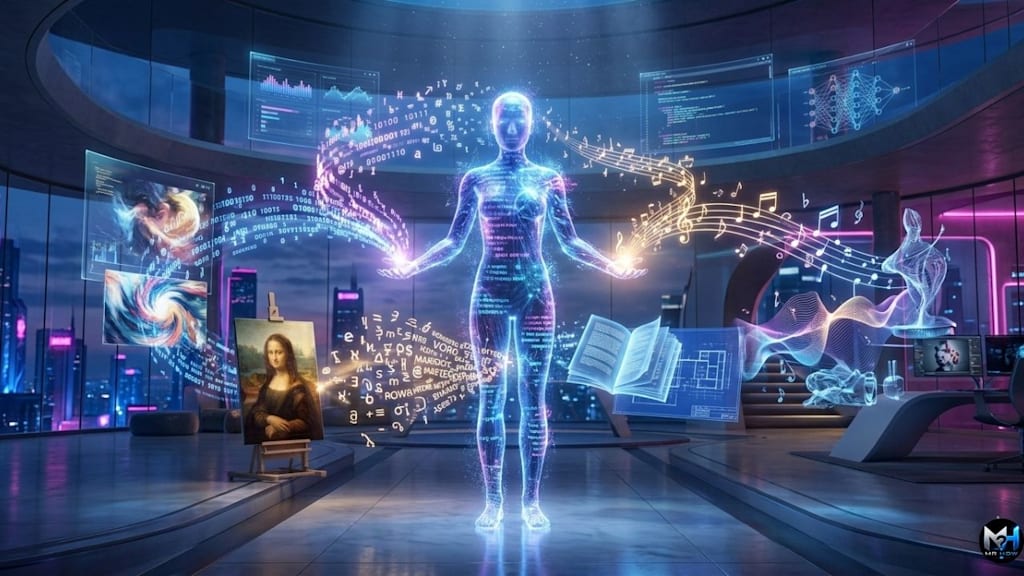
Generative AI is one of the most important developments in modern technology. It refers to a type of artificial intelligence that is designed not just to analyze or understand information, but to create entirely new content from it.
In simple terms, generative AI can write text, create images, produce music, generate videos, and even assist in writing computer code. It behaves less like a traditional tool and more like a creative partner that learns patterns from data and then uses those patterns to produce new outputs.
To understand it better, imagine teaching a machine by showing it millions of books, images, songs, and videos. The machine does not memorize them exactly. Instead, it learns the structure, style, and relationships within the data. Once trained, it can generate new content that looks similar in style but is not copied from the original material.
This ability comes from advanced machine learning techniques, especially deep learning. Deep learning uses artificial neural networks, which are systems inspired by the human brain. These networks are trained on huge datasets and gradually learn how language, images, and sounds are structured.
One of the most important breakthroughs in this field was the development of transformer models. These models allow AI systems to understand context more effectively, especially in language. They are the foundation of modern large language models, which power tools like chat-based assistants and text generators.
Another important technique is diffusion models, which are widely used in image generation. These models start with random noise and gradually refine it into a clear and realistic image. This is how AI systems can now produce detailed artwork, realistic photographs, and creative visual designs.
Generative AI has a wide range of applications across many industries. In content creation, it helps writers, designers, and marketers generate ideas, drafts, and visuals quickly. In education, it can act as a tutor, explaining complex topics in simple language. In software development, it helps programmers write and debug code more efficiently.
In healthcare, generative AI is being explored for tasks like medical imaging analysis and drug discovery, helping researchers identify patterns that would be difficult for humans to detect manually. In entertainment, it is used to create music, scripts, visual effects, and even entire virtual environments for games and films.
Despite its benefits, generative AI also raises several important challenges. One major concern is misinformation. Because AI can generate highly realistic text, images, and videos, it can sometimes be used to create fake or misleading content. This raises questions about trust and authenticity in digital media.
Another concern is bias. Since AI models learn from existing data, they can unintentionally learn and reproduce biases present in that data. This can lead to unfair or inaccurate outputs in certain situations.
There are also ongoing debates about copyright and data usage. Many AI systems are trained on large datasets that include publicly available content, raising questions about ownership and fair use.
Additionally, there are concerns about job displacement. As AI becomes more capable of performing creative and technical tasks, some roles may change or become automated, requiring workers to adapt to new skills.
However, it is also important to recognize that generative AI is not just replacing human work. In many cases, it is enhancing human creativity. It allows people to work faster, explore more ideas, and focus on higher-level thinking while AI handles repetitive tasks.
Looking ahead, generative AI is expected to become even more advanced and integrated into everyday life. It will likely play a larger role in education, business, healthcare, and entertainment. As the technology continues to evolve, responsible use and ethical guidelines will become increasingly important.
In conclusion, generative AI represents a major shift in how humans interact with technology. It moves beyond simple automation and into the realm of creation. By learning from vast amounts of data, it can generate new and meaningful content that supports human creativity and innovation in powerful ways.
To put this technology into perspective, modern generative AI systems are trained using enormous computational power and large datasets collected from books, websites, research papers, images, and other digital sources. This training process can take weeks or months and requires specialized hardware such as GPUs and AI accelerators. Once training is complete, the model can respond to user prompts in real time, making it feel fast and interactive despite the complexity behind it.
Popular tools demonstrate generative AI in action. Chat-based systems can hold conversations, answer questions, and assist with writing tasks. Image generation tools can turn simple text prompts into detailed artwork within seconds. Music and voice systems can create new compositions or replicate styles that sound human.
grow, experts believe it will become integrated into everyday digital tools such as search engines, office software, and creative applications. Governments and organizations are developing guidelines to ensure responsible use, transparency, and safety in AI systems.
Ultimately, generative AI represents a shift toward a future where humans and machines collaborate more closely in creative and intellectual work.
About the Creator
Enjoyed the story? Support the Creator.
Subscribe for free to receive all their stories in your feed.
Comments
There are no comments for this story
Be the first to respond and start the conversation.