
Galileo Got a Unit. Einstein Got One Too. Here’s What Two Obscure Units Reveal About Scientific Naming
The gal and the einstein are real, specialized, and easy to miss. Their survival shows that scientific naming follows measurement communities, not genius.
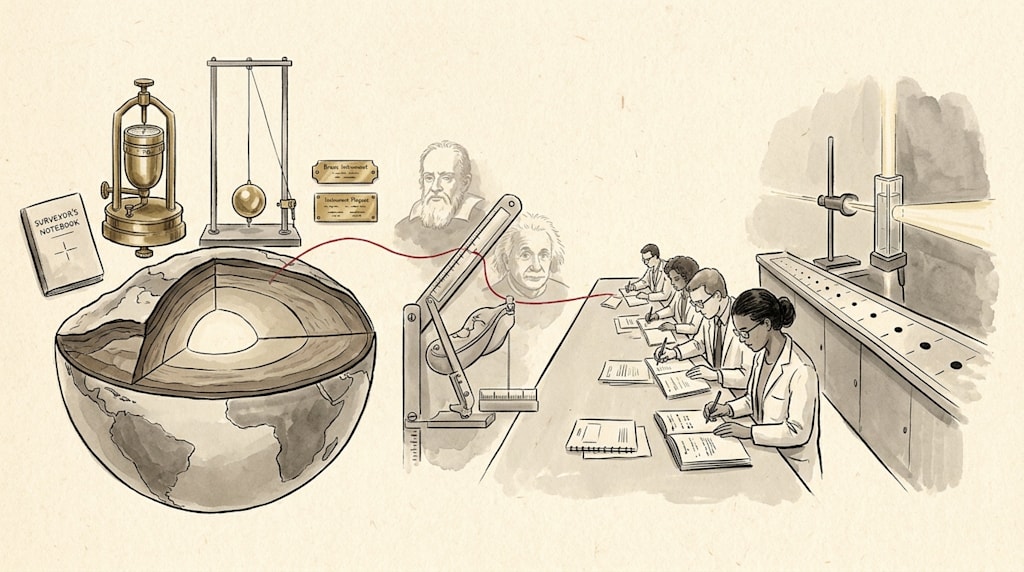
Galileo has an acceleration unit called the gal. One gal equals one centimetre per second squared, or one hundredth of a metre per second squared. It comes from the CGS system, not the SI. Gravity work keeps it alive. Earth’s surface gravity is about 980 gal. Regional surveys use the milligal. Microgravity work uses the microgal. Satellite gravity and absolute gravimeters still produce data in these units. A community writes them every day, so they survive.
Einstein’s unit is trickier. IUPAC defines one einstein as one mole of photons. IUPAC calls it widely used but not officially recognized. Some writers use it for the energy of one mole of photons. IUPAC discourages that use because the energy depends on frequency or wavelength. Without that information, the number means little. In photochemistry, the einstein works best as a photon count. Bodenstein and Wagner proposed it in 1929, by analogy with the faraday in electrochemistry. The faraday counts one mole of electrons. The einstein counts one mole of photons. Both attach a founder’s name to a macroscopic mole count.
The gal and the einstein share a profile. Neither belongs to the SI. Both live inside specialized fields. Both were named after unit naming had stopped being a public event in science. They are ordinary cases, not outliers.
A common story says the years from 1600 to 1900 were the golden age for unit names. Classical physics had open territory, new quantities kept appearing, and the first person to define one often got the name. That story has truth in it. The gal was named as the CGS system expanded. The torr, pascal, newton, volt, gauss, and maxwell arrived in a dense stretch of nineteenth- and early twentieth-century standardization. They mapped onto basic quantities in mechanics, heat, and electromagnetism.
But the story goes wrong if it says naming stopped after 1900. The twentieth century added scientist-named SI units. The hertz honors Hertz. The becquerel honors Becquerel. The gray honors Gray. The sievert honors Sievert. The becquerel and gray arrived in 1975. The sievert followed in radiation protection. These units serve nuclear physics, radiation metrology, and radiation protection, fields that became institutionalized in the twentieth century. What changed was the target of naming. Nineteenth-century names clustered around force, energy, power, charge, voltage, and magnetic flux. Twentieth-century names clustered around derived quantities from specialized measurement: radioactivity, absorbed dose, dose equivalent. Those quantities mean little to the public. They are essential in nuclear industry, medical physics, and safety regulation.
Smaller examples fill out the pattern. The darcy measures permeability. It is not an SI unit. Petroleum engineering and geology use it widely. Its definition comes from Darcy’s law. Henry Darcy was a nineteenth-century French hydraulic engineer, but the unit itself was proposed and named around the 1930s. The fermi was an old name for one femtometre. Enrico Fermi supplied the name. Hofstadter introduced it in 1956 because nuclear physics needed that length scale. The SI prefix form, femtometre, later replaced it. These units show where naming went after 1900. It moved into the working language of disciplinary communities. A field with a stable measurement tradition, a clear quantity, and enough users will grow convenient units. SI acceptance is a separate question.
Why does naming feel harder now? The function of unit naming has split. During the three centuries when classical physics built its institutions, a unified and commensurable unit system was a core project. Naming a unit fixed a quantity and embedded it in an expanding public framework. By the twentieth century, that framework had a skeleton. New names followed two local paths. One path is institutional naming inside the SI to fill gaps in derived quantities, as with the becquerel, gray, and sievert. The other path is a specialized field adopting a habitual unit for its own work, as with the gal, darcy, and einstein. Habitual units can last for decades without entering public metrological awareness. SI units can enter the system while serving highly specialized quantities. Neither path produces the nineteenth-century public event of “force equals newton” or “power equals watt.”
Gender adds another layer. Eponymous SI units are extremely uneven. The only unit named after a woman is the curie, and the becquerel replaced it in 1975. This fact does not prove that women scientists contributed less. It shows who a standardizing measurement community sees, records, and treats as a founder. Unit naming is an epistemological act and an act of recognition. “The historical process matters more than individual effort” becomes more precise here. Individual contribution matters. Naming happens where institutions, disciplines, and communities meet. Individual effort becomes a unit name only when that meeting point captures it.
The gal and the einstein exist because they sit outside the SI. Many units outside the SI stay alive through measurement needs. A unit lives when people write it, read it, and compare data with it every day. A resolution from the General Conference on Weights and Measures matters, but daily use matters more. The history of units is a history of organized measurement, institutionalized knowledge, and distributed recognition. It reads poorly as an extended list of scientists. Galileo and Einstein each left a name. Later communities attached those names to recurring measurement needs. The names stuck because the work needed them.
About the Creator
Jin
Writer of reamstories
https://reamstories.com/jin
Enjoyed the story? Support the Creator.
Subscribe for free to receive all their stories in your feed. You could also become a paid subscriber, letting them know you appreciate their work.
Comments
There are no comments for this story
Be the first to respond and start the conversation.