
Euclid Wasn’t Bossing You Around. He Was Showing His Work.
The five postulates were a request, not a command. Two thousand years of arguing about the fifth one gave us non-Euclidean geometry, GPS, and a curved universe.
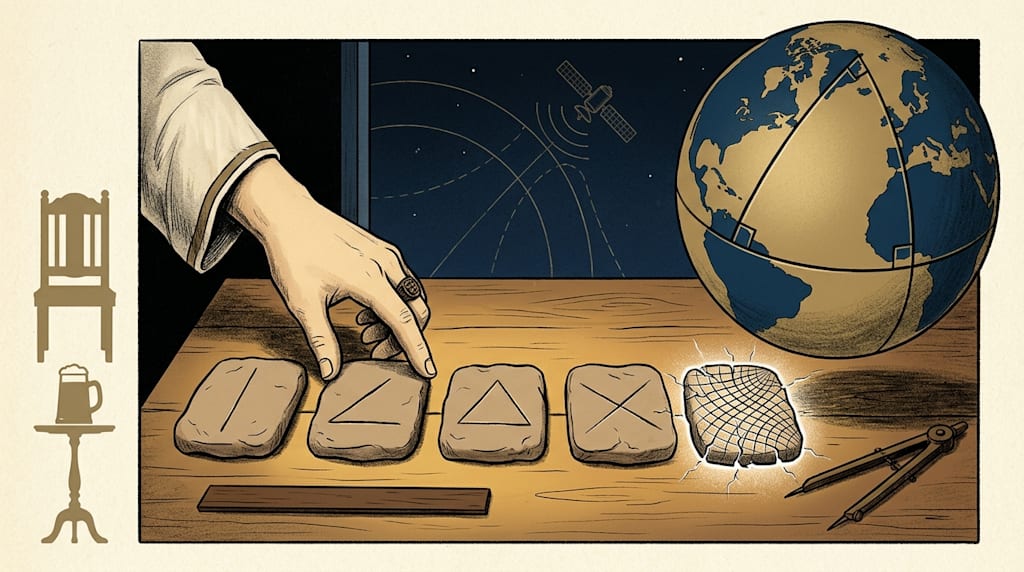
If Euclid could see the sentence “axioms need no proof,” he would probably blink. He never wrote “do not ask why.” At the start of the Elements he did something simpler and more exposed. He laid his starting points on the table.
The Greek word for postulate is aitēma, a request, a demand, an ask. In Thomas Heath’s 1908 English translation, the sentence begins, “Let the following be postulated.” That sounds like someone about to begin a game and reading the rules first: let us agree that I may use a straightedge and a compass.
Book I of the Elements opens with three kinds of material: 23 definitions, 5 postulates, and 5 common notions. In Chinese, people often say “the five axioms” when they mean the five postulates. Keep the two apart. The postulates are starting points about construction and spatial relations. The common notions are more general rules about equality and quantity.
The first three postulates are blunt. A straight line can be drawn between any two points. A finite straight line can be extended continuously in a straight line. A circle can be drawn with any center and any radius. In plain language, allow me a straightedge and a compass.
This is like reading the rules before a card game and waiting for everyone to nod. A person who writes all his premises on the table for anyone to inspect is doing the least domineering thing possible. The domineering move is to hide the premises and show only the conclusion.
Why something has to stay unproved
The question “why must something remain unproved?” is older than Euclid. Aristotle had already discussed it in the Posterior Analytics. Every conclusion is proved from premises. Those premises need earlier premises. Follow the chain back and there are only three outcomes. Either the chain runs forever and never reaches a beginning. Or it circles and returns to where it started. Or it stops somewhere and says, “From here on, we agree.”
Anyone who has raised a child knows this. A “why” can be asked twenty times, and at the end the adult says, “Because that is the rule.” In 1968 the German philosopher Hans Albert gave this predicament a name: the Münchhausen trilemma. Euclid chose the third path, and he stopped openly. Where he stopped and how many starting points he needed were all written out.
So an axiom system is not a command “do not ask.” It is a way of saying, “If we ask this far, we need to agree on a starting point.” A starting point is not beyond question. On the contrary, it is exactly the place that should be watched.
You can ask: Do these postulates contradict one another? Is one of them derivable from the others, and therefore redundant? Are they sufficient to prove the theorems we want? Does the model they build match the part of the world we care about? These are serious mathematical questions, and they are more interesting than “the teacher said we do not need to ask.”
Where the “do not ask” feeling comes from
I have never found a sentence in the Elements that forbids doubt. I suspect the feeling comes from school textbooks. The phrase “axioms need no proof” is said once, the teacher turns the page, and the exercises begin. That is how I was taught. I remember feeling annoyed: why should it be equal just because it says equal?
The Chinese world has an earlier source as well. In 1607 Matteo Ricci and Xu Guangqi translated the first six books into Chinese. In his Miscellaneous Remarks on the Elements, Xu praised the book with “four no-needs”: no need to doubt, no need to conjecture, no need to test, no need to revise. The sentence sounds oppressive today. But what Xu was praising was the chain of reasoning: each step follows from what came before, so later conclusions do not need to be doubted. He was not saying that the opening postulates must never be questioned. There is a gap between the original intention and the later reception.
A side note. The edition Xu Guangqi and Matteo Ricci used was the Latin text edited by Clavius in 1574. Its first book begins with “36 definitions, 4 requests, 19 common notions.” The first Chinese readers of Euclid therefore saw an arrangement with four requests and nineteen common notions, not the textbook list of five postulates. It would be too strong to say that “it was not five at all,” because that can suggest the Euclidean tradition itself lacked five postulates. More accurately, the version and the terminology made the first Chinese encounter look different. The central gesture did not change: the starting points were put on the table.
The fifth postulate and two thousand years of questions
There really were people who asked “why,” and they kept asking for two thousand years. The fifth postulate was questioned hardest. You can see why from its shape. The first four are short, almost like slogans. The fifth is long, winding, and contains “extended indefinitely,” something no straightedge can verify.
In the fifth century, Proclus, in his commentary on the Elements, said outright that this postulate should be removed from the list, because it looks like a theorem and ought to be proved. Euclid himself seems to have been uneasy about it. The first 28 propositions of Book I do not use it. It first appears at Proposition 29. This is indirect evidence, but many histories of mathematics read it that way.
What followed was a relay race lasting many centuries. In the second century, Ptolemy tried to derive the fifth postulate from the first four. Proclus later pointed out the flaw in his proof. In the fifth century, Proclus produced a proof of his own, but quietly used an assumption equivalent to the fifth postulate. Between the eleventh and thirteenth centuries, al-Haytham, Omar Khayyam, and al-Tusi made several attempts in the Islamic world. The quadrilateral Khayyam studied later took Saccheri’s name. In 1733 Saccheri published a book with a confident title: Euclid Freed of Every Flaw. He used proof by contradiction, derived a pile of strange conclusions, and then declared that they violated the nature of straight lines. In 1795 Playfair gave the equivalent form familiar from textbooks: through a point not on a line, there is exactly one line parallel to it. In 1826 Lobachevsky presented his results at Kazan University. From 1829 he published them in the Kazan Messenger. He denied the fifth postulate and still built a consistent geometry. In 1832 Bolyai published the same discovery independently, as an appendix to his father’s book. In 1854 Riemann gave a probationary lecture at Göttingen titled On the Hypotheses Which Lie at the Foundations of Geometry. In 1868 Beltrami built a model of non-Euclidean geometry inside Euclidean geometry. If non-Euclidean geometry had a contradiction, so would Euclidean geometry.
Behind that table there is a good deal of heartache. János Bolyai’s father, Farkas Bolyai, spent much of his life trying to prove the fifth postulate and failed. He wrote to his son, begging him for God’s sake not to touch parallel lines, saying the subject would swallow all his time, health, and happiness. The son did not listen. He wrote back that he had created a strange new world out of nothing.
Gauss is more slippery. He had already thought of it. In 1829 he wrote to Bessel that he would probably never publish it in his lifetime, for fear of the “clamor of the Boeotians.” In today’s language, he feared the keyboard warriors. When Bolyai’s paper reached him, Gauss replied that he could not praise it, because praising it would be praising himself. Young Bolyai was hit hard by that sentence.
After two thousand years of asking, what was the answer? The fifth postulate really cannot be derived. It is independent of the first four. You can keep it, or you can replace it with its negation, and either path can be made consistent, strictly speaking relative to the consistency of Euclidean geometry. The geometries simply look different.
Take a globe. Start at the North Pole, follow two meridians south to the equator, then connect the two points along the equator. The three angles of that triangle are all right angles. They sum to 270 degrees. On a sphere, the “straight lines” are great circles, and any two great circles intersect. There are no parallel lines at all. To turn the sphere into a full geometry, other postulates must be changed as well. For example, two points do not always determine exactly one “line”; between the North and South Poles there are infinitely many.
The first time I drew that triangle on a globe with a marker, I stared at the three right angles for a while. It felt as if the textbook had tricked me for years. Later I made peace with it. The textbook had not lied. It simply had not said that it was standing on an infinite flat sheet of paper.
Lobachevsky’s geometry goes in the opposite direction. Through a point not on a line there is more than one parallel, and the angles of a triangle sum to less than 180 degrees. Euclidean geometry sits in the middle, with exactly 180 degrees.
These are not paper games. The ideas in Riemann’s lecture grew into Riemannian geometry. In 1915 the mathematical skeleton of Einstein’s general relativity was a generalized version of it. Your phone’s GPS uses it every day. The atomic clocks on satellites run faster than clocks on the ground by about 38 microseconds per day. General relativity contributes about +45 microseconds. Special relativity takes back about 7. Light travels about 300 meters in a microsecond. Without correction, the positioning error could accumulate to roughly 10 kilometers in a day.
So does the fifth postulate forbid questions? The opposite. People grabbed hold of it and asked, and the asking produced a whole new mathematics.
Euclid had holes of his own
Euclid’s problem was that he postulated too little. He quietly used assumptions he never wrote down. His first proposition constructs an equilateral triangle on a given segment. He draws a circle centered at each endpoint, then takes the intersection of the two circles. None of his five postulates guarantees that the two circles must intersect. There are several similar places. The most typical is the relation “a point lies between two other points,” which he simply assumes from the diagram.
In 1882 Pasch was the first to write this kind of “betweenness” relation into axioms. In 1899 Hilbert published Foundations of Geometry, using about twenty axioms in five groups, and filled in Euclid’s holes. Hilbert has a widely quoted sentence, something like: wherever we say “point, line, plane,” we could say “table, chair, beer mug,” and the theorems would still hold. The sentence is not in the book. It comes from his student Blumenthal. The meaning is clear. In modern mathematics, axioms are rules of a game. Point and line are just names. If you want to call them beer mugs, that is fine.
Even the five common notions are not untouchable. The fifth is “the whole is greater than the part.” For finite lengths and areas, that is fine. But in 1638 Galileo noticed in Two New Sciences that the positive integers can be paired one-to-one with their squares. The square numbers are only a part of the positive integers, yet there are “just as many” of them. In 1888 Dedekind simply made this the definition of an infinite set: a set that can be put into one-to-one correspondence with a proper part of itself is infinite. Even a sentence as natural as “the whole is greater than the part” has to give way when it meets infinity.
I should admit that the feeling of “domineering” is not invented out of nothing. The Greeks probably believed that these postulates described real space. They did not have the modern idea that axioms are only conventions. Later, in 1781, Kant treated Euclidean geometry in the Critique of Pure Reason as necessary knowledge about space. The cult of geometry came more from later philosophers and textbooks than from Euclid. To call Euclid domineering is to charge him with the reception history of later generations.
What we can ask of axioms today
What can we ask of axioms today? Quite a lot, and all of it is serious mathematics. First, do these axioms contradict one another? Second, is any one of them derivable from the others, and therefore redundant? Third, are they sufficient to prove the theorems we want? Fourth, does the model they build match the part of reality we care about? Fifth, is the axiom system itself decidable? Can a machine decide the truth or falsity of any proposition in it?
The third question has a neat result. Around 1930 Tarski isolated the part of plane geometry that can be expressed in first-order logic and gave it a set of axioms. He proved that this part is complete: every proposition can be decided, and there is even a mechanical algorithm for deciding it. Arithmetic is not so lucky. In 1931 Gödel proved that any axiom system that can be mechanically listed and is strong enough to describe the addition and multiplication of natural numbers is either inconsistent or incomplete.
The limit matters. Tarski’s system is deliberately limited to what first-order language can say. It cannot encode natural-number arithmetic, which is why it escapes Gödel. That does not make “Euclidean geometry as a whole” complete, and it does not give you a first-order handle on every geometric notion one might want, such as area, without adding more machinery. The boundary of an axiom system is itself an object of mathematical study.
The man who laid his cards on the table
I have always thought that Euclid’s strongest move was not that he “prescribed” something. He laid all his cards on the table. Because he laid them out, later people knew where to press. Because he laid them out, someone could stare at the fifth postulate for two thousand years and finally see a curved universe.
An axiom is not “do not ask.” It is “from here on, we can be exact.” A system that hides its starting points and shows only its conclusions is domineering. A system that spreads its starting points on the table and says “I am assuming these” is open, even if later generations find that it assumed too little, or even assumed wrongly.
If Euclid could see non-Euclidean geometry, Riemannian geometry, general relativity, and GPS, he would not cry foul. He might pause for a moment. Then he might say: so my “please allow” fifth postulate could be replaced by another request. Good. Continue. He would ask for a straightedge, a compass, and a little more table space.
About the Creator
Jin
Writer of reamstories
https://reamstories.com/jin
Enjoyed the story? Support the Creator.
Subscribe for free to receive all their stories in your feed. You could also become a paid subscriber, letting them know you appreciate their work.
Comments
There are no comments for this story
Be the first to respond and start the conversation.