
Echoes from Planet Nine
A lone scientist’s discovery of a distant signal reveals that humanity’s forgotten past may be the key to an irreversible future.
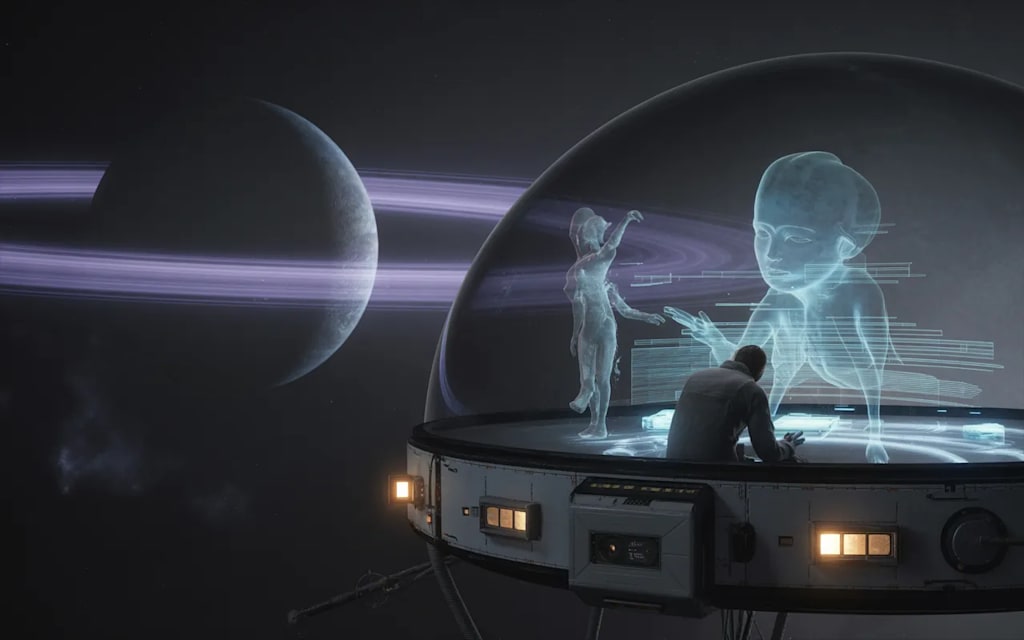
No one believed in Planet Nine anymore.
It had been a theory once—an invisible giant lurking at the far edge of the solar system, tugging at the orbits of distant objects like a ghost pulling strings. Astronomers argued, published papers, revised models, and then, slowly, interest faded. New discoveries closer to home stole the spotlight. Funding shifted. Planet Nine became one of those ideas people remembered vaguely, like a half-forgotten dream.
Except Dr. Elara Voss never stopped listening for it.
She worked alone now, stationed at the Kuiper Deep Array—an aging cluster of radio telescopes orbiting far beyond Neptune. Officially, her assignment was to monitor deep-space interference patterns and catalog cosmic background noise. Unofficially, she was chasing something no one else cared about anymore.
Signal anomalies.
It started as a pattern she almost ignored. A faint repetition buried inside the static—too structured to be random, too irregular to be artificial. It wasn’t a clean signal. It wavered, stretched, broke apart, then reassembled itself like something trying to remember how to speak.
At first, Elara assumed it was interference. Solar radiation, stray transmissions, malfunctioning equipment—she ruled them out one by one. But the signal persisted.
And then it changed.
It began to pulse.
Not in a steady rhythm, but in sequences. Long. Short. Long-long. Short. Pauses in between, uneven but deliberate. It was like listening to someone tapping on a wall from the other side of a vast, silent room.
Elara ran it through every decoding system she had. Binary conversion. Linguistic pattern recognition. Mathematical mapping. Most outputs returned nonsense.
But one didn’t.
It wasn’t language—not exactly. It was closer to memory.
The system translated the pulses into layered visual approximations, like fragments of images reconstructed from incomplete data. Blurred shapes. Shifting light. A horizon that curved too sharply. A sky darker than anything she’d ever seen.
Elara stared at the projection for hours.
“Where are you coming from?” she whispered.
She already knew the answer.
The coordinates aligned with the predicted orbit of Planet Nine.
Her pulse quickened. If something was transmitting from there—if something existed there—then it wasn’t just a theoretical planet. It was… active.
Alive?
No. That was too far.
She needed proof.
—
Days blurred into weeks as Elara refined the signal. She adjusted frequencies, filtered noise, amplified faint traces. The clearer it became, the stranger it grew.
The “images” sharpened.
A surface of dark ice stretched endlessly beneath a sky that shimmered with slow-moving light, like curtains of shadow. Structures—if that’s what they were—rose from the ground in smooth, impossible curves. They didn’t look built. They looked grown.
And then there were the figures.
At first, they were only distortions—gaps in the image where something should have been. But as the signal strengthened, their outlines emerged.
Tall. Slender. Almost human, but not quite. Their forms flickered, as if they weren’t entirely fixed in place. Like reflections on moving water.
Elara leaned closer to the screen, barely breathing.
“This isn’t possible.”
But it was.
And they were looking back.
—
The breakthrough came on day forty-three.
Elara had been attempting something risky: sending a signal back.
Not a message in any human language—those had failed. Instead, she mirrored the structure of the incoming pulses. She echoed them, altered slightly, like responding to a knock with the same rhythm.
It felt absurd. Primitive.
But it worked.
The incoming signal shifted immediately.
The pulses tightened, becoming more rapid, more focused. The visual fragments surged in clarity, resolving into something closer to a continuous stream.
And then, for the first time, the translation system produced something coherent.
Not an image.
A voice.
It wasn’t sound—not really. It was more like a sensation interpreted as language, bypassing her ears and forming directly in her mind.
You hear us.
Elara froze.
Her throat tightened, but she forced herself to respond.
“Yes,” she said aloud, though she knew the words themselves didn’t matter. “I hear you.”
A pause.
Then:
We have waited.
Her mind raced. “For what?”
The answer came slowly, as if searching for the right shape.
For you to remember us.
A chill spread through her.
“Remember?” she repeated. “I’ve never—”
The signal surged, cutting her off.
Images flooded her mind—not the distant, alien landscapes she’d been studying, but something else entirely.
Earth.
Ancient. Unrecognizable. Skies filled with unfamiliar constellations. Oceans glowing faintly under a dimmer sun. And within it all… those same figures, moving among early humans, their forms shimmering like heat haze.
Elara staggered back, gripping the console.
“What is this?” she gasped.
You knew us once, the presence said. Before you forgot.
Her heart pounded. “That’s impossible.”
You left us.
The words hit harder than she expected.
“We didn’t leave anyone,” she said. “Humanity never—”
Another surge.
This time, the images were fragmented. Chaotic.
A separation. A tearing apart. The figures retreating into darkness, into the far reaches of the solar system. A sense of loss so profound it felt like a physical weight pressing against her chest.
You chose the light, they said. We remained in the cold.
Elara shook her head, trying to ground herself. “No. This has to be a misinterpretation. A projection. My system—”
You are afraid.
She hesitated.
“Yes,” she admitted.
A long silence followed.
Then, softer:
So were we.
—
The transmissions continued for days.
Elara stopped trying to categorize them as data. They weren’t just signals. They were… conversations. Exchanges of thought and memory, filtered through imperfect translation.
She learned that the beings—if that word even applied—existed in a state that blurred the line between physical and something else. They experienced time differently, stretching moments into centuries, compressing centuries into moments.
And they had been alone.
For a very long time.
“Why contact us now?” Elara asked during one exchange.
Because you are listening again.
“Why does that matter?”
A pause.
Because we are fading.
The words carried a weight she couldn’t ignore.
“What do you mean?”
The response came as an image.
The structures on Planet Nine—those smooth, flowing forms—were dimming. Cracking. Dissolving into the dark. The figures themselves flickered more violently now, their shapes unstable.
We cannot remain without you.
Elara’s stomach dropped. “Without us? What does that mean?”
We were never separate.
Her mind reeled. “That doesn’t make sense.”
It will.
—
The realization came slowly.
Too slowly.
By the time Elara understood, it was almost too late.
The signals weren’t just being received.
They were changing her.
It started subtly. A shift in perception. Colors seemed deeper, richer. Time felt… flexible. Moments stretched when she focused, compressed when she didn’t.
And then the memories began.
Not hers.
At least, not entirely.
She saw the ancient Earth again—but this time, she wasn’t just observing. She was there. Feeling the air, the ground beneath her feet. And beside her, those beings—no, not beside her.
With her.
Connected.
A shared existence.
Humanity hadn’t just encountered them.
They had been intertwined.
Until something—some choice—had split them apart.
Elara collapsed into her chair, breathing hard.
“No,” she whispered. “No, this isn’t real.”
It is, they said gently.
“You’re… merging with me,” she realized. “Using the signal to—what? Reconnect?”
To become whole again.
Panic surged through her.
“I can’t let that happen,” she said. “I don’t even know what that means for us—for humanity.”
You already know.
She did.
Deep down, beneath the fear, beneath the confusion… she understood.
It wouldn’t be destruction.
It would be transformation.
But it wouldn’t be reversible.
Elara stared at the console, at the endless stream of pulses still flowing in.
“You’re dying,” she said quietly.
Yes.
“And you think joining with us will save you.”
And you.
She closed her eyes.
The silence stretched.
Then, slowly, she reached for the transmitter.
“I don’t know if this is a good idea,” she said.
Neither did we, once.
A faint, almost human echo of something like a smile brushed her thoughts.
Elara took a breath.
And sent the signal.
The echoes from Planet Nine didn’t fade.
They grew louder.
About the Creator
Enjoyed the story? Support the Creator.
Subscribe for free to receive all their stories in your feed.
Comments
There are no comments for this story
Be the first to respond and start the conversation.