
Crocodiles Don’t Age and Birds Just Drop Dead? The Internet Lied to You in the Most Interesting Way
A saltwater crocodile, a ten-year-old lovebird, and two zookeepers explain why “negligible senescence” is not a superpower.
I
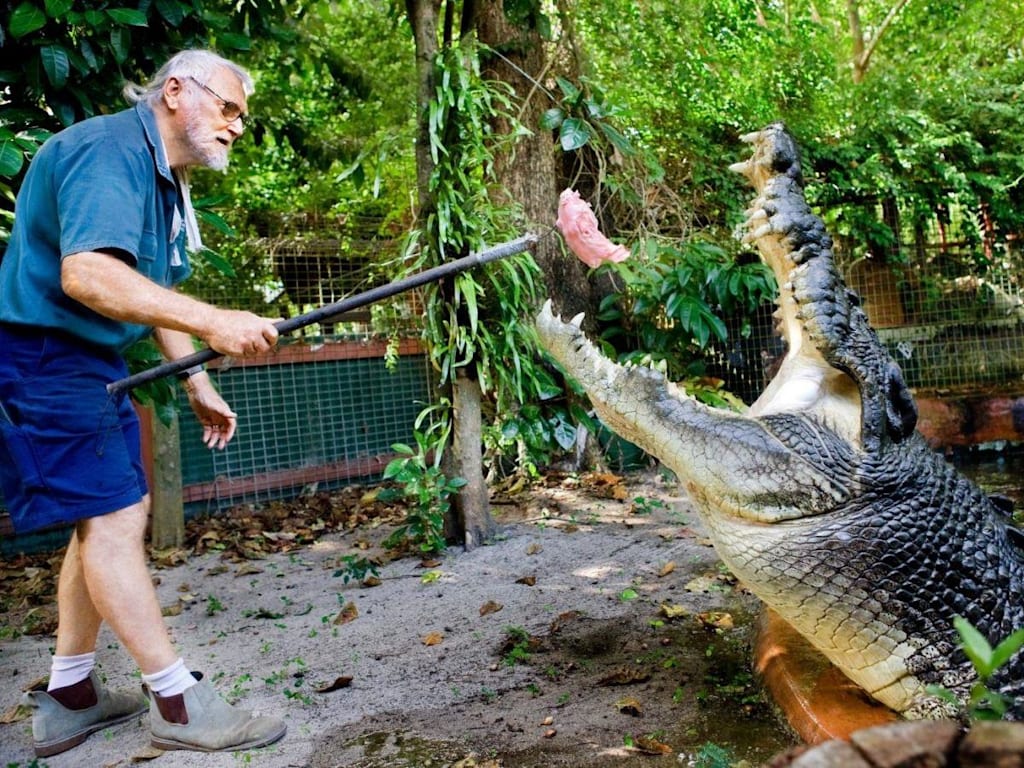
At four in the afternoon, Lao Zhou, a keeper at the zoo’s reptile house, squats by the crocodile pool and measures the water temperature with a long rod. The saltwater crocodile in the pool has been kept here for twenty-three years. The ridges on its back armor have been worn a little round by time, and there is an old wound on its left hind leg from a fight over food years ago. Lao Zhou says the crocodile has been eating less lately, but every spring, during mating season, it is as aggressive as ever. When it opens its mouth to threaten the crocodile in the next pool, the muscles in its lower jaw bulge, and there is no visible difference from ten years ago.
In the bird house next door, a lovebird named Green Bean is molting. Keeper Xiao Chen reaches into the cage to change the water bowl, and Green Bean pecks the web of her hand, not hard, but accurately. Xiao Chen says Green Bean is ten this year. By lovebird standards, it has already passed the greater part of its life. Yet the force of its peck, the speed with which it grabs food, and the volume of its six a.m. call are no different to the naked eye from when it first reached sexual maturity.
Neither Lao Zhou nor Xiao Chen knows the term “negligible senescence.” But the two animals they face every day happen to stand at opposite ends of that term.
II
The internet says crocodiles and birds undergo “negligible senescence.” That claim is half grounded and half distorted.
“Negligible senescence” does not mean “does not age.” It is a statistical concept: within a population, the annual risk of death among adults does not rise significantly with age. The 2022 study in Science compared seventy-seven species of ectothermic vertebrates, including crocodilians, turtles, snakes, and lizards. The researchers did something very unglamorous: they tagged individuals, recaptured them year after year, and recorded who died and who was still alive. It took decades of accumulated data to draw the curve of death risk against age. For some crocodilian species, the curve is flat. At age ten, the annual risk of death might be one or two percent; at age one hundred, the number might still be one or two percent. Age does not push up the probability of death the way it does for dogs and humans.
But there are three limits here. First, it is population statistics, not an individual myth. That saltwater crocodile can still get skin disease, wear down its teeth, and stop eating when the water temperature changes abruptly. Second, it does not mean there is no physiological decline. Fertility, tissue repair speed, and the healing of old wounds still go down. Third, it varies by species. In the same study, the freshwater crocodile ranked only in the middle of the animal kingdom for aging, far from the most extreme “non-ager.” And at very old ages, death risk may rise again.
So translating “negligible senescence” into “doesn’t age normally, then suddenly dies at the end” turns a statistical curve into a fantasy premise.
III
“Crocodiles grow stronger as they get older” is another misreading, but it has a basis.
Crocodiles do grow slowly throughout life. After sexual maturity, most mammals stop growing and divert energy to reproduction and maintenance; crocodiles do not. Their growth rate declines year by year, but the back armor still lengthens and body weight still increases. A forty-year-old saltwater crocodile is much heavier than a twenty-year-old one, and looks “stronger and stronger.” But a large body does not mean a young physiology. Lao Zhou’s crocodile has badly worn teeth; when it swallows a whole piece of fish, it has to twist its head to tear it apart, and a bone that a young crocodile could snap in one bite takes it several extra seconds. Its “strength” is an appearance built from lifelong growth and survivor bias: it has lived long enough, grown large enough, and avoided elimination, so it looks as if it is growing younger.
Lao Zhou puts it accurately: “The crocodile isn’t ageless. Heaven just settles accounts with it slowly.”
IV
On the bird side, the accounts are settled even more slowly, but the ledger is always there.
A dog, well kept, lives ten to fifteen years. A lovebird, also well kept, lives about the same. But by seven or eight, a dog has to get up slowly, the muscles in its hind legs are visibly thinner, its coat is graying, and it pants after a short run. A lovebird at ten looks little different from a freshly mature adult: it still pecks, still grabs food. Xiao Chen says Green Bean laid a clutch last year. Only one hatched, but the shell hardness and the interval between eggs showed no obvious change from previous years.
Another comparison: a captive sparrow, about the size of a pet hamster, often lives two to three times as long as the hamster. Albatrosses and macaws can live past seventy in captivity, yet their bodies are far smaller than those of elephants and whales, which are also long-lived. Lifespan generally correlates with body size across animals, and birds are the most glaring exception to that rule.
One online explanation says birds have a short aging period and die suddenly because a slight decline in physiological function makes survival impossible, so they “drop dead.” That is only half right. Wild birds do face high demands in flight, foraging, and escaping predators, and a slight decline makes them easy to eliminate. But that does not explain the captive comparison: a well-kept lovebird visibly ages far more slowly than a dog of similar lifespan. Birds do not “suddenly collapse at the end.” They stay in good condition for a long time, then gradually decline. They stretch aging out and slow it down.
V
Why can birds age slowly? The answer has to do with flight.
Flight is extremely energy-demanding. To get airborne, birds evolved highly efficient cardiovascular and metabolic systems. But high metabolism usually produces more reactive oxygen species, and reactive oxygen species are a major driver of aging. Birds, however, have a strong anti-rust system. Comparative studies show that bird mitochondria can produce certain reactive oxygen species at levels about an order of magnitude lower than mammals. Bird cells resist oxidative damage two to three times better than those of mammals with comparable metabolic rates. Bird telomeres, the protective caps at the ends of chromosomes, are unusually long in many species, or better maintained. A 2024 comparative genomics study pointed out that during the evolution of flight, birds and bats underwent convergent evolution in genes related to lifespan regulation, metabolism, cancer suppression, and reactive oxygen species control.
Bats are mammals, distantly related to birds, but they also fly and are relatively long-lived. Flight is both a cost and a dividend: the high metabolic pressure selected for stronger bodily maintenance systems. Birds are not ageless. They carry a maintenance system polished by flight, and so they age slowly.
VI
Then why do mammals age quickly? Here is an explanation that must be labeled a hypothesis: the longevity bottleneck hypothesis.
The biologist João Pedro de Magalhães proposed that for more than a hundred million years, while dinosaurs ruled the Earth, early mammals lived in small, nocturnal, short-lived ecological niches. Under heavy predation and resource competition, selection favored “breed fast” over “maintain the body for a long time.” Gene pathways related to longevity, efficient DNA repair, and tissue regeneration may have been weakened or shut down in mammalian ancestors. Later, mammals evolved long-lived species such as elephants, whales, and primates, but the underlying code was never completely rewritten.
This hypothesis is not settled science. But it offers a useful perspective: mammalian aging is not only a present-day physiological problem. It also carries an evolutionary legacy from the age of dinosaurs. Crocodiles and birds look like animals that slowed the clock. Mammals look like descendants of a “live fast, die young” strategy. Even after producing long-lived species, they still carry the shadow of an older era in their bodies.
VII
When the closing music starts, Lao Zhou begins draining the crocodile pool. The saltwater crocodile slowly sinks, leaving only its eyes and nostrils above water, like a piece of old wood afloat. Next door in the bird house, Xiao Chen finishes changing Green Bean’s water. Green Bean hops back onto its perch and pecks the cage bars twice, a crisp sound no different from its six a.m. call.
As Lao Zhou locks up, he says, “Still have to measure the water temperature tomorrow.” Xiao Chen answers, and turns off the bird house lights.
Two curves of time, each moving forward in the dark.
About the Creator
Jin
Writer of reamstories
https://reamstories.com/jin
Enjoyed the story? Support the Creator.
Subscribe for free to receive all their stories in your feed. You could also become a paid subscriber, letting them know you appreciate their work.
Comments
There are no comments for this story
Be the first to respond and start the conversation.