
Brain Size Is a Bad IQ Test for Animals
Crows, whales, elephant fish, and Einstein’s brain all break the simple rule.
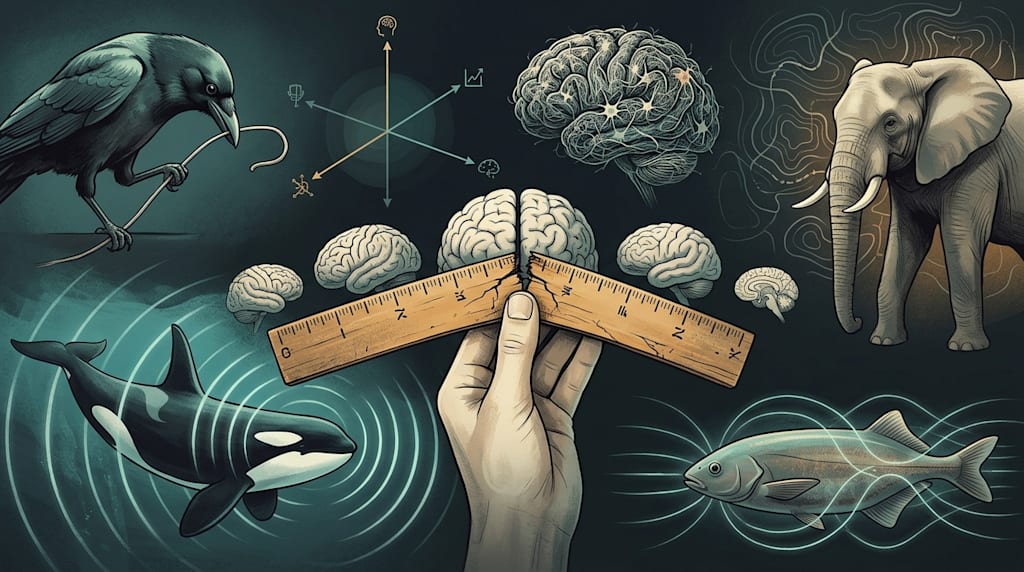
It is easy to link a larger brain with greater intelligence. Human brains are not the largest in the animal kingdom, but humans tend to treat their own cognitive abilities as the standard, and the intuition that “more brain” means “more mind” follows naturally. A quick look at other animals makes that intuition harder to defend.
Crows are a useful starting point. Their brains are small compared with those of many mammals, yet corvids perform well on tasks involving tool use, causal reasoning, delayed gratification, and preparation for future needs. Some corvids bend wire to retrieve food, remember complex social relationships, recognize individual human faces, and adjust their behavior according to what another animal is likely to do. They lack the six-layered cortex of mammals, but they achieve complex cognition through a different neural architecture. Brain size is one variable. Brain organization is another.
Cetaceans push the argument in a different direction. The brain volume of an orca exceeds that of a human. Reported estimates for some cetaceans, including orcas, place cortical neuron numbers near or above human values, although methods and regions vary. A large body, an elaborate sensory-motor system, and a rich ecological repertoire all complicate any simple comparison. The phrase “whales are not as intelligent as humans” needs care. The issue runs deeper than etiquette. The comparison itself needs a definition: which intelligence is being compared? Language and abstract reasoning? Social cooperation? Spatial memory? Echolocation? Long-term ecological knowledge? Different species have different strengths, and those strengths cannot be reduced to a single ranking of individual intelligence.
Why brain size does not convert directly into intelligence
Research in neurobiology over recent decades has established several constraints.
First, larger-bodied animals tend to have larger neural regions devoted to body movement and sensation. A bigger body generates more tactile, proprioceptive, and motor-coordination information to process. That brain tissue supports the operation of the body. It does not map directly onto what humans usually call “thinking.”
Second, the brain is not a uniform mass. White matter supports network conduction and synchronization; it is not inert packing material. Cranial imaging volume can be affected by ventricles and cerebrospinal fluid, while brain weight usually excludes cerebrospinal fluid. Any discussion of “brain capacity” therefore needs to specify whether the measure is cranial volume, brain volume, brain weight, cortical thickness, or surface area. These are not interchangeable.
Third, cortical thickness, folding, and surface area do not scale in a strict proportional way. A larger body does not simply enlarge every neuron by the same factor. Neurons vary greatly in size, and neuron density differs across species. A large-bodied animal does not need several times as many neurons merely to control a larger body. The familiar intuition that a body scaled by x³ requires a cortex scaled by x³, with nearly x³ times as many neurons, does not hold.
Fourth, the encephalization quotient, or EQ, has reference value but clear limits. Roth and Dicke reported in 2005 that the orca’s EQ is roughly 2.57 to 3.3, above the chimpanzee’s roughly 2.49, below the bottlenose dolphin’s 4.14, and far below the human range of 7.4 to 7.8. These figures indicate relatively high brain mass within mammals, but EQ depends on the formula and the reference group. Its explanatory power drops when it is extended to birds, fish, or insects. Bird brains lack a mammalian-style cortex but can have high neuron density and different nuclear organization. One ruler applied to every animal measures the wrong things.
Brain size, total neuron count, and brain-to-body ratio each capture something, but none is a stable readout of the cognitive portion of a brain across species. Brain size reflects body control, sensory-motor demand, neuron density, white-matter connectivity, and energy cost. It is a composite result, not a direct intelligence score.
The electric world of the elephant fish
The elephant fish Gnathonemus petersii offers a useful case. Its adult brain weight as a proportion of body weight is slightly above that of humans. Its brain is reported to consume about 60% of the animal’s oxygen uptake, among the highest percentages measured in vertebrates. The fish uses specialized muscles to generate a weak electric field and sensitive electroreceptors to locate objects, communicate, and navigate. It also has usable dim-light vision. In aquariums, observers have seen it appear to use electric discharges while interacting with a light metal ball.
This case shows that high brain energy cost does not imply human-style intelligence. The elephant fish devotes substantial neural resources to electroreception and electric-organ control. That is its ecological specialization. The aquarium “ball play” is an anecdote, not evidence of intelligence. The “highest oxygen share” claim also needs measurement conditions and sample limits. The example still makes a useful point: a brain’s cost is tied to a species’ sensory world. A human task is a poor test for a fish that inspects its surroundings through an electric field.
The difficulty of IQ testing across species
As of 2026, most nonhuman animals cannot use IQ tests designed for humans and based on human language. Graphic tests work only with species that can be tested in captivity with reasonable cooperation. IQ is also not the same as intelligence. Defining and measuring intelligence in species with different environments and behavioral strategies is difficult.
What remains, to a large extent, is practice. Humans often reason that they are smarter than elephants because people have killed, captured, and domesticated many elephants. After long interaction, people have not found experimental evidence that elephants surpass humans in intelligence. The reasoning has a weakness: it risks reverse-engineering the conclusion. Humans define intelligence around tasks humans perform well, then use those tasks to show that humans perform well.
Elephants are not cognitively simple. Studies have reported mirror self-recognition, cooperative problem solving, classification of human language, and detailed olfactory and numerical cognition. A history of domestication is not an intelligence test. Humans show distinctive abilities in language, abstract reasoning, and cumulative culture. Elephants show distinctive abilities in ecological memory, olfaction, social cognition, and spatial knowledge. Comparison should use several dimensions rather than a single league table.
Within humans, brain size is still not an intelligence readout
Even within the human species, brain size does not accurately represent neuron number, and neuron number does not accurately represent cognitive ability. Human neuron counts vary by billions, and that variation shows no stable statistical relationship with differences in intelligence. Some people with larger brains and better performance on cognitive tasks have fewer connections between neurons than average, which may improve the efficiency of some neural activity. In other cases, a larger brain is attributable to disease, and a larger brain predicts a worse outcome.
Einstein is often cited in this context. His measured brain weight was about 1,230 grams, below the modern adult male average of about 1,400 grams. His cortex was thinner than those of five comparison brains, and his neuron density was above average. The example is often misread as proof that brain weight is irrelevant. Individual brain weight is affected by height, age, sex, cause of death, fixation, and measurement conditions. Einstein’s brain shows that brain weight cannot be treated as an intelligence readout. A single anecdote does not prove the reverse either.
A 1907 article cited names, ages at death, occupations, nationalities, and measured brain weights collected by the American Anthropometric Society. The table includes notable people. In the lower right corner is Gall, a novelist and phrenologist who could not have known that his brain weight would fall so far below the ordinary range. Daniel Lyons, who died in 1907, had normal intelligence, but his measured brain weight was less than 680 grams. These historical materials are interesting as history of science, not as modern evidence. Sample selection, cause of death, age, and measurement methods all introduce bias. The Daniel Lyons case also requires pathological context. The material shows that the relation between brain weight and intelligence is more complex than intuition suggests. It does not show that brain weight is irrelevant.
A multidimensional map, not a single ranking
Crows, whales, elephant fish, elephants, and variation within humans point to the same conclusion. Brain size is not a ruler for intelligence. Brain size reflects body control, sensory-motor demand, neuron density, white-matter connectivity, and energy cost. EQ has reference value within mammals, but its cross-class explanatory power is limited. Nonhuman animals cannot readily use human IQ tests, and ecological tasks carry human-centered bias.
A more useful approach is to break “intelligence” into dimensions: learning and memory, causal reasoning, tool use, social cognition, spatial navigation, temporal expectation, cooperation and communication, and behavioral flexibility. These dimensions can then be compared alongside neural architecture, connectivity, energy cost, and ecological task demands. Humans show distinctive performance in some dimensions. Corvids, cetaceans, elephants, and dolphins show strong performance in others. A single cross-species intelligence ranking is not supported by the evidence.
The crude intuition that a bigger brain means greater intelligence is not adequate. The ratio of brain weight to body weight is only an approximation. A higher neuron count also requires qualification. The hard question is which brain, organized in which way, in which ecological world, solves which problems. Size alone does not answer it. Comparing intelligence across species needs a multidimensional map. A single ruler will not do.
About the Creator
Jin
Writer of reamstories
https://reamstories.com/jin
Enjoyed the story? Support the Creator.
Subscribe for free to receive all their stories in your feed. You could also become a paid subscriber, letting them know you appreciate their work.
Comments
There are no comments for this story
Be the first to respond and start the conversation.