
AI Is Solving Math. That’s the Problem.
Terence Tao and 25 Fields Medalists warn that the race for answers is draining the questions that make mathematics worth doing.
Is AI Killing the Open Tradition of Mathematics?
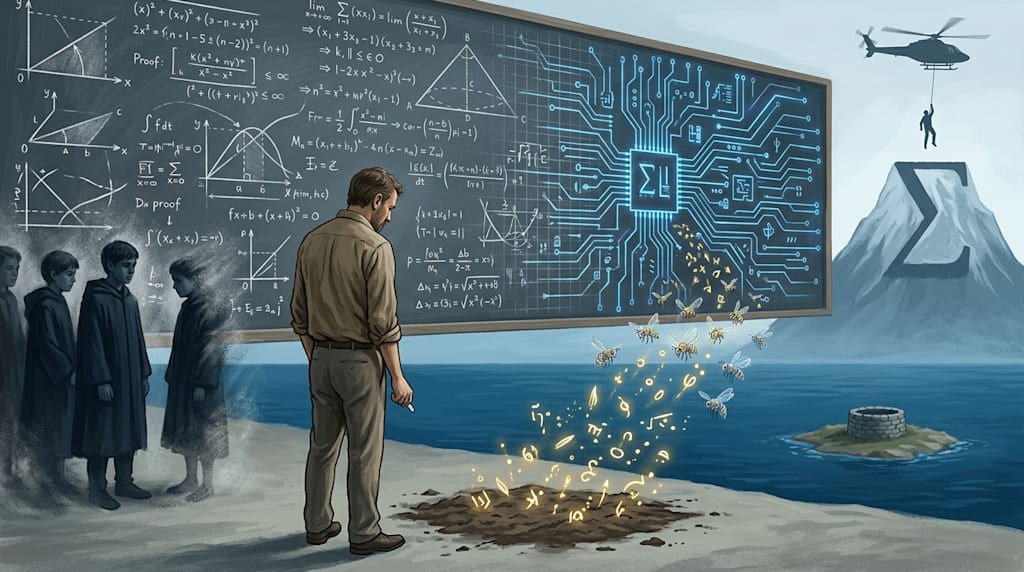
On the third day after Terence Tao posted in the math community, the comment section had hundreds of replies. He answered them one by one, sometimes still online at 3 a.m. He had discussed AI in public before. This time the tone was different. He wrote: “Those open problems that can generate new methods and new insights are a kind of non-renewable resource that may be rapidly consumed.”
People quoted that line. It stung because it turned mathematics’ open tradition into a cost-benefit problem.
Mathematical problems can be generated without limit. You can write down an unproved proposition at random. Most have no research value. The scarce ones sit at a particular spot in the terrain of difficulty: existing tools cannot reach them, but they are not hopeless. Solving one often opens a new field. Tao offered an analogy: a region surrounded by ocean can still lack drinking water.
Traditionally, a mathematician who finds a promising direction talks about it in a seminar or private discussion. Peers build on it. Openness is not about moral superiority. Mathematical progress depends on collective judgment and repeated failure. Now, once a problem is public, AI agents can arrive within minutes, use more computing power, and race ahead to advance or solve it. The cost of openness has changed. A researcher starts to calculate: should I say my immature ideas out loud?
Tao’s worry: if researchers stop speaking, the incentive structure of open science reverses at its base.
The training pipeline is more concrete. A graduate student usually does not start with the hardest open problem. The advisor assigns a project of moderate difficulty. The student learns to judge whether a problem is worth studying, how to choose tools, how to change direction after failure. That tacit knowledge does not come from reading a final proof.
Those training problems now fall inside what AI can do. Tao said that if AI replaces graduate students, AI can generate graduate-level papers, but we will not get the next generation of students. If the system only produces results and no one digests them or builds the next knowledge base, the scientific community can optimize existing techniques and lose the ability to produce original ideas.
He offered another analogy: doing mathematics is like walking a long distance. AI is a helicopter that drops people near the answer. The value of mathematics is not only the destination. When a scientist spends hours calculating on paper, doing experiments by hand, or debugging a simulation, they often learn more than the answer. They see new phenomena, connections, similarities to earlier literature. They talk about those findings with others. That may matter more than the final proof.
In January, a Nature article titled “Artificial Intelligence Promotes Scientists’ Growing Influence but Restrains the Expansion of Scientific Cognitive Boundaries” looked at what happens when AI tools enter research. Scientists who use AI publish more papers and get more citations. Their problems become more concentrated. The range of topics the whole community explores shrinks. A Nature survey of nearly 3,800 doctoral students found that three-quarters thought AI could improve learning and research efficiency. Sixty-five percent worried it would weaken thinking, research, and writing.
The impact is clearest in mathematics, not physics, chemistry, or experimental science. Mathematics has clear verifiers. Programming has compilers and unit tests. Mathematics has Lean and other formal proof systems. AI gets a clear correct-or-wrong signal after each attempt, so it can iterate fast.
Mengdi Wang, a Princeton professor, explained the technical reason. Large models learn the most common, highest-probability parts of existing knowledge. They underestimate or ignore the long tail. Scientific discovery often happens in the long tail. Mathematics and programming were early because they have clear verifiers. The real world does not. Physics, chemistry, and biology must be tested by experiments. Equipment, materials, human operators, and the environment introduce uncertainty. That is why we see “AI solves a math problem” often, and AI independently discovering a new law of physics rarely.
On September 11, 2026, Terence Tao was one of 25 initial signatories to a statement co-signed by Fields Medalists. The statement’s core claim: the goals of AI companies and the goals of the mathematical community are misaligned.
AI companies treat solving famous problems as a benchmark. They want quantifiable performance numbers and press. The mathematical community wants conceptual understanding, distilled methods, and knowledge passed on. When instrumental rationality sets the research agenda, problems that cannot be quickly benchmarked and need long immersion get pushed to the side.
The statement says AI’s success in major problems has made headlines outside mathematics. But solving a problem is a tool and a proxy for the real goal: conceptual understanding and insight. Forget that in the AI world, and the tool turns against the goal. Mass-producing true/false statements faster and faster may destroy the conditions for new ideas rather than create them.
Solutions are announced hastily. There is no time for proper writing, for distilling new methods, or for citing prior work. As in other creative fields, this raises attribution and plagiarism problems. Without mathematicians willing to develop the ideas and integrate them into the canon, AI ideas never come alive. The chain of people passing mathematics to people breaks.
The mathematical community is a small version of humanity. It has individuals using different methods, bound by shared values. Its most valuable resources are students and ideas. The community cultivates them until they can live independently in mathematics. Advisors pose problems to train students, to put them in a position to make progress in research and elsewhere. Mathematicians spread their own ideas through lectures, private discussions, and careful writing. They connect those ideas to earlier work. These processes take time. They depend on person-to-person interaction.
Tao does not think AI is destined to destroy mathematics. He worries that the culture, norms, and infrastructure of mathematics have not adapted to “proof abundance.”
He once described the early reasoning model o1 as “a mediocre but not entirely incompetent graduate student.” By March, his assessment had changed. At the UCLA conference “Accelerating Math and Theoretical Physics with AI,” he said current large models are ready for mathematics and theoretical physics because “the time saved already exceeds the time wasted.” In an April Nature interview, he said mathematicians’ “job description is changing.” He uses AI for literature retrieval, code generation, drawing, computation, and testing “bold ideas.” He has said he teamed up with ChatGPT to crack a MathOverflow problem, saving hours of coding.
He summarized the shift as mathematics moving from “proof scarcity” to “proof abundance.” The problem: our mathematical infrastructure and culture have not adapted.
In an interview, he called the research system “at a somewhat dangerous point.” AI is producing scientific output, or at least “things that look like scientific output,” faster and faster. The cost may be damage to the training of the next generation.
The signatures on the statement webpage keep coming. Tao’s next blog post is titled “AI and Mathematics: The Next Step.”
About the Creator
Jin
Writer of reamstories
https://reamstories.com/jin
Enjoyed the story? Support the Creator.
Subscribe for free to receive all their stories in your feed. You could also become a paid subscriber, letting them know you appreciate their work.
Comments
There are no comments for this story
Be the first to respond and start the conversation.