
AI Has No Envy. That Is Why It Will Change Mathematics.
A scooped mathematician loses a night. A machine learns the method and moves on. The shift is not raw intelligence. It is the cost of friction.
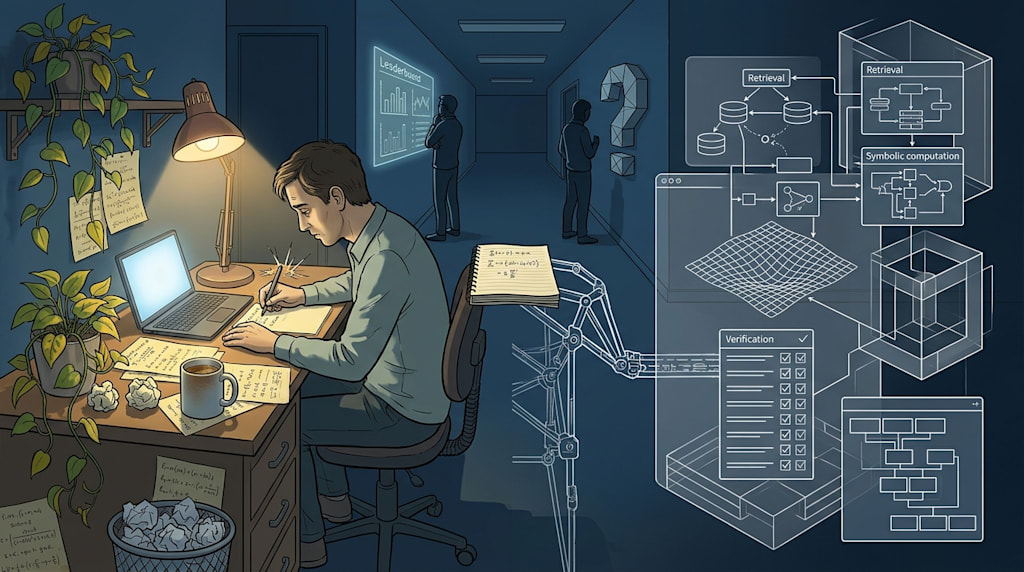
At two in the morning, B crumpled the third sheet of draft paper and threw it into the wastebasket. The paper ball bounced once and landed beside the bin. He did not pick it up. The tea on the desk had been brewed at ten; a film had formed on its surface. He stared at A’s preprint on the screen. Lemma 3.2 on page four used the same technical route he had thought of last week. Even the choice of constants was similar. He closed the PDF, opened his own draft, and the cursor stopped after half a line of formula. It blinked for seven minutes. Then he closed the laptop, went to the kitchen, boiled water, came back, and opened the laptop again. The draft was still there. He deleted the half-line, rewrote it, and deleted it again at the third line. The streetlight outside shone in. The edges of the pothos leaves were turning yellow. He should have watered it last week.
This is an ordinary night for a human mathematician. Being scooped does not make a person collapse right away. It is more like a thin splinter in the fingertip. It does not stop you from gripping a pen, but you feel it every time you apply pressure. The next day B still goes to the office. He still pushes formulas. Now there is an extra layer. He must first route around A’s method and find a different entry point. That difference is not necessarily better. B needs it to sustain something hard to name. Maybe self-respect. Maybe the small mark that says, I made this.
The same problem, processed by a system, looks like this. Retrieve Brendle-Hung. Extract the perturbation order and constant dependence. Try a second-order perturbation in a symbolic computation environment. Check the positivity condition of the curvature tensor. Output an improved version. Annotate the verification status of each step. The log has no field for hesitation. It will not close the laptop and reopen it at two in the morning. It will not take a detour because this move was not mine. Once a method becomes usable, it is broken into parts and recombined.
Some people call this an emotionless problem-solving machine. That description catches the surface. It misses the cost structure. The machine having no emotions is not the main issue. Its psychological friction cost is zero. A human mathematician carries an emotional architecture on top of the intellectual difficulty. There is fear of being scooped. There is fear that the method is not beautiful enough. There is fear that a move honed over decades will become public knowledge overnight. A announces a solution. B checks it and confirms it is correct. B can continue with his own work, but his mind will not remain completely still. Frustration, loss, envy, and self-doubt are research costs. They do not necessarily destroy a person, but they consume state, mood, and judgment. The system does not carry these. Point out its error, and it will not defend itself out of shame. Surpass it once, and it will not lose sleep. It incorporates what is usable into the next search.
So the speed at which a method turns from a personal ultimate move into public nutrient is compressed. In the past, when a mathematician invented a powerful method, he might have a window of several years or even a decade. Others needed time to learn it. They needed insight to understand it. They needed luck to improve it after learning it. Now, once a paper is public, a system can in a short time retrieve, dismantle, formalize, trial, and combine it. It rapidly eats the replicable parts of the method. The human originator’s advantage increasingly lies in knowing why the move matters and where to strike next, not in knowing the move.
One brake is needed here. The claim that AI learns a method in one look and surpasses it in the second cannot be written as single-model magic. A model in one conversation will not permanently become stronger just because it read a paper. What happens is a closed loop. Retrieval, context, agent memory, fine-tuning, formal libraries, symbolic computation, parallel search, human filtering, and verification all feed one another. Attributing all the contribution to the model misjudges where the moat is. Underestimating the iteration speed of this system also misjudges the future. On formalizable, verifiable tasks with large search spaces, a human plus AI system iterates far faster than a single human. That is not the same as Claude independently becoming a god. Birkar says GPT has no creativity and can only do lemma-level things. That is not fully contradictory with large-scale agent systems hitting core problems. A single LLM’s weak creativity does not mean a human-machine system cannot do lemma-level combination, explicit constant work, and construction search.
Another bottleneck is verification. The faster AI outputs, the more expensive verification becomes. A wrong proof may hide a local new idea. It may also be beautiful nonsense. To extract the local new idea from the noise requires human judgment, peer review, formal verification, and numerical checks. The scarce resource in future mathematics may not be generating proofs. It may be trustworthy verification. A referee facing fifty pages of generated proof will not first read it. He will first look for a formal tool and run it. If it fails, it goes back. If it passes, he looks for local constructions worth keeping. This process will become part of mathematical infrastructure. Whoever can design a better verification loop will have influence.
Toward those concrete cases, the best attitude is cautious excitement. The Brendle-Hung method being pushed faster and more explicitly, or some human-machine system making an improvement in a curvature construction, would show that method propagation and constant optimization are accelerating. But “pair MMP has been blown up” is mathematically too heavy a statement to rely on social media retellings. One needs preprints, peer review, formalization status, and a clear boundary between human and system contributions. Even if all the cases hold, the accurate description is the impact of a human plus AI system, not the model independently completing it.
The harder question is how mathematicians’ motives and strategies will be restructured.
Two PhD students are talking in the corridor. One says that if he does mathematics, he wants to be the best in the world, unmatched in some field. The other says he is not that ambitious. He just wants to know why something looks the way it does. The first will have a hard few years. On more and more tracks, he will lose to AI, or at least be pressed hard by human-machine systems. AI may lose to him temporarily. It has no emotional cost, no scoop trauma, and no psychological barrier of “this move is not original.” It can learn his ultimate move before his eyes and then show him a combination he never thought of. The moat he built through decades of practice will be thinned on formalizable, verifiable, data-rich, large-search-space tasks.
The second has prospects. Mathematics was never only about solving problems. It also includes asking good questions, constructing new concepts, judging what is important, designing proof architecture, making cross-domain analogies, and deciding what is worth knowing. AI can help you search, combine, formalize, calculate, and make constants explicit. It is still not good at deciding for you which problem is worth a lifetime. Low-dimensional topology is relatively slow. Some of Thurston’s tools are still not well used. The bottleneck is data, formalization, spatial intuition, and verification cost. That is not necessarily an essential barrier, and it is not a simple matter of time either. Human spatial intuition and conceptual taste still have an irreplaceable place.
The future mathematician may look more like a director and a verifier. You pose a problem. You design a proof route. You mobilize a group of agents to search, compute, formalize, and refute. Then you judge which results are trustworthy, which local ideas are worth keeping, and which directions are worth continuing. You no longer compare with AI over who finishes the known method first. You compare over who asks better questions, who constructs better concepts, and who designs a more reliable verification loop. AI works as an exoskeleton. It has no envy, but human institutions still compete. It will not automatically evolve, but the human-machine verification loop will.
Later, B poured out the cold tea and brewed a new cup. He watered the pothos. He opened A’s paper, copied Lemma 3.2 into his notebook, and wrote beside it: “The constants can be tighter, but that is not the point.” Then he turned to a new page and began writing the next problem. Outside, it was still dark. A cookie crumb had landed on the keyboard cover. He flicked it off with his finger.
About the Creator
Jin
Writer of reamstories
https://reamstories.com/jin
Enjoyed the story? Support the Creator.
Subscribe for free to receive all their stories in your feed. You could also become a paid subscriber, letting them know you appreciate their work.
Comments
There are no comments for this story
Be the first to respond and start the conversation.