

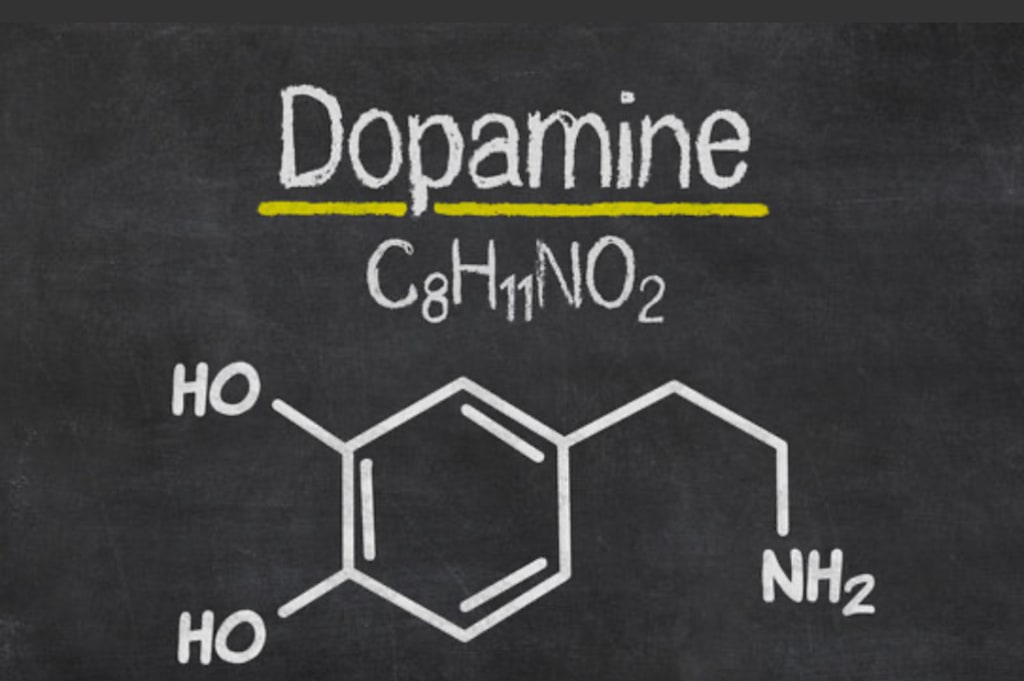
Everyone talks about dopamine like it's this simple little pleasure button in your brain. You eat something good, boom dopamine. You get a like on Instagram, dopamine. Someone texts you back, dopamine. We've turned it into this catch all explanation for why humans do dumb things and can't stop doing them.
But honestly the real story is a lot more interesting and a little bit darker than that.
It's Not Actually About Pleasure
Here's the thing that most people get completely wrong. Dopamine is not a pleasure chemical. Like at all.
Neuroscientist Kent Berridge at the University of Michigan spent decades trying to prove the opposite and ended up accidentally disproving it himself. His research showed that dopamine is actually responsible for "wanting" not "liking." Those two things sound the same but they're not even close to the same thing. The brain circuit that makes you desperately crave something is completely separate from the circuit that makes you enjoy it when you get it. (Berridge & Robinson, 2016, American Psychologist)
Think about that for a second. You can want something really badly and get absolutely nothing out of having it. That's not a personal failing, thats literally how your brain is wired. Dopamine drives you toward the reward. It doesn't actually deliver it.
Berridge described it in an interview as "wanting without liking." And if you've ever kept scrolling for another 45 minutes and felt emptier than before you started, you already know exactly what that means.
So What Is It Actually Doing
Dopamine is really about anticipation and motivation. When something good might happen, your brain floods with it. Not when the good thing happens. When it might.
This goes back to research by neuroscientist Wolfram Schultz, who found that dopamine neurons fire most intensely not at the reward itself but at the cue that predicts the reward. The notification sound. The little red number on your app. The slot machine spinning. That's when dopamine spikes. The actual payoff, getting the candy, winning the money, reading the comment, barely registers by comparison. (Schultz, 1997, Science)
Your brain is basically running on suspense. And the people building apps absolutely know this.
How We Got Here
Addiction has always been framed as a moral problem. Weak people, bad choices, lack of willpower. But over 40 years of research on the dopaminergic system has made that framing pretty hard to defend. Drugs hijack the same reward pathways that evolved to keep us alive. Eating, sex, social connection, all of those things spike dopamine because for most of human history, chasing those things kept you breathing. (National Institute on Drug Abuse, 2022)
What's changed is that we now have industries built entirely around artificially spiking those same pathways. The research coming out of places like Stanford and Harvard is pretty clear that social media platforms activate the same neural circuitry involved in gambling and substance use. Stanford psychiatrist Anna Lembke literally called smartphones "the modern day hypodermic needle" in terms of how fast and efficiently they deliver dopamine triggering stimulation to the brain. (Lembke, Dopamine Nation, 2021)
That's not metaphor. Thats neuroscience. Research published in PMC found that frequent engagement with social media platforms actually alters dopamine pathways over time, creating dependency patterns that closely resemble what we see in substance addiction. The prefrontal cortex, the part of your brain responsible for decision making and impulse control, starts to show changes too. (PMC, 2025)
The Crash Nobody Talks About
Dopamine operates on a balance. When it spikes, it has to come down. And the brain tries to restore that balance by suppressing dopamine activity after a big hit, which is where the crash comes in.
Dartmouth researchers described it this way: if there's a huge deviation upward, there's going to be a deviation downward. That's the comedown. That specific moment where you've been on your phone for two hours and you feel weirdly worse than you did before you picked it up. That's not just boredom or guilt, thats actual neurochemistry. Your brain's dopamine levels dip below baseline and suddenly everything feels a little flat and grey and not quite worth doing. (Dartmouth Undergraduate Journal of Science, 2022)
And because the brain learns fast, it starts to need more stimulation just to feel normal. This is called tolerance, and it's not unique to drugs. Screens do it, sugar does it, anything that repeatedly overstimulates the reward system can do it.
The Slot Machine Was Always the Model
Former Google design ethicist Tristan Harris has been pretty vocal about the fact that a lot of the features we use every day, pull to refresh, infinite scroll, unpredictable notifications, were deliberately designed to work like slot machines. Not sort of like slot machines. Actually modeled on them.
Variable reward schedules, where you sometimes get a reward and sometimes don't, produce stronger behavioral conditioning than consistent rewards. Psychologist B.F. Skinner figured this out in the 1950s. Tech companies figured out how to put it in your pocket.
The result is that billions of people are caught in what researchers now call a "dopamine loop." Anticipation, brief reward, renewed anticipation, repeat. The loop isn't a side effect of bad design. In a lot of cases it is the design. (netpsychology.org, 2025)
What This Means for Actual Addiction
It's worth being clear that dopamine dysregulation shows up on a spectrum. On one end you have everyday compulsive phone checking. On the other end you have severe substance use disorders that destroy lives. Both involve the same underlying system but they're not the same thing, and flattening that distinction doesn't help anyone.
What the research does show is that the line between behavioral addiction and substance addiction is blurrier than we used to think. The brain changes associated with things like compulsive gambling or problematic internet use overlap significantly with those seen in drug addiction, specifically in areas related to reward processing, impulse control and habit formation. (Frontiers in Neural Circuits, 2021)
The dopaminergic system doesn't really care whether the trigger is a drug, a bet, or a notification. It responds to the pattern.
Can You Actually Fix It
Short answer, yes but not by just trying harder. The brain is plastic, meaning it can reorganize. Research points to things like consistent behavioral change, mindfulness practices, and acceptance based therapy as genuinely effective at weakening those compulsive neural loops over time. It takes a while, it doesn't feel great at first, and the cues that trigger wanting don't disappear overnight. (Neuroscience and Biobehavioral Reviews, 2024) The deeper fix is probably environmental. Not relying on willpower to resist things specifically engineered to defeat willpower.
Understanding what dopamine actually does, that it's the wanting not the getting, is weirdly useful here. Because once you know that the craving and the satisfaction are two completely different systems, you stop expecting one to solve the other. The scroll never delivers what the urge to scroll was promising. It literally can't. That's not a you problem. That's just how the neuroscience works.
Sources
Berridge, K. C., & Robinson, T. E. (2016). Liking, wanting, and the incentive-sensitization theory of addiction. American Psychologist, 71(8), 670–679.
Schultz, W. (1997). A neural substrate of prediction and reward. Science, 275(5306), 1593–1599.
Lembke, A. (2021). Dopamine Nation: Finding Balance in the Age of Indulgence. Dutton.
National Institute on Drug Abuse. (2022). The brain and addiction. drugs.nida.nih.gov
Frontiers in Neural Circuits. (2021). Dopamine circuit mechanisms of addiction-like behaviors. doi:10.3389/fncir.2021.752420
Dartmouth Undergraduate Journal of Science. (2022). Social media, dopamine, and stress: converging pathways.
PMC / National Library of Medicine. (2025). Social media algorithms and teen addiction: neurophysiological impact. PMC11804976
Neuroscience and Biobehavioral Reviews. (2024). Acceptance and commitment therapy in compulsive behavior. Vol. 159.
About the Creator
Nate Heinitz
I’m a Red Seal journeyman plumber and foreman with 20 years in the dirt, dealing with flooded basements to commercial build-outs. When I’m not running a crew on the job site, I’m usually on the mats coaching or training Muay Thai.
Enjoyed the story? Support the Creator.
Subscribe for free to receive all their stories in your feed.
Comments
There are no comments for this story
Be the first to respond and start the conversation.