
Yunqing Tang and the Mystery of Numbers That Would Not Settle Down
The mathematician whose work helped solve a fifty-year-old puzzle about the hidden patterns in numbers.
Introduction
Most of us stop thinking about fractions once we leave school. We remember that the number beneath the line is called the denominator, and we hope never to meet a particularly complicated one again. For mathematician Yunqing Tang, denominators became part of a much deeper question: could the fractions appearing in a certain kind of mathematical pattern remain under control, or would they inevitably grow more complicated?
The question had resisted proof for about fifty years. Tang and her collaborators helped settle it, adding to an impressive body of work that has taken her from Peking University to Harvard, Princeton and the University of California, Berkeley. Her story offers a glimpse of modern mathematics, where apparently small questions can lead into a vast landscape of connected ideas.
A Beginning in Beijing
Yunqing Tang studied mathematics at Peking University between 2007 and 2011. During those undergraduate years, she began doing research in algebraic geometry and number theory. She later recalled that this early research deepened her understanding of mathematics, and she spoke warmly of the encouraging environment she found at the university.
Number theory begins with familiar objects such as whole numbers and fractions, but its questions can become extraordinarily difficult. Why do certain numerical patterns appear? When can an equation be solved using whole numbers? What happens when a mathematical object is examined using different prime numbers? These are the sorts of questions that eventually drew Tang into arithmetic geometry, a field that brings numbers and geometric ideas together.
This combination may sound strange at first. Geometry makes us think of shapes, while arithmetic makes us think of calculations. Yet a single equation can describe both a numerical relationship and a geometric shape. Studying it from both viewpoints can reveal properties that would remain hidden if we looked at only one.
From Harvard to Berkeley
After graduating from Peking University, Tang continued her studies at Harvard. She completed her doctorate there in 2016 under the supervision of mathematician Mark Kisin. Her career then took her through several research posts, including work at Princeton and in France, before she joined Berkeley’s mathematics faculty in 2022. She is now an associate professor there.
That journey involved more than moving between famous institutions. Research mathematics depends on sustained thought, the willingness to approach a problem from several directions, and conversations with people who see it differently. Tang has spoken appreciatively about her mentors and collaborators, including mathematicians with whom she worked from her graduate student years onwards.
Her work has addressed questions about modular forms, geometric objects called abelian varieties, and what can be learned when mathematical objects are examined through prime numbers. Those names may be unfamiliar, but the underlying aim is approachable. Tang looks for connections between properties that appear separate, and then tries to prove exactly when those connections hold.
The Puzzle of the Denominators
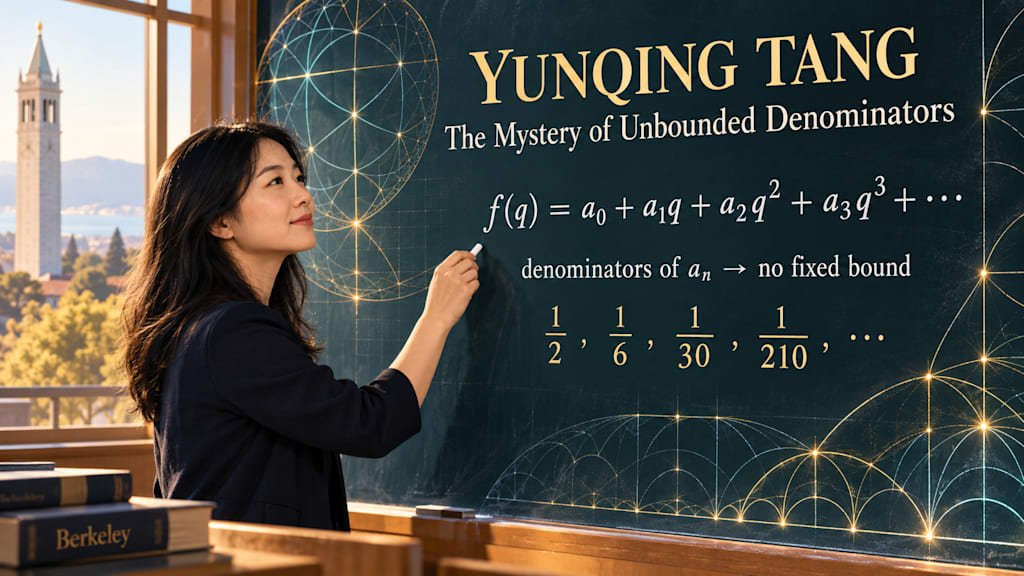
One of Tang’s best-known achievements concerns a conjecture proposed by mathematicians A. O. L. Atkin and H. P. F. Swinnerton-Dyer. It deals with modular forms, special mathematical patterns with remarkable symmetries. Mathematicians can express these patterns as sequences of numbers and examine the fractions that appear within them.
Here is the puzzle in ordinary language. For some of these patterns, the denominators of the fractions keep becoming larger, with no fixed limit that contains them all. Atkin and Swinnerton-Dyer proposed that this behaviour could distinguish certain kinds of modular forms from others. The claim sounded precise, but proving it required far more than checking a long list of examples. No list, however long, can by itself establish what happens forever.
Tang worked on the problem with Frank Calegari and Vesselin Dimitrov. Together, they proved the conjecture, resolving a question that had stood for roughly half a century. The result was significant because it gave mathematicians a rigorous way to connect the behaviour of those fractions with the deeper structure of the patterns producing them.
It is easy to underestimate such a result because the word denominator sounds so ordinary. Yet this is often how mathematics works. A question that can be introduced with schoolroom language may depend on ideas developed across several branches of advanced research. The difficulty lies in finding a proof that covers every case, including cases nobody has calculated or even imagined individually.
Recognition for a Wider Body of Work
The denominators conjecture is only one part of Tang’s research. She has also made important contributions to other problems in arithmetic geometry, sometimes working alone and sometimes with collaborators. In 2024, the Association for Women in Mathematics recognised her with its research prize in algebra and number theory, citing a range of achievements rather than a single result.
She received the SASTRA Ramanujan Prize in 2022. This award recognises young mathematicians whose work relates broadly to the mathematical interests of Srinivasa Ramanujan, whose discoveries still influence number theory today. The prize committee praised the range of Tang’s results and the techniques she had brought together to obtain them.
Her more recent recognition includes a 2026 New Horizons in Mathematics Prize. Berkeley reported that she shared the prize with Dimitrov for work in Diophantine geometry, including the denominators conjecture and further results developed with Calegari. The three collaborators were also awarded the 2026 Frank Nelson Cole Prize for Number Theory for their proof.
Why Her Work Matters
Nobody needs to pretend that arithmetic geometry is easy. Even professional mathematicians specialise because the subject has grown too large for one person to master every part. Tang’s achievements matter because she has found ways through problems that had resisted other highly capable researchers.
Her story also shows the value of collaboration. The public often imagines a mathematician working alone until inspiration suddenly arrives. Inspiration matters, but a difficult proof may also grow through years of study, shared ideas, criticism and repeated attempts. Tang has credited the people who helped shape her thinking, while making substantial contributions of her own.
There is something appealing about the particular puzzle for which she has become known. Fractions are among the first mathematical objects children learn to use. In Tang’s hands, a question about their denominators became a route into ideas at the forefront of research. The familiar numbers on a page turned out to hold a much bigger story.
Conclusion
Yunqing Tang’s path began with undergraduate research in Beijing and led to a professorship at Berkeley. Along the way, she built a career exploring how numbers and geometry fit together. Her work with Calegari and Dimitrov settled a decades-old conjecture, while her wider research continues to open new questions.
Mathematics advances when someone notices that an old question still has more to reveal. Tang has shown that even something as familiar as a fraction can point towards a hidden structure, provided someone has the patience and insight to follow it.
About the Creator
Alan Spencer
Have been an author and writer for over 20 years. Have been a journalist, editor, proofreader, and a designer and presenter of training courses. Have written over 100 articles, two books, and around 20 training courses.
Enjoyed the story? Support the Creator.
Subscribe for free to receive all their stories in your feed. You could also become a paid subscriber, letting them know you appreciate their work.
Comments
There are no comments for this story
Be the first to respond and start the conversation.