
Your Next Car May Feel More Like an iPhone Than a Vehicle
The explosive growth of automotive infotainment is changing how people drive, travel, and interact with cars.

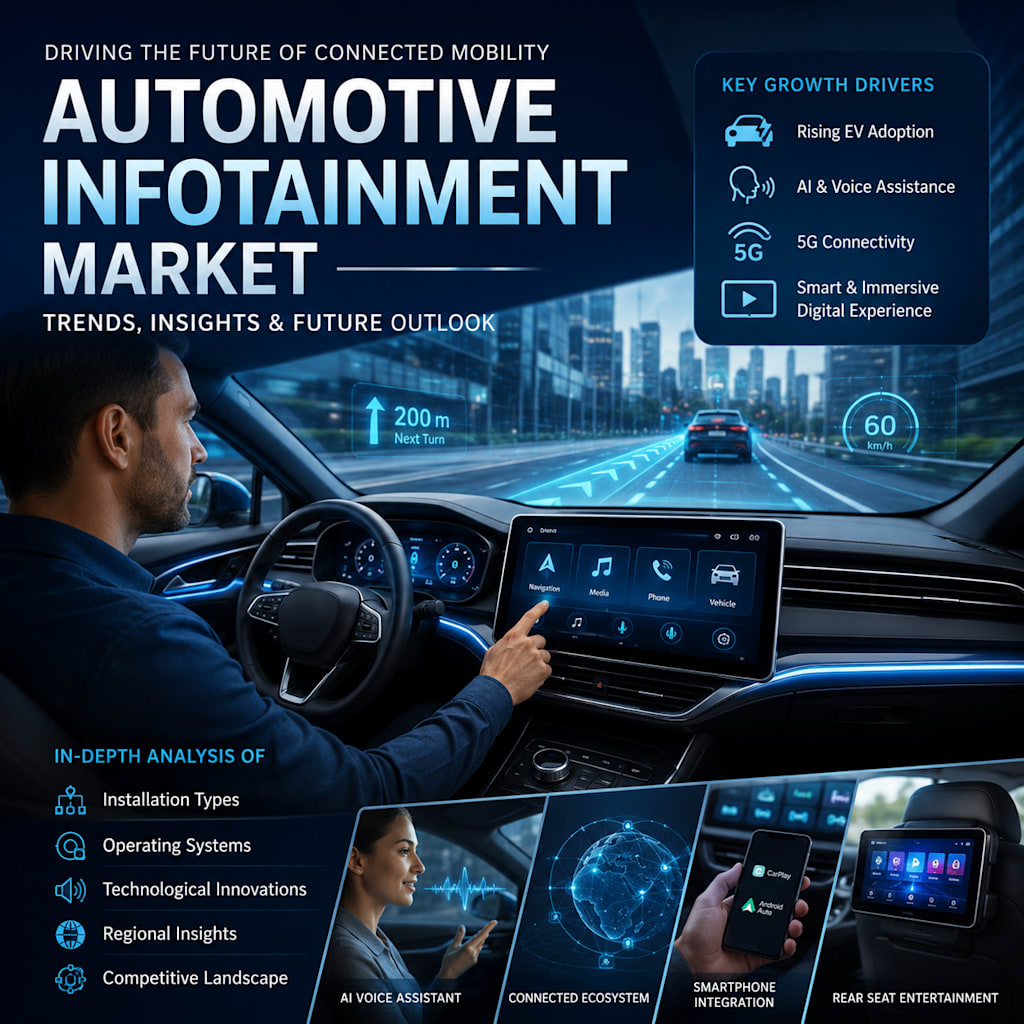
Cars are not just machines of transport anymore.
In the past decade, they have been transformed into connected digital experiences, with interactive displays, voice assistance, real-time navigation, and entertainment systems, all driven by advanced AI-driven automotive interface systems. What was once considered far-fetched technology is now becoming a standard feature across all vehicle types.
The foundation of this transformation is the automotive infotainment system.
Through interactive touch screen dashboards, high-quality audio, intelligent AI voice control and cloud-connected services, infotainment systems are fundamentally redefining the driving experience. As electric vehicles (EVs), software defined vehicles and connected cars continue their expansion globally, the automotive infotainment market is poised for one of the most significant growth periods of its history.
The market is stepping into a new era of growth.
The global automotive infotainment market size was valued at around $22.6 billion in 2025, with an estimated market size expected to reach nearly $41.5 billion by 2034.
This equates to a strong compound annual growth rate (CAGR) of 7.0% for the period 2026-2034.
This expansion is driven by a significant shift in consumer expectations; drivers no longer see infotainment as just an add-on or luxury feature but as a critical component of the overall vehicle experience. Consumers today expect their cars to act like smart phones: connected, intelligent, personalized, and always up-to-date.
Electric Vehicles Are Reshaping the Interior of cars.
One of the leading drivers for infotainment system expansion is the rapid adoption of electric vehicles (EVs). In 2024, sales of EVs worldwide exceeded 17 million units, a huge milestone for the automotive sector.Unlike traditional petrol-engine vehicles, EVs rely more heavily on smart display systems and software integrated vehicle features. Drivers now interact with their vehicles through the infotainment systems for various purposes such as battery status monitoring, electric vehicle charging station mapping, electric vehicle energy efficiency tracking, over-the-air (OTA) software updates, and AI driven route optimization. As EV manufacturers continue to compete in offeringfuturistic in-car experiences, infotainment systems are continuously evolving to become more interactive and smarter. We can already see the emergence of full digital cockpits, large panoramic displays and sophisticated AI driven interfaces in new EV models.
Cars are slowly becoming Software-Defined.
The shift towards hardware-oriented automotive design to software-defined vehicles is steadily gaining momentum. This trend is further propelling infotainment systems, moving away from isolated, static units towards dynamic digital environments. Drivers are no longer restricted to fixed vehicle features as they receive updates through OTA feature upgrades, download new applications and services, enhance navigation capabilities, improve voice assistant functionalities and even purchase subscription-based digital features. This shift to a software-first approach has opened up new revenue streams for automakers and infotainment suppliers. Vehicles are no longer the traditional form of transport but more like connected consumer electronics that drivers use in their daily lives.
AI voice assistants are taking over the control.
AI is becoming one of the most impactful technologies in automotive infotainment systems. AI driven voice assistant technology is rapidly evolving beyond the basic ability to take simple commands. Future AI-driven systems are capable of understanding natural language, remember past driver preferences and engage in dynamic conversations. Drivers will be able to control climate settings, find EV charging stations, send messages, re-route navigation, control music playback, obtain vehicle diagnostics and a host of other functionalities, all hands-free via voice commands. A few car manufacturers have already integrated advanced conversational AI models into their infotainment systems, making driving more intuitive and personalized than ever before. It is probable that voice driven infotainment systems could soon eliminate the need for any physical controls in vehicles.
5G Connectivity Is Accelerating Vehicle Intelligence.
5G networks have accelerated the adoption of cloud-connected infotainment systems and enabled real-time access. These advanced networks have been essential in unlocking the potential of high-definition media streaming, real-time traffic intelligence, cloud gaming, vehicle to vehicle communications and remote vehicle diagnostics, as well as enabling live software updates. 5G also facilitates increased data flow between vehicles and their surroundings for future advanced driver assistance and autonomous vehicle technologies. As connected car services expand, infotainment systems are becoming central hubs for all in-car communication.
In-Dash Infotainment Still Leads the Market.
In-dash infotainment systems account for more than 65% of market share in 2025 and will likely continue to lead the market in the coming years. Infotainment systems with large, touch-screen interfaces are becoming standard even in mid-range cars and demand from customers for seamlessly integrated navigation, smart phone mirroring capabilities, voice interfaces, multi-screen dashboard views and high-quality audio systems is ever increasing. In response, car designers are increasingly focusing on vehicle interior designs centered around single, integrated digital screens instead of physical controls.
Linux And Open Source Platforms Gaining Ground.
Linux-based systems continue to dominate the automotive infotainment market thanks to their flexibility, scalability and compatibility with modern software defined vehicle architectures. The preference for open-source operating systems by car manufacturers can be attributed to its capacity for quicker personalization, better integration of third-party applications and easier deployment of over-the-air (OTA) updates as well as development costs. This trend has facilitated the expansion of Android Automotive and other Linux based platforms across both EV and traditional vehicles.
Asia-Pacific is the biggest market.
The Asia Pacific region currently leads the automotive infotainment market, accounting for over 40% of global market revenue. China is the primary market contributor thanks to its vast production of electric vehicles and the rapid adoption of sophisticated digital cockpit systems. Japan and South Korea are the other key players contributing to the market growth with their strong automotive electronics industry and focus on advanced infotainment system R & D. North America and Europe are also major contributors to the market with their heavy investment in advanced driver-assistance systems, AI driven systems and premium infotainment solutions. Intense competition for automotive software and advanced driver experience can be witnessed globally across these regions.
The growth of immersive and augmented reality displays.
Augmented Reality (AR) and immersive displays are another significant growth trend in the automotive infotainment sector. AR head-up displays (HUDs) have gradually transitioned from luxury to premium mainstream vehicles, capable of projecting navigational information, hazard alerts and critical driving data directly onto the windshield. This functionality helps in enhancing driving safety by minimizing the need for drivers to take their eyes off the road. Simultaneously, infotainment systems are becoming more immersive visually through Curved OLED displays, multiple display setups, personalized user interfaces and gesture based controls. The distinction between a car's interior and a consumer electronics device is rapidly blurring.
Challenges for the industry.
In spite of the rapid growth, the automotive infotainment industry has some key challenges to address. Cybersecurity risks are high as connected vehicles are increasingly vulnerable to hacking and data theft. Driver distraction, caused by increasingly complex and immersive displays, is also a concern and requires careful design. Moreover, supply chain constraints for semiconductors are proving problematic for infotainment hardware manufacturers. Reliability and security of the systems need to be maintained, especially as cars continue to evolve into software defined entities.
The future of automotive infotainment is here.
The future of automotive infotainment is likely to be driven by Artificial intelligence (AI), seamless vehicle connectivity and personalized driving experiences. Cars of the future will evolve into intelligent, connected digital devices that seamlessly integrate entertainment, communication, navigation, and vehicle management. Infotainment systems of the future could be the primary means of interaction between humans and autonomous vehicles. Car manufacturers will continue to compete in developing advanced infotainment systems that enhance the overall driving experience, thus making it one of the most crucial elements of the next-generation vehicles.
Final thought.
The automotive infotainment market is no longer solely about the in-car entertainment features; rather, it is a broader reflection of the global transition toward connected, AI driven, software defined mobility. Infotainment systems have become a fundamental component of modern cars, supporting electric vehicle technology, cloud connectivity, advanced AI based systems and immersive display technologies, to create a unique driving experience.
About the Creator
Robert
Senior Market Researcher at IMARC Group, specializing in global market analysis, industry trends, and data-driven insights across diverse sectors.
Enjoyed the story? Support the Creator.
Subscribe for free to receive all their stories in your feed.
Comments
There are no comments for this story
Be the first to respond and start the conversation.