
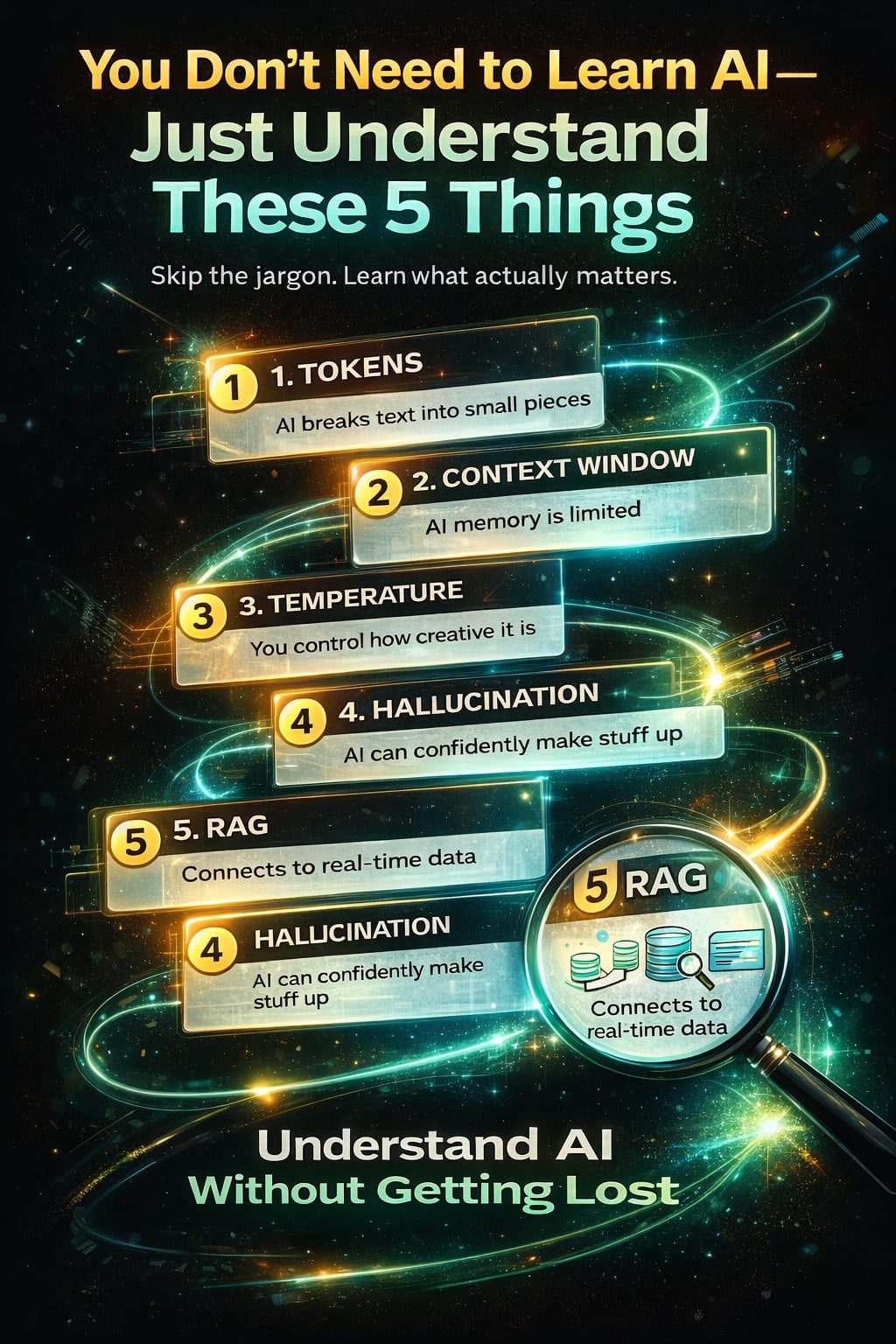
You Don’t Need to Learn AI — Just Understand These 5 Things
Skip the jargon. Learn what actually matters.

Everyone is talking about AI. Scroll any feed, open any app, and you’ll see it— AI is everywhere. People throw around terms like models, neural networks, LLMs, and automation like they fully understand what’s going on. But here’s the truth: Most don’t. They either repeat definitions… or nod along, hoping no one asks them to explain. And honestly? That’s fine. Because you don’t need to learn everything about AI to understand it. You just need to understand a few key ideas. Once you do, things stop feeling complicated. You stop guessing. And you start using AI with intention. These five concepts are your shortcut.
1. AI Doesn’t Read — It Breaks Everything Apart
When you type something into AI, it doesn’t read your sentence like a human. It doesn’t “see” meaning the way you do. Instead, it breaks your input into tiny pieces called Tokens. These pieces can be: . Whole words . Parts of words . Even punctuation marks So when you write a sentence, AI is actually processing a sequence of tokens—not a complete thought. Why does this matter? Because tokens control everything behind the scenes: . How much text you can input . How long the response can be . How much it costs (in paid tools) . How fast the system runs The more tokens involved, the heavier the task. Think of tokens as the “building blocks” of language for AI. It’s not understanding your message the way a person would. It’s assembling meaning from fragments. Once you realize that, you start writing better prompts—clearer, sharper, and more effective.
2. AI Has a Memory… But It’s Limited
AI can feel like it remembers everything you say. But it doesn’t. It has a boundary—a limit called the Context Window. This is the maximum amount of text the AI can keep in mind at one time. Once that limit is reached, older parts of the conversation begin to disappear. Quietly. Without warning. Why does this matter? Because it explains a lot of common frustrations: . AI forgetting earlier instructions . Losing track of context in long chats . Giving inconsistent answers over time It’s not being careless. It’s just running out of space. A larger context window means: . Better continuity . More accurate responses . Less repetition You can think of it like short-term memory. No matter how smart someone is, if you overload their memory, they’ll start forgetting things. Same with AI. Understanding this changes how you interact with it. You stop assuming it remembers everything… and start structuring your inputs more intentionally.
3. You Control How AI Sounds
Here’s something most people don’t realize: AI doesn’t have a fixed personality. It can be precise, creative, serious, or playful—depending on how it’s set. This is controlled by something called Temperature. Think of it as a creativity dial. 1) Low temperature → focused, predictable, factual 2) High temperature → creative, diverse, sometimes unpredictable Why does this matter? Because the same question can produce completely different answers based on this setting. Ask for a definition at low temperature, and you’ll get something clean and accurate. Ask the same thing at a high temperature, and you might get something more imaginative—or less reliable. It’s not about better or worse. It’s about purpose. . Writing an essay? Add some creativity. . Solving a math problem? Keep it strict. . Brainstorming ideas? Turn it up. You’re not just asking questions. You’re shaping how the AI thinks. That’s a powerful shift.
4. AI Can Be Confident… And Completely Wrong
This is where things get interesting. And a little dangerous. AI can give answers that sound perfect. Fluent. Clear. Confident. And still be wrong. This is known as a Hallucination. It happens because AI doesn’t actually “know” facts. It predicts the most likely next word based on patterns. Most of the time, this works beautifully. But sometimes, it creates information that sounds real… but isn’t. That could mean: . Incorrect facts . Made-up references . Confident explanations of something false Why does this matter? Because trust can be misleading. AI doesn’t lie intentionally. It doesn’t have awareness. It just generates what seems right. So if you’re using AI for: . Learning . Research . Important decisions You need to verify what it says. Not everything requires fact-checking. But anything important does. Understanding hallucinations doesn’t make AI less useful. It makes you a smarter user.
5. The Upgrade That Changes Everything
So if AI sometimes guesses… How do we make it more reliable? That’s where Retrieval-Augmented Generation comes in. Instead of relying only on what it has learned before, RAG allows AI to pull in external information. That could include: . Documents . Databases . Websites . Real-time data So instead of guessing, the AI can look things up before answering. Why does this matter? Because it transforms AI from: A smart guesser → into a research assistant. With RAG, you get: . More accurate answers . Fewer hallucinations . Better real-world performance It’s one of the biggest reasons modern AI tools are becoming so powerful. They’re no longer limited to what they “remember.” They can access what they need.
The Bottom Line
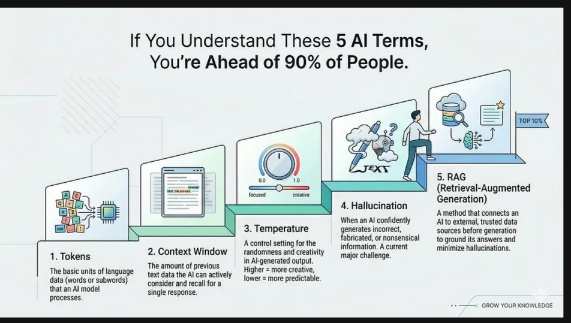
AI isn’t magic. It just feels like it—until you understand what’s happening underneath. And once you do, everything changes. You stop being impressed by surface-level responses. You start noticing patterns. You start asking better questions. And most importantly… you start getting better results. These five ideas: 1. Tokens 2. Context Window 3. Temperature 4. Hallucination 5. RAG They’re not complicated. But they’re powerful. And knowing them puts you ahead of most people who are still guessing.
One Simple Shift
Stop asking: “What can AI do?” Start asking: “How is AI generating this answer?” That’s the difference between using AI casually… and using it intelligently.
About the Creator
Enjoyed the story? Support the Creator.
Subscribe for free to receive all their stories in your feed.
Comments
There are no comments for this story
Be the first to respond and start the conversation.