
Wood Pellet Market Trends: Renewable Energy Demand, Carbon Reduction Goals & Forecast to 2034
How rising renewable energy demand, carbon neutrality targets, and sustainable fuel adoption are reshaping energy generation and consumption patterns in the wood pellet market

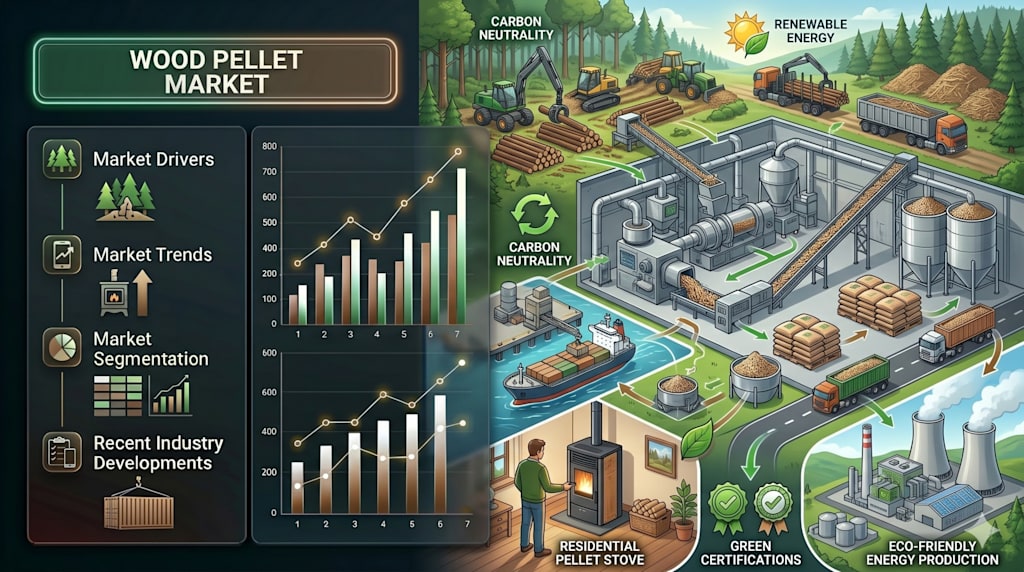
According to IMARC Group's latest research publication, The global wood pellet market size was valued at USD 14.8 Billion in 2025. Looking forward, IMARC Group estimates the market to reach USD 23.3 Billion by 2034, exhibiting a CAGR of 5.20% during 2026-2034, exhibiting steady and consistent expansion throughout the forecast period. Europe currently dominates the market, holding a significant share of over 47.9%, driven by strong renewable energy mandates, carbon neutrality commitments, and widespread adoption of wood pellets for both residential heating and industrial power generation.
How AI is Reshaping the Future of the Wood Pellet Market
- Precision Feedstock Quality Assessment and Sorting: AI-powered computer vision systems are being deployed at wood pellet production facilities to assess incoming feedstock in real time, identifying moisture content, contaminant presence, and biomass density variations with a level of accuracy impossible to achieve through manual inspection. By classifying raw materials such as sawdust, wood chips, and forest residues before they enter the pelletizing process, these systems ensure consistent pellet quality and energy content across production batches. Given that forest wood and waste hold approximately 33.6% of the feedstock type segment, optimizing the utilization of these materials is critical to production cost management and sustainability compliance.
- Predictive Maintenance for Pelletizing Machinery: AI-integrated sensor networks continuously monitor the operational health of pelletizing mills, dryers, and conveyors, analyzing vibration, temperature, and pressure data to predict component failures before they cause production downtime. In an industry where production continuity directly determines export commitments and energy supply reliability, predictive maintenance reduces unplanned stoppages and lowers maintenance costs. Manufacturers servicing export markets, such as the United States which recorded wood pellet exports of 9.5 million metric tons valued at USD 1.75 Billion, rely on consistent production throughput to fulfill long-term supply agreements with European utility buyers.
- Energy Efficiency Optimization in Drying and Pelletizing Processes: Drying biomass feedstock to the precise moisture threshold required for quality pellet formation is one of the most energy-intensive steps in wood pellet manufacturing. AI systems that model dryer performance in real time and automatically adjust fuel input, airflow, and residence time based on feedstock moisture readings are delivering measurable reductions in thermal energy consumption per ton of finished pellets. These efficiency gains directly lower production costs and improve the competitive positioning of wood pellets relative to fossil fuel alternatives, reinforcing their attractiveness in price-sensitive residential heating markets where demand accounts for approximately 58.4% of the application segment.
- Supply Chain Optimization and Logistics Planning: AI-driven logistics platforms are enabling wood pellet producers and traders to optimize shipping routes, port scheduling, and inventory positioning across complex international supply chains connecting North American and Southeast Asian producers with European and Asian end markets. Vietnam, for instance, exported 2.6 million tons of wood pellets worth USD 345.5 million in a recent reporting period, with Japan and South Korea accounting for 92% of those exports. AI tools help coordinate this concentrated trade flow by forecasting demand fluctuations, optimizing vessel loading efficiency, and minimizing storage costs at transit hubs, ensuring reliable delivery to power plants and residential distributors.
- Carbon Accounting and Sustainability Reporting Automation: As regulatory bodies and corporate buyers increasingly require granular lifecycle carbon data for the biomass they procure, AI platforms are automating the collection, verification, and reporting of carbon accounting metrics across the wood pellet supply chain. These tools track feedstock origin, transportation emissions, and combustion factors to produce auditable sustainability reports aligned with frameworks such as the EU Renewable Energy Directive. The UNEP Emissions Gap Report 2024 underlined the urgent need for nations to reduce greenhouse gas emissions by 42% by 2030 and 57% by 2035, making credible carbon reporting a market-access requirement rather than a voluntary initiative for wood pellet producers.
Wood Pellet Industry Overview
The global wood pellet industry is experiencing strong growth momentum, underpinned by a structural global shift away from fossil fuel dependence toward renewable and low-carbon energy alternatives. Wood pellets, produced primarily from compressed biomass including sawdust, wood shavings, forest residues, and agricultural waste, are recognized as a carbon-neutral fuel because the CO2 released during combustion is offset by the carbon absorbed during the growth of the source biomass. This carbon neutrality profile has positioned wood pellets as a preferred co-firing fuel for coal power plants transitioning toward renewable energy compliance, as well as a clean alternative for residential and commercial heating in cold-climate markets. The World Bioenergy Association has identified wood pellets as one of the fastest-growing segments within the global bioenergy sector, with the world producing 1.9 billion cubic meters of wood fuel. NOAA data confirms that atmospheric CO2 is now 50% higher than pre-industrial levels, with 2022 marking the 11th consecutive year of CO2 increases exceeding 2 parts per million, the highest sustained rate in 65 years of monitoring. This scientific backdrop is reinforcing policy urgency across major economies and translating directly into accelerated wood pellet adoption across power generation, industrial heating, and residential energy segments.
Wood Pellet Market Trends and Drivers
The expanding global commitment to carbon neutrality and the phase-out of fossil fuels is the most significant structural driver of wood pellet market demand. Governments across Europe, North America, and Asia Pacific are implementing renewable energy directives, carbon pricing mechanisms, and bioenergy subsidies that make wood pellets economically competitive with conventional fuels. The European Union Renewable Energy Directive has triggered exponential growth in the cross-border trade of pelletized wood fiber, establishing Europe as the world's largest consuming region with a 47.9% market share and driving record EU consumption of 24.8 million metric tons. In the United States, the Home Efficiency Rebate program, also known as the Clean Air program, actively incentivizes households to replace conventional heating systems with biomass-fed alternatives including wood pellet stoves, directly stimulating residential demand and supporting the domestic pellet production base.
Technological advancements in pellet manufacturing and combustion are continuously improving the performance characteristics and cost-competitiveness of wood pellets as an energy source. Innovations in pelletizing machinery, including automation and precision process control, have increased production capacity while reducing per-unit manufacturing costs. Canada's Clean Fuels Fund, representing a USD 1.1 billion investment, is supporting the development of innovative clean fuel technologies including advanced biomass production systems, reinforcing the pipeline of technological improvement across the North American pellet industry. The US Department of Agriculture's Wood Innovations and Community Wood Energy programs are providing targeted funding for renewable wood energy initiatives that simultaneously improve local economies and advance sustainable forest management practices, ensuring long-term feedstock availability for pellet producers. In October 2024, PT Bukit Asam Tbk launched a Wood Pellet Pilot Plant in Tanjung Enim, South Sumatra, with a production capacity of 200 kg of biomass from Red Kaliandra per hour, designed to support coal co-firing in power plants and contribute to national emission reduction goals in alignment with Indonesia's sustainability policy framework.
The residential heating segment, which commands approximately 58.4% of the application segment, continues to benefit from rising consumer preference for cleaner and more affordable home heating alternatives in cold-climate regions. EU wood pellet consumption for residential use set a record of 23.1 million metric tons, driven primarily by increased household adoption in Germany and co-firing applications in the Netherlands. Advances in pellet stove technology, expanding distribution networks, and government subsidy programs for renewable heating system installations are collectively lowering barriers to adoption for residential consumers across European and North American markets.
Leading Companies Operating in the Global Wood Pellet Industry
- Enviva Inc.
- Drax Group plc
- Pinnacle Renewable Energy Inc.
- Pacific BioEnergy Corporation
- Graanul Invest AS
- Fram Renewable Fuels LLC
- Viridian Energy and Environmental LLC
- Lignetics Inc.
- German Pellets GmbH
- Energex Corporation
- Rentech Nitrogen Partners LP
- Highland Pellets LLC
Wood Pellet Market Report Segmentation
By Feedstock Type:
- Forest Wood and Waste
- Agriculture Residue
- Others
Forest wood and waste represent the largest feedstock category, holding approximately 33.6% of market share, owing to the widespread availability of sawdust, wood chips, and tree trimmings from forestry and wood processing operations, the cost-effectiveness of utilizing these residues, and their strong alignment with circular economy and low-carbon production principles.
By Application:
- Power Plants
- Residential Heating
- Commercial Heating
- Combined Heat and Power (CHP)
- Others
Residential heating leads the application segment with approximately 58.4% of market share, driven by rising consumer demand for environmentally sustainable home heating alternatives, government incentive programs promoting biomass-fed heating system adoption, advances in pellet stove efficiency, and the cold climates of major European consuming countries that sustain consistent year-round demand.
Regional Insights
- North America (United States, Canada)
- Asia Pacific (China, Japan, India, South Korea, Australia, Indonesia, Others)
- Europe (Germany, France, United Kingdom, Italy, Spain, Russia, Others)
- Latin America (Brazil, Mexico, Others)
- Middle East and Africa
Europe exhibits clear dominance in the wood pellet market, holding a share of over 47.9%, driven by stringent environmental regulations, ambitious renewable energy targets under the EU Renewable Energy Directive, and strong government incentive frameworks promoting the transition away from fossil fuels in both power generation and residential heating. The EU consumed 24.8 million metric tons of wood pellets in a recent reporting period, affirming the continent's position as the defining demand anchor of the global industry. North America is a significant production and export hub, with the United States recording 9.5 million metric tons in pellet exports valued at USD 1.75 Billion, primarily supplying European utilities seeking renewable energy compliance. Asia Pacific is emerging as a high-growth consumption region, with Japan and South Korea together absorbing 92% of Vietnam's wood pellet exports as these nations pursue coal co-firing programs to meet national decarbonization commitments.
Recent News and Developments in the Wood Pellet Market
- October 2024: PT Bukit Asam Tbk launched a Wood Pellet Pilot Plant in Tanjung Enim, South Sumatra, with a capacity of 200 kg of biomass from Red Kaliandra per hour, designed to support coal co-firing in Indonesian power plants and contribute to national emission reduction targets in alignment with the government's sustainability agenda.
- September 2024: Vietnam reported wood pellet exports of 2.6 million tons valued at USD 345.5 million, reflecting a 25.9% volume increase year-on-year, with Japan and South Korea collectively representing 92% of total export volume, underscoring the deepening demand from Asian power utilities co-firing biomass to meet national decarbonization targets.
- June 2024: Enviva Inc. completed restructuring proceedings and announced a renewed operational strategy focused on long-term supply agreements with European utility partners, reaffirming its position as the world's largest industrial wood pellet producer and signaling continued commitment to the transatlantic renewable biomass trade corridor.
- March 2025: Drax Group plc confirmed the renewal of long-term wood pellet supply agreements with North American producers to sustain operations at its Selby biomass power station in the United Kingdom, which is one of the largest renewable power generators in the country, reflecting continued institutional confidence in wood pellets as a core renewable energy feedstock.
- January 2025: The European Commission published updated sustainability criteria under the revised Renewable Energy Directive, tightening feedstock sourcing standards and lifecycle carbon accounting requirements for wood pellets used in power generation, prompting producers across North America and Southeast Asia to accelerate certification and supply chain traceability investments.
Note: If you require specific details, data, or insights that are not currently included in the scope of this report, we are happy to accommodate your request. As part of our customization service, we will gather and provide the additional information you need, tailored to your specific requirements. Please let us know your exact needs, and we will ensure the report is updated accordingly to meet your expectations.
About the Creator
Abhay Rajput
I am working in market research company that provides market and business research intelligence across the globe.
Enjoyed the story? Support the Creator.
Subscribe for free to receive all their stories in your feed.
Comments
There are no comments for this story
Be the first to respond and start the conversation.