
Wood Pellet Market Size: Sustainable Fuel Adoption, Industrial Demand & Forecast to 2034
How biomass power generation, export expansion, and carbon reduction policies are transforming the global wood pellet market outlook worldwide.

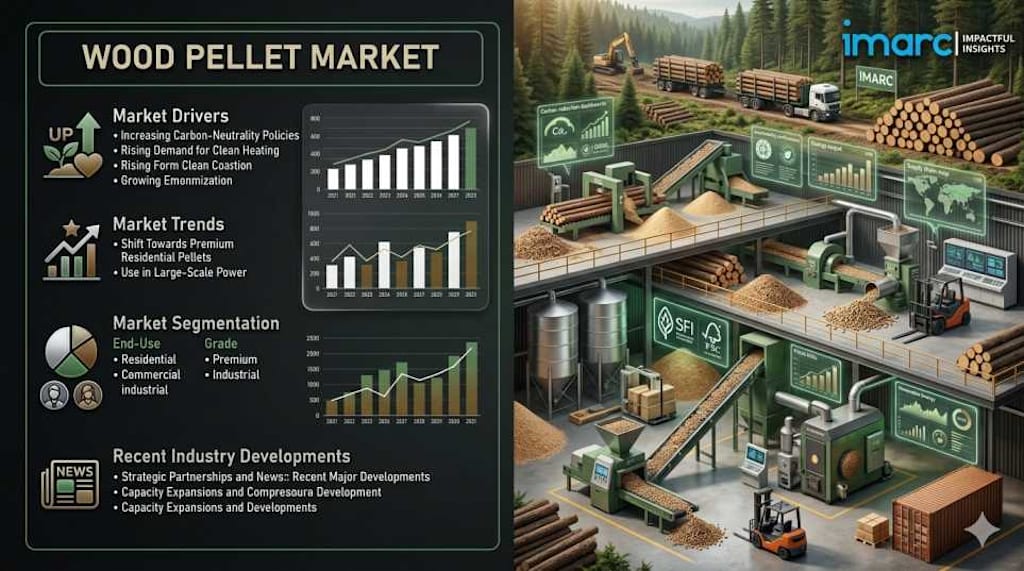
Rising environmental concerns, government-led decarbonization policies, and the urgent need to replace fossil fuels with cleaner alternatives are driving demand for wood pellets across power generation, industrial heating, and residential applications. According to IMARC Group's latest data,the global wood pellet market size was valued at USD 14.8 Billion in 2025. Looking forward, IMARC Group estimates the market to reach USD 23.3 Billion by 2034, exhibiting a CAGR of 5.20% during 2026-2034.. Europe currently dominates the market, holding a significant market share of over 47.9% in 2025.
Wood pellets have emerged as a cornerstone of the global bioenergy sector, serving as a carbon-neutral, cost-effective substitute for coal in utility-scale power plants and a reliable fuel for residential and commercial heating systems. Produced from compressed biomass such as sawdust, wood chips, and agricultural residues, these pellets offer consistent energy content and compatibility with existing thermal infrastructure. Government mandates promoting renewable energy targets, multilateral commitments to reducing greenhouse gas emissions, and expanding cross-border trade flows are reinforcing market momentum. Key segments include forest wood and waste, agriculture residue, and other feedstocks, with power generation and residential heating applications leading uptake globally.
Wood Pellet Market Growth Drivers:
Rising Demand for Renewable Energy and Carbon Neutrality Goals
Nations worldwide are accelerating their shift away from fossil fuels to meet binding climate commitments. Wood pellets hold a unique carbon-neutral status, as CO2 emitted during combustion is offset by CO2 absorbed during the biomass growth cycle. According to NOAA, atmospheric CO2 is now 50% higher than pre-industrial levels, intensifying regulatory pressure for clean energy alternatives. The UN Environment Programme's Emissions Gap Report 2024 outlined that nations must cut greenhouse gas emissions by 42% by 2030 to maintain the Paris Agreement's 1.5 degrees Celsius target. This urgency positions wood pellets as a viable, immediate-deployment solution for utilities phasing out coal without dismantling capital-intensive infrastructure.
Government Incentives, Subsidies, and Policy Support
Regulatory frameworks across key markets are directly stimulating wood pellet production and consumption. The European Union Renewable Energy Directive has triggered exponential growth in the trading of pelletized wood fibers across member states. In the United States, the Home Efficiency Rebate program, also known as the Clean Air program, encourages households to replace outdated heating systems with biomass-fed alternatives, directly expanding the domestic consumer base. Canada's Clean Fuels Fund has committed a $1.1 billion investment toward innovative clean fuel technologies, including wood-based bioenergy. These policy instruments collectively make wood pellets more affordable and accessible across multiple geographies.
Expanding Export Markets and Cross-Border Trade Flows
The United States has emerged as a dominant global supplier, with wood pellet exports reaching 9.5 million metric tons, valued at $1.75 billion, destined primarily for European power plants seeking renewable fuel compliance. Vietnam exported 2.6 million tons of wood pellets, reflecting the rapid emergence of Southeast Asian producers in global supply chains. Japan and South Korea are scaling domestic bioenergy programs through feed-in tariff systems and Renewable Portfolio Standards, opening significant new demand corridors. This expanding trade network reinforces the structural, long-term nature of global wood pellet demand.
Wood Pellet Market Trends:
Technological Advancements in Pellet Production and Combustion
Innovations in pelletizing machinery, automation, and die technology have significantly reduced per-unit production costs while improving output consistency and energy content reliability. R&D programs backed by government funding have produced cleaner-burning stoves and boilers with lower particulate emissions, addressing longstanding environmental critiques of biomass combustion. The U.S. Department of Agriculture's Forest Service Wood Innovations and Community Wood Energy programs are actively funding projects that improve production efficiency and support sustainable forestry management. These advances are broadening the commercial appeal of wood pellets across residential, industrial, and utility-scale applications.
Sustainability-Led Feedstock Sourcing and Forest Certification
Producers are increasingly investing in supply chain traceability and third-party forest-of-origin certification to comply with tightening sustainability regulations, particularly under the EU's updated Renewable Energy Directive provisions. Forest wood and waste currently represent the largest feedstock category, holding approximately 33.6% of the market, owing to the widespread availability of sawdust, wood chips, and tree trimmings from forestry and wood processing operations. Agriculture residue is gaining ground as an alternative in regions where dedicated forestry is limited but crop waste is abundant. This shift toward verified sustainable sourcing is becoming a key competitive differentiator among leading producers.
Industrial Co-Firing and Utility-Scale Power Generation Adoption
Large utility operators across Europe are converting or co-firing existing coal-fired plants with wood pellets to meet national renewable portfolio standards without replacing entire generation fleets. This strategy allows energy companies to deliver immediate emissions reductions while leveraging existing boiler and grid infrastructure. In October 2024, PT Bukit Asam Tbk launched a Wood Pellet Pilot Plant in Tanjung Enim, South Sumatra, producing 200 kg of biomass from Red Kaliandra per hour to support coal co-firing at Indonesian power plants. This industrial co-firing trend is expanding from Europe into Asia-Pacific markets, diversifying the global demand base for wood pellets at scale.
Recent News and Developments in the Wood Pellet Market
October 2024: PT Bukit Asam Tbk launched a Wood Pellet Pilot Plant in Tanjung Enim, South Sumatra, Indonesia, producing 200 kg of biomass per hour from Red Kaliandra to support coal co-firing in power plants and align with the government's emission reduction and sustainability targets.
January 2025: Major European pellet importers began enforcing stricter forest-of-origin certification requirements under updated EU biomass sustainability regulations, prompting North American and Southeast Asian producers to publish enhanced supply chain traceability documentation to maintain market access.
March 2026: Several North American wood pellet manufacturers announced capacity expansion plans targeting long-term European offtake agreements, responding to strengthening demand from utilities accelerating coal phase-out under national net-zero commitments.
Note: If you require specific details, data, or insights that are not currently included in the scope of this report, we are happy to accommodate your request. As part of our customization service, we will gather and provide the additional information you need, tailored to your specific requirements. Please let us know your exact needs, and we will ensure the report is updated accordingly to meet your expectations.
About the Creator
Suhaira Yusuf
I specialize in Consumer Insights, focusing on transforming detailed market data into strategic business solutions that accelerate growth and improve customer engagement.
Enjoyed the story? Support the Creator.
Subscribe for free to receive all their stories in your feed.
Comments
There are no comments for this story
Be the first to respond and start the conversation.